
Paper: GS – II, Subject: Governance, Topic: Role of Civil services in a democracy, Issue: Civil Servants in the Era of Digital Governance.
Context:
Civil Services Day underscores the centrality of civil servants in governance. In the era of Digital India, their role is increasingly shifting from policy formulation to effective, outcome-oriented implementation, with a focus on inclusive and last-mile delivery.
Key Takeaways:
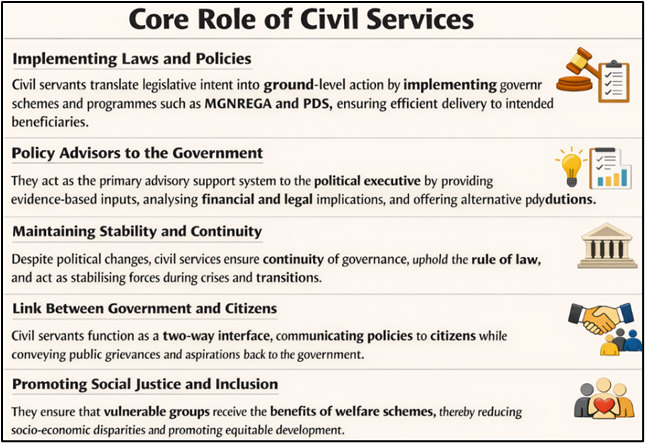
Evolving Role in Digital India:
- Shift to Outcome-Oriented Governance: The focus has moved towards “holistic development with saturation”, ensuring that every eligible citizen receives benefits through data-driven monitoring and targeted interventions.
- Bridging Policy and Implementation: Civil servants translate policies into actionable programmes and ensure delivery in remote areas, addressing regional and social disparities.
- Adapting to Emerging Governance Areas: Their role now extends to domains such as digital governance, climate change, and public-private partnerships, requiring data literacy and strategic thinking.
- Digital Transformation of Administration: The use of digital tools, online platforms, AI-based assessments, and data analytics has enhanced efficiency, transparency, and accessibility in governance.
Key Challenges:
- Political Interference and Erosion of Neutrality: Undue influence in transfers and decision-making undermines administrative independence.
- Lack of Specialisation and Capacity Constraints: Generalist officers often lack domain expertise required for complex governance functions.
- Red Tape and Procedural Delays: Bureaucratic rigidity leads to slow decision-making and inefficient service delivery.
- Corruption and Weak Accountability: Misconduct and lack of strong accountability mechanisms weaken public trust.
- Digital Challenges: Information overload, screen fatigue, and unequal access to digital resources affect efficiency and inclusiveness.
Reforms and Way Forward:
- Strengthening Neutrality and Accountability: Fixed tenures, transparent evaluation systems, and independent oversight can ensure impartial governance.
- Professionalisation and Specialisation: Promoting domain expertise through lateral entry, continuous training, and capacity-building initiatives like Mission Karmayogi.
- Enhancing Citizen-Centric Governance: Institutionalising social audits, improving grievance redressal, and increasing public participation.
- Promoting Digital and Administrative Innovation: Expanding e-governance, using AI and data analytics, and simplifying procedures to improve efficiency.
- Ensuring Ethical Governance: Strengthening integrity frameworks, transparency, and adherence to constitutional values.
Conclusion:
Civil services remain the backbone of India’s governance system, but their role is becoming more complex and technology-driven. Strengthening their capacity, ensuring neutrality, and embracing digital transformation are essential to achieving responsive, inclusive, and effective governance in a rapidly evolving society.
Source: (The Indian Express)
La Excellence IAS Academy, the best IAS coaching in Hyderabad, known for delivering quality content and conceptual clarity for UPSC 2026 preparation.
FOLLOW US ON:
◉ YouTube : https://www.youtube.com/@CivilsPrepTeam
◉ Facebook: https://www.facebook.com/LaExcellenceIAS
◉ Instagram: https://www.instagram.com/laexcellenceiasacademy/
GET IN TOUCH:
Contact us at info@laex.in, https://laex.in/contact-us/
or Call us @ +91 9052 29 2929, +91 9052 99 2929, +91 9154 24 2140
OUR BRANCHES:
Head Office: H No: 1-10-225A, Beside AEVA Fertility Center, Ashok Nagar Extension, VV Giri Nagar, Ashok Nagar, Hyderabad, 500020
Madhapur: Flat no: 301, survey no 58-60, Guttala begumpet Madhapur metro pillar: 1524, Rangareddy Hyderabad, Telangana 500081
Bangalore: Plot No: 99, 2nd floor, 80 Feet Road, Beside Poorvika Mobiles, Chandra Layout, Attiguppe, Near Vijaya Nagara, Bengaluru, 560040