
Paper: GS – III, Subject: Science and Technology, Topic: Space Technology, Issue: Global Governance of the Moon.
Context:
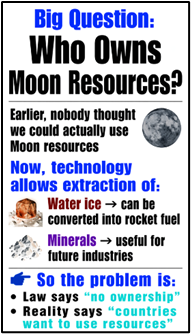
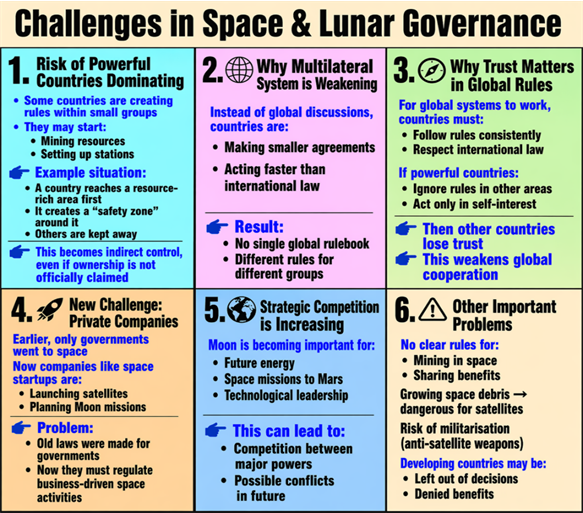
As countries prepare to return to the Moon and use its resources, an important question arises: Who will make the rules? The issue is whether a few powerful countries should decide, or whether all nations should participate through global institutions.
Key Takeaways:
BACKGROUND
- Outer space is not like land on Earth. It is treated as a shared area belonging to all humanity, not owned by any one country (global commons).
- The Outer Space Treaty (1967) clearly states that:
- No country can claim the Moon or any planet as its own
- Space must be used only for peaceful purposes
- Countries are responsible even for private companies operating in space
- Over time, additional rules were created:
- Countries must help astronauts in danger (Rescue Agreement)
- Countries are responsible for damage caused by their space objects (Liability Convention)
- All space objects must be registered (Registration Convention)
- Later, the Moon Agreement (1979) said that:
- Moon resources belong to all humanity
- Benefits should be shared globally
- But major countries did not accept this fully
- Recently, new arrangements like the Artemis Accords have emerged:
- These are agreements between selected countries for Moon missions
- They focus on practical cooperation but are not truly global rules
INDIA’S POSITION:
- India supports peaceful use of outer space and strengthens international cooperation.
- At the same time, India is also promoting private sector participation through IN-SPACe.
- India is also expanding its technological and strategic space capabilities.
- Overall, India follows a balanced approach combining global cooperation with national interest.
WAY FORWARD:
- Strengthen inclusive global governance to ensure all nations participate in space rule-making.
- Establish clear international laws on space resource extraction and benefit-sharing.
- Preserve the Moon as a global common and prevent resource colonisation.
- Regulate private space companies to ensure accountability and fair competition.
- Prevent militarisation of space and avoid an arms race beyond Earth.
- Ensure equitable access and fair benefits for developing countries.
- Promote international cooperation through joint missions, data sharing, and technology exchange.

Source: (The Hindu)
La Excellence IAS Academy, the best IAS coaching in Hyderabad, known for delivering quality content and conceptual clarity for UPSC 2026 preparation.
FOLLOW US ON:
◉ YouTube : https://www.youtube.com/@CivilsPrepTeam
◉ Facebook: https://www.facebook.com/LaExcellenceIAS
◉ Instagram: https://www.instagram.com/laexcellenceiasacademy/
GET IN TOUCH:
Contact us at info@laex.in, https://laex.in/contact-us/
or Call us @ +91 9052 29 2929, +91 9052 99 2929, +91 9154 24 2140
OUR BRANCHES:
Head Office: H No: 1-10-225A, Beside AEVA Fertility Center, Ashok Nagar Extension, VV Giri Nagar, Ashok Nagar, Hyderabad, 500020
Madhapur: Flat no: 301, survey no 58-60, Guttala begumpet Madhapur metro pillar: 1524, Rangareddy Hyderabad, Telangana 500081
Bangalore: Plot No: 99, 2nd floor, 80 Feet Road, Beside Poorvika Mobiles, Chandra Layout, Attiguppe, Near Vijaya Nagara, Bengaluru, 560040
Lunar Governance and the Case for Multilateral Rulemaking