
Paper: GS – III, Subject: Internal Security, Topic: Left wing Extremism, Issue: Red Corridor to Development Corridor Post LWE Governance.
Context:
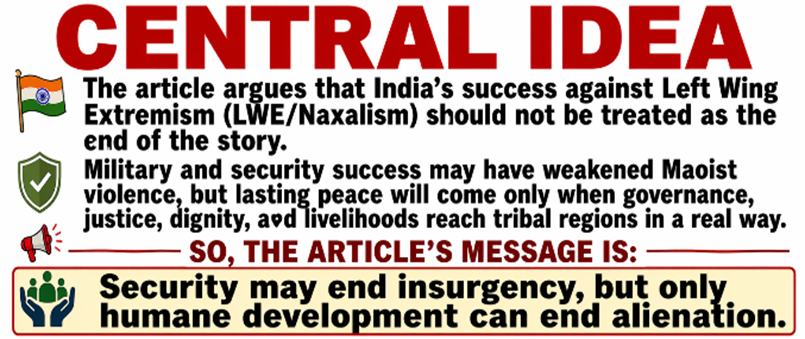
India has recently achieved a major milestone by declaring the effective end of Maoist insurgency, by meeting its target of eliminating it by 31st March 2026. This marks a transition from a security-centric approach to a governance-centric phase, where the challenge is to convert peace into lasting development and legitimacy in tribal regions.
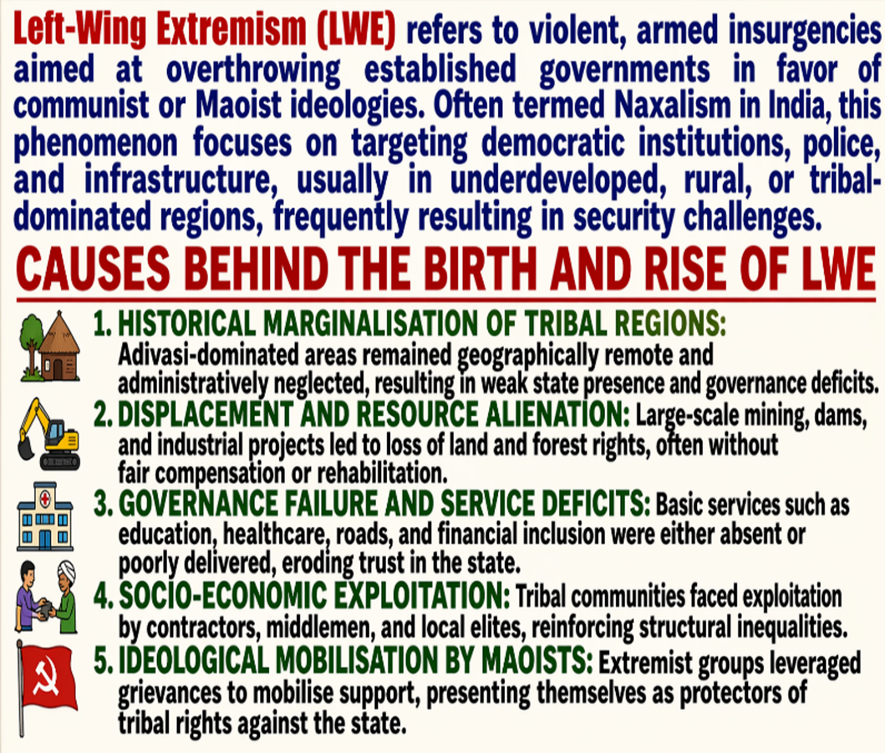
Key Takeaways:
Government Targets and Strategy Against LWE:
- In 2009, Manmohan Singh identified LWE as the most serious internal security threat of India.
- The State adopted a dual strategy:
- Security-led approach: Area domination, intelligence coordination, and dismantling insurgent networks.
- Development-led approach: Infrastructure expansion, livelihood generation, and governance outreach.
- A time-bound national objective was set to eliminate LWE by 31st March 2026, reflecting a mission-mode approach combining security and development.
- On March 30, 2026, Union Home Minister informed Parliament that India is now free from Maoist insurgency (i.e End of LWE as a significant Internal Security threat).
- There has been a significant decline in violent incidents, casualties, and geographical spread of LWE.
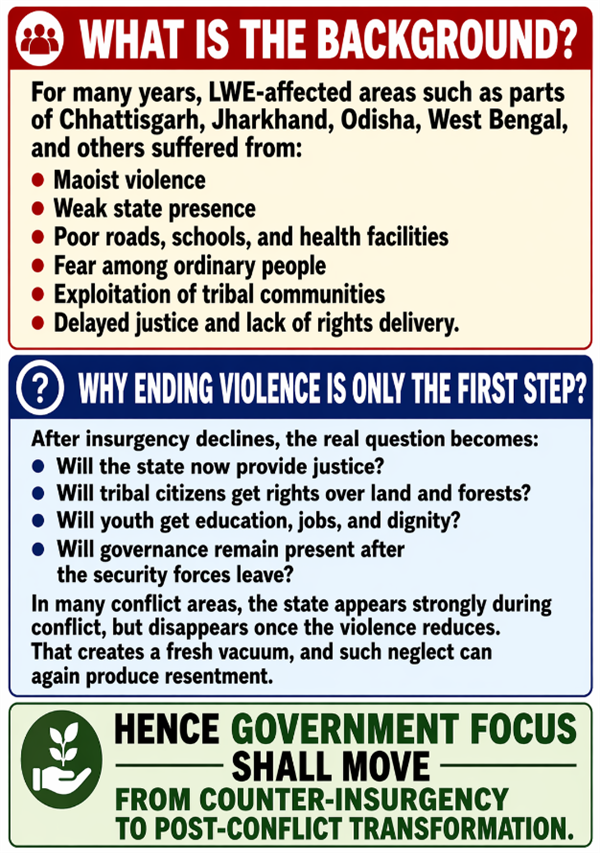
Need for a Humane Post-LWE Approach:
- A humane post-LWE approach requires the State to move beyond being merely a force of control and instead function as a source of trust, fairness, dignity, and opportunity, where citizens experience governance as rights-based and empathetic rather than coercive or distant.
Key Pillars of a Humane Approach:
- Rights with respect: Rights must be delivered as legal entitlements and constitutional guarantees rather than charity, ensuring dignity, ownership, and active citizenship among tribal communities.
- Believable justice: Justice must become tangible through humane policing, effective grievance redressal, faster case disposal, accessible legal aid, systematic review of prolonged undertrial detention, and reduction of minor-offence burdens disproportionately affecting SC/ST communities, thereby restoring faith in institutions.
- Functioning institutions: Everyday governance must be visible and reliable through regular functioning of schools, anganwadis, health centres, banking systems, road connectivity, and empowered panchayats, ensuring that the State is consistently present in citizens’ lives.
- Youth aspirations and opportunities: Long-term stability depends on enabling youth through sports pathways, higher education access, scholarships, residential schooling, skill development aligned to local economies, promotion of women-led enterprises, and creation of dignified local employment opportunities, reducing vulnerability to conflict dynamics.
AIEEEE Governance Framework (A recommended Administrative Principle):
- The AIEEEE framework emphasises Accountability, Innovation, Evidence, Equity, Empathy, and Efficiency as core pillars of governance, ensuring that public administration is answerable, locally responsive, data-driven, fair, humane, and outcome-oriented, particularly in complex and historically neglected regions.
Convergence of Government Instruments (Institutional Strategy):
- Effective post-LWE transformation requires convergence rather than proliferation of schemes, by integrating:
- Aspirational Districts Programme and Aspirational Blocks framework for monitoring and targeted intervention
- Pradhan Mantri Janjati Adivasi Nyaya Maha Abhiyaan and Dharti Aaba Janjatiya Gram Utkarsh Abhiyan for tribal inclusion and saturation
- Adi Karmayogi Abhiyan for capacity building of frontline administration
- Article 275(1) grants and Tribal Sub Plan (TSP) funds for financial support
- Finance Commission-enabled devolution for strengthening local governance
- The objective is to ensure coordinated, accountable, and last-mile delivery of benefits, especially in geographically and administratively challenging tribal regions.
CONCLUSION:
- Conflict tends to arise where governance is absent, distrusted, or unjust; while security operations can suppress insurgency, lasting peace depends on rebuilding trust through credible institutions, fair processes, and inclusive development, requiring a shift from counter-insurgency to relationship-based governance.
- The true success of post-LWE transformation will not be measured merely by declining violence, but by tangible improvements in rights, justice, livelihoods, and dignity for tribal citizens, ensuring the effective presence of the Constitution in their everyday lives.
Source: (The Hindu)
La Excellence IAS Academy, the best IAS coaching in Hyderabad, known for delivering quality content and conceptual clarity for UPSC 2026 preparation.
FOLLOW US ON:
◉ YouTube : https://www.youtube.com/@CivilsPrepTeam
◉ Facebook: https://www.facebook.com/LaExcellenceIAS
◉ Instagram: https://www.instagram.com/laexcellenceiasacademy/
GET IN TOUCH:
Contact us at info@laex.in, https://laex.in/contact-us/
or Call us @ +91 9052 29 2929, +91 9052 99 2929, +91 9154 24 2140
OUR BRANCHES:
Head Office: H No: 1-10-225A, Beside AEVA Fertility Center, Ashok Nagar Extension, VV Giri Nagar, Ashok Nagar, Hyderabad, 500020
Madhapur: Flat no: 301, survey no 58-60, Guttala begumpet Madhapur metro pillar: 1524, Rangareddy Hyderabad, Telangana 500081
Bangalore: Plot No: 99, 2nd floor, 80 Feet Road, Beside Poorvika Mobiles, Chandra Layout, Attiguppe, Near Vijaya Nagara, Bengaluru, 560040