
Paper: GS – III, Subject: Economy, Topic: Growth and Development, Issue: India’s GDP Ranking Decline: Role of Exchange Rates and Data Revision.
Context:
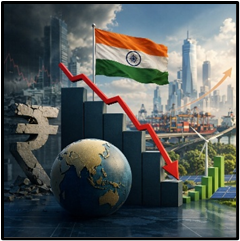
- According to the International Monetary Fund (IMF) World Economic Outlook (2026), India has slipped from the fourth to the sixth largest economy in the world in terms of nominal Gross Domestic Product (GDP).
- India is now placed behind Japan and the United Kingdom, despite continuing to register strong economic growth domestically.
Key Takeaways:
BACKGROUND:
- Gross Domestic Product (GDP) represents the total monetary value of all final goods and services produced within a country during a given period.
- Nominal GDP is calculated at current market prices and is converted into US dollars for international comparison.
- Global economic rankings are based on GDP measured in US dollar terms, not in domestic currencies.
- Exchange rates play a critical role because any depreciation of the domestic currency reduces the GDP value when expressed in dollars.
- For example, even if India’s production increases in rupee terms, a weakening rupee will reduce its comparative size in dollar terms.
KEY REASONS FOR INDIA’S SLIPPAGE IN RANKINGS:
1. Depreciation of the Indian Rupee:
- The Indian rupee has weakened against the US dollar over the past year.
- This depreciation reduces the dollar value of India’s GDP even if real output has increased.
- For instance, if the exchange rate moves from ₹75 per dollar to ₹85 per dollar, the same level of output translates into a smaller GDP in dollar terms.
- Therefore, exchange rate movements have a direct impact on global rankings.
2. Revision in GDP Estimation Methodology:
- India revised its GDP data by updating the base year and improving statistical estimation methods.
- The revised estimates indicated that previous GDP figures were somewhat overstated.
- As a result, India’s nominal GDP size was adjusted downward.
- Such revisions improve data accuracy but may temporarily affect international comparisons.
3. Relative Performance of Other Economies:
- Japan and the United Kingdom have shown relatively better performance in nominal GDP terms.
- Changes in their economic output and currency valuations have enabled them to move ahead of India.
- Global rankings are relative; therefore, even if India grows, it may slip if others perform better in comparison.
4. Currency Movements in Advanced Economies:
- The value of currencies such as the British Pound and Japanese Yen also influences GDP rankings.
- If these currencies remain stable or strengthen relative to the US dollar, their GDP values appear larger.
- This creates a comparative disadvantage for countries with depreciating currencies.
ASSESSMENT: DOES THIS REFLECT ECONOMIC WEAKNESS?
- The decline in ranking does not indicate a structural weakness in the Indian economy.
- India continues to be one of the fastest-growing major economies in the world.
- The change is largely a result of:
- Exchange rate fluctuations
- Statistical revisions
- Relative global performance
- In real terms, which measure actual production growth, India’s economic performance remains robust.
FUTURE OUTLOOK:
- IMF projections indicate that India’s GDP is expected to grow significantly in the coming years.
- India is likely to regain its position among the top four economies in the near future.
- Over the long term, India is projected to become the third largest economy globally by around 2030–31.
- Sustained growth, demographic advantage, and structural reforms are expected to drive this trajectory.
CONCLUSION:
- India’s slip to the sixth position is primarily a statistical and currency-driven outcome rather than a decline in economic strength.
- The episode highlights the limitations of nominal GDP comparisons and the importance of considering broader indicators such as growth rates and purchasing power.
- India’s long-term economic fundamentals remain strong, and its global economic standing is expected to improve in the coming decade.
Source: (The Indian Express)
La Excellence IAS Academy, the best IAS coaching in Hyderabad, known for delivering quality content and conceptual clarity for UPSC 2026 preparation.
FOLLOW US ON:
◉ YouTube : https://www.youtube.com/@CivilsPrepTeam
◉ Facebook: https://www.facebook.com/LaExcellenceIAS
◉ Instagram: https://www.instagram.com/laexcellenceiasacademy/
GET IN TOUCH:
Contact us at info@laex.in, https://laex.in/contact-us/
or Call us @ +91 9052 29 2929, +91 9052 99 2929, +91 9154 24 2140
OUR BRANCHES:
Head Office: H No: 1-10-225A, Beside AEVA Fertility Center, Ashok Nagar Extension, VV Giri Nagar, Ashok Nagar, Hyderabad, 500020
Madhapur: Flat no: 301, survey no 58-60, Guttala begumpet Madhapur metro pillar: 1524, Rangareddy Hyderabad, Telangana 500081
Bangalore: Plot No: 99, 2nd floor, 80 Feet Road, Beside Poorvika Mobiles, Chandra Layout, Attiguppe, Near Vijaya Nagara, Bengaluru, 560040