
Paper: GS – II, Subject: Polity, Topic: Judiciary, Issue: Sabarimala temple entry case.
Context:
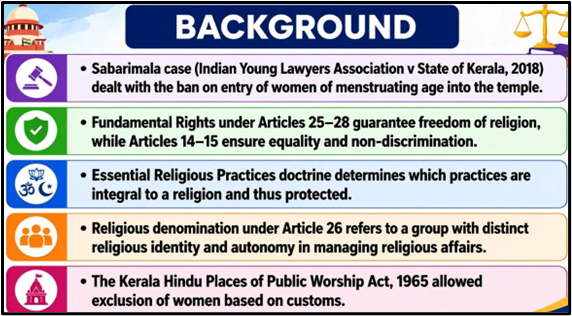
The Supreme Court is revisiting the Sabarimala temple entry issue, examining broader constitutional questions on essential religious practices, women’s rights, and the balance between religious freedom and equality.
Key Takeaways:
Supreme Court Judgment on Women’s Entry into Sabarimala Temple:
- The 2018 Supreme Court judgment struck down the ban on entry of women, declaring it unconstitutional and violative of equality, dignity, and non-discrimination.
- The Court held that exclusion based on menstruation is discriminatory and not an essential religious practice.
- It ruled that devotees of Lord Ayyappa do not constitute a separate religious denomination entitled to exclusive rights under Article 26.
- The case highlights tension between Article 25 (individual right to worship) and Article 26 (denominational rights).
- Courts have emphasised that religious freedom is subject to morality, health, and other fundamental rights.
- The Essential Religious Practices doctrine has evolved through judicial interpretation, distinguishing core religious beliefs from social customs.
- Earlier judgments like Shirur Mutt case (1954) laid the foundation for defining religious practices and denominational rights.
- The doctrine has been criticised for giving courts excessive power to determine religious essentials.
- The ongoing review examines whether courts should defer to religious communities or actively reform discriminatory practices.
- The Union government has argued that constitutional morality should not override judicial restraint and that courts should not act as reformers.
- The debate also involves whether gender-based exclusion can be justified as a religious practice.
- Constitutional provisions allow state intervention in secular aspects of religion to ensure social reform and equality.
- The Constituent Assembly debates indicate that equality and non-discrimination were intended to override discriminatory practices.
- The definition of religious denomination requires common faith, organisation, and distinct identity, which the Court found lacking in Ayyappa devotees.
- Critics argue that applying Western concepts of denomination to Hindu traditions may be inappropriate due to their fluid nature.
- The case raises broader questions about limits of judicial review, separation of powers, and role of judiciary in social reform.
CONCLUSION:
The Sabarimala case represents a critical intersection of faith, equality, and constitutional values, requiring a balanced approach that upholds rights while respecting religious diversity and institutional limits.
Source: (The Hindu)
La Excellence IAS Academy, the best IAS coaching in Hyderabad, known for delivering quality content and conceptual clarity for UPSC 2026 preparation.
FOLLOW US ON:
◉ YouTube : https://www.youtube.com/@CivilsPrepTeam
◉ Facebook: https://www.facebook.com/LaExcellenceIAS
◉ Instagram: https://www.instagram.com/laexcellenceiasacademy/
GET IN TOUCH:
Contact us at info@laex.in, https://laex.in/contact-us/
or Call us @ +91 9052 29 2929, +91 9052 99 2929, +91 9154 24 2140
OUR BRANCHES:
Head Office: H No: 1-10-225A, Beside AEVA Fertility Center, Ashok Nagar Extension, VV Giri Nagar, Ashok Nagar, Hyderabad, 500020
Madhapur: Flat no: 301, survey no 58-60, Guttala begumpet Madhapur metro pillar: 1524, Rangareddy Hyderabad, Telangana 500081
Bangalore: Plot No: 99, 2nd floor, 80 Feet Road, Beside Poorvika Mobiles, Chandra Layout, Attiguppe, Near Vijaya Nagara, Bengaluru, 560040