
Paper: GS – II, Subject: Governance, Topic: Government Policies, Issue: Public Health and State Responsibility.
Context:
India’s large-scale vaccination drives, especially during COVID-19, have highlighted the absence of a formal vaccine injury compensation mechanism, raising concerns about accountability, trust, and justice for individuals facing rare adverse effects.
Key Takeaways:
BACKGROUND:
- Vaccination is a public health intervention aimed at preventing infectious diseases and achieving herd immunity.
- Adverse Events Following Immunisation (AEFI) are medical incidents that occur after vaccination, which may or may not be causally linked.
- No-fault compensation refers to compensating individuals without requiring proof of negligence or fault.
- Public health policy often balances individual risk with collective societal benefit.
- Legal remedies in India include tort law and consumer protection, but they require proof of negligence and are time-consuming.
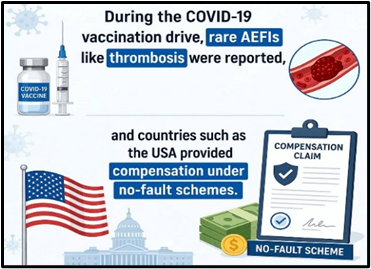
Vaccine Injury Compensation Mechanism in India:
- India administered over 200 crore vaccine doses during COVID-19, making vaccination a collective social responsibility rather than a purely individual choice.
- While vaccines are safe and effective, rare adverse effects such as anaphylaxis or thrombosis can occur, leading to serious health consequences.
- Existing legal mechanisms are inadequate because they require proving manufacturer or state fault, which is difficult in vaccine-related cases.
- Consumer protection laws are also limited due to complex evidentiary requirements and exclusion of certain public health interventions.
- The absence of a structured compensation mechanism creates a gap in accountability and undermines trust in public health systems.
- The Supreme Court has directed the government to consider a no-fault compensation framework, indicating judicial recognition of the issue.
- Constitutional principles such as right to health (Article 21) and legitimate expectation support the need for compensation when state-mandated actions cause harm.
- A proposed framework for India includes defining specific AEFI conditions, establishing causation timelines, and setting up independent adjudication mechanisms.
- Creation of a dedicated compensation fund financed by government and manufacturers can ensure sustainability.
- Strengthening AEFI surveillance systems, including mandatory reporting and transparency, is essential for credibility.
- Concerns that compensation may fuel vaccine hesitancy are countered by evidence showing that transparency enhances public trust and uptake.
- Compensation frameworks reinforce the social contract where individuals accept small risks for collective benefit, and the state assumes responsibility for adverse outcomes.
- With new vaccination programmes such as HPV immunisation, the need for such a mechanism becomes more urgent.
CONCLUSION:
Establishing a vaccine injury compensation mechanism is essential to uphold constitutional accountability, strengthen public trust, and ensure equitable and ethical public health governance.
Source: (The Hindu)
La Excellence IAS Academy, the best IAS coaching in Hyderabad, known for delivering quality content and conceptual clarity for UPSC 2026 preparation.
FOLLOW US ON:
◉ YouTube : https://www.youtube.com/@CivilsPrepTeam
◉ Facebook: https://www.facebook.com/LaExcellenceIAS
◉ Instagram: https://www.instagram.com/laexcellenceiasacademy/
GET IN TOUCH:
Contact us at info@laex.in, https://laex.in/contact-us/
or Call us @ +91 9052 29 2929, +91 9052 99 2929, +91 9154 24 2140
OUR BRANCHES:
Head Office: H No: 1-10-225A, Beside AEVA Fertility Center, Ashok Nagar Extension, VV Giri Nagar, Ashok Nagar, Hyderabad, 500020
Madhapur: Flat no: 301, survey no 58-60, Guttala begumpet Madhapur metro pillar: 1524, Rangareddy Hyderabad, Telangana 500081
Bangalore: Plot No: 99, 2nd floor, 80 Feet Road, Beside Poorvika Mobiles, Chandra Layout, Attiguppe, Near Vijaya Nagara, Bengaluru, 560040