
Paper: GS – II, Subject: International Relations, Topic: Agreements involving India and/or affecting India’s interests, Issue: WHO Pandemic Agreement, PABS framework.
Context:
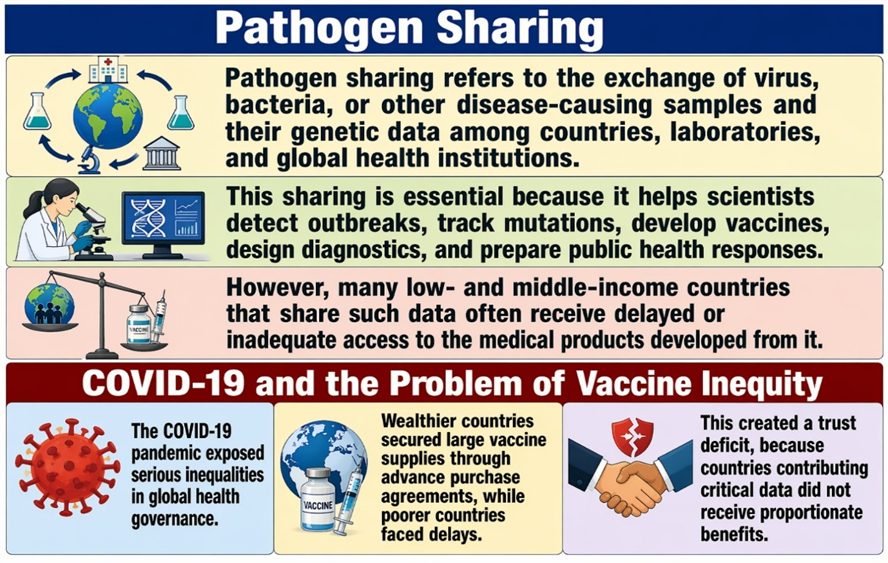
Global health governance faces a critical challenge: countries that share pathogen samples and genomic data often do not receive timely access to vaccines, diagnostics, or therapeutics developed from that data. The WHO Pandemic Agreement, adopted on 20 May 2025, seeks to correct this imbalance by strengthening pandemic preparedness, international cooperation, and equitable access to health products.
Key Takeaways:
BACKGROUND:
WHO Pandemic Agreement:
- The WHO Pandemic Agreement was officially adopted by the World Health Assembly on 20 May 2025 after three years of negotiations.
- It marks a historic step toward strengthening global pandemic prevention, preparedness, and response.
- The agreement was adopted under Article 19 of the WHO Constitution and is only the second such legal instrument after the Framework Convention on Tobacco Control.
- The treaty is open for signature and ratification and will become binding once 60 countries ratify it.
Pathogen Access and Benefit-Sharing System:
- The Pathogen Access and Benefit-Sharing system seeks to link pathogen sharing with guaranteed benefits.
- While the core treaty has been adopted, member states are still negotiating the detailed PABS annex.
- The PABS annex is expected to be finalized in 2026, and its design will determine how effective the agreement becomes in practice.
EXPLANATION:
Core Issue of Unequal Benefit Distribution:
- Developing countries often become the first sites of disease outbreaks and therefore provide early pathogen samples and genomic information.
- Pharmaceutical companies and research institutions may use this material to develop vaccines, diagnostics, and therapeutics.
- However, the countries that shared the data may not receive affordable or timely access to the final products.
- This creates a mismatch between contribution and benefit in global health cooperation.
Purpose of the PABS Framework:
- The PABS framework aims to create a predictable system where pathogen access is connected with benefit-sharing.
- It seeks to ensure that companies using pathogen samples and data provide a portion of resulting vaccines, therapeutics, and diagnostics to the WHO.
- The proposed arrangement includes sharing a part of pandemic-related products with WHO and supplying another part at affordable prices.
- This is intended to prevent a repeat of vaccine nationalism witnessed during COVID-19.
Key Provisions of the WHO Pandemic Agreement:
- The agreement promotes timely and equitable access to vaccines, diagnostics, and therapeutics during pandemics.
- It encourages technology and knowledge transfer so that developing countries can build local production capacity.
- It provides for a coordinating financial mechanism to support pandemic prevention, preparedness, and response.
- It also supports a Global Supply Chain and Logistics Network to improve timely and affordable access to health products.
Concerns and Challenges:
- The benefit-sharing mechanism is still unclear because the PABS annex is under negotiation.
- Developed countries and pharmaceutical companies are concerned about intellectual property protection and innovation incentives.
- Developing countries want stronger obligations for technology transfer, affordable pricing, and guaranteed access.
- The agreement also preserves national sovereignty, as the WHO cannot impose lockdowns, vaccine mandates, travel bans, or domestic legal changes on countries.
India’s Position and Relevance:
- India has supported equity-based global health governance, especially for low- and middle-income countries.
- India has argued for fair access to vaccines, diagnostics, and therapeutics during health emergencies.
- India has also supported technology transfer and intellectual property flexibility, including during COVID-19 debates at the WTO.
- This issue is important for India because it connects public health, diplomacy, pharmaceutical manufacturing, and global justice.
CONCLUSION:
The WHO Pandemic Agreement represents an important step toward correcting inequalities in global pandemic governance. However, its real success will depend on the final design of the PABS annex, especially whether it can convert pathogen sharing into assured access to vaccines, diagnostics, therapeutics, technology transfer, and affordable pricing.
Source: (The Hindu)
La Excellence IAS Academy, the best IAS coaching in Hyderabad, known for delivering quality content and conceptual clarity for UPSC 2026 preparation.
FOLLOW US ON:
◉ YouTube : https://www.youtube.com/@CivilsPrepTeam
◉ Facebook: https://www.facebook.com/LaExcellenceIAS
◉ Instagram: https://www.instagram.com/laexcellenceiasacademy/
GET IN TOUCH:
Contact us at info@laex.in, https://laex.in/contact-us/
or Call us @ +91 9052 29 2929, +91 9052 99 2929, +91 9154 24 2140
OUR BRANCHES:
Head Office: H No: 1-10-225A, Beside AEVA Fertility Center, Ashok Nagar Extension, VV Giri Nagar, Ashok Nagar, Hyderabad, 500020
Madhapur: Flat no: 301, survey no 58-60, Guttala begumpet Madhapur metro pillar: 1524, Rangareddy Hyderabad, Telangana 500081
Bangalore: Plot No: 99, 2nd floor, 80 Feet Road, Beside Poorvika Mobiles, Chandra Layout, Attiguppe, Near Vijaya Nagara, Bengaluru, 560040