
Paper: GS – I, Subject: Geography, Topic: Geo-physical Phenomenon, Issue: India’s Escalating Heatwave Crisis.
Context:
India is witnessing earlier and more intense heatwaves, with temperatures crossing 40°C even in April, as highlighted in the given newspaper article. This reflects a shift from seasonal discomfort to a structural climate and governance challenge, affecting health, economy, and democratic processes like elections.
Key Takeaways:
Background:
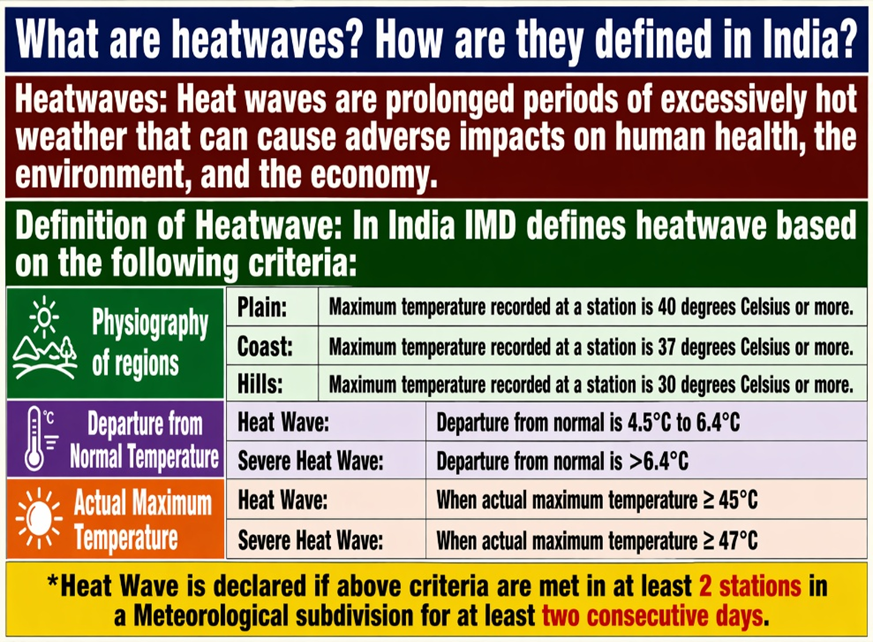
Why is India Highly Vulnerable?
- India’s tropical location naturally exposes it to high summer temperatures.
- A large proportion of the population depends on outdoor occupations such as agriculture and construction.
- Rapid and unplanned urbanisation has increased heat retention in cities through the urban heat island effect.
- There is limited adaptive infrastructure, including cooling systems, green cover, and public health preparedness.
EXPLANATION:
Early Onset and Intensification of Heatwaves:
- Heatwaves are now occurring earlier than usual, shifting from May–June to April.
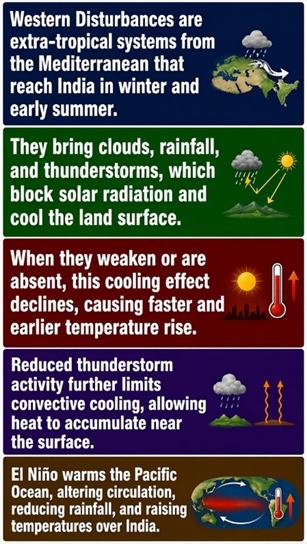
- This is linked to reduced western disturbances, lower thunderstorm activity, and residual warming effects from climatic phenomena such as El Niño.
- These factors indicate an interaction between natural variability and long-term climate change.
Public Health Implications:
- Prolonged exposure to high temperatures leads to heat stress, dehydration, and cardiovascular complications.
- Warmer nights reduce the body’s ability to recover, thereby increasing mortality risk.
- Heatwaves are increasingly being treated as public health emergencies.
Economic Consequences:
- High temperatures reduce labour productivity, particularly among informal and outdoor workers.
- Significant work-hours are lost, especially in sectors such as construction and agriculture.
- This results in income loss and exacerbates socio-economic inequalities.
Impact on Agriculture and Food Security:
- Excessive heat accelerates crop maturity, reducing grain filling and yield.
- It particularly affects rabi crops such as wheat.
- This leads to supply constraints, contributing to food inflation and food security concerns.
Urban Heat Island Effect:
- Urban areas experience higher temperatures due to concrete surfaces, reduced vegetation, and heat absorption by infrastructure.
- Coastal cities face additional stress due to high humidity, increasing the perceived temperature.
Governance Challenges and Heat Action Plans:
- India has developed Heat Action Plans as a primary institutional response.
- However, these plans are largely focused on emergency measures such as alerts and short-term relief.
- There is inadequate emphasis on long-term structural interventions such as urban greening, labour protection, and infrastructure redesign.
- Funding constraints and limited coverage of informal workers reduce their effectiveness.
Social and Institutional Dimensions:
- Heatwaves are beginning to affect democratic processes such as elections by influencing voter turnout.
- This demonstrates that heat stress is not only an environmental issue but also an institutional and governance challenge.
Need for Structural and Long-term Solutions:
- There is a need for climate-resilient urban planning, including increased green cover and improved building design.
- Labour laws must incorporate heat safety provisions, particularly for informal workers.
- Public systems must be strengthened through mobile health services and accessible cooling infrastructure.
- Climate adaptation must be integrated into development planning rather than treated as a standalone issue.
CONCLUSION:
Heatwaves in India are no longer isolated climatic events but represent a systemic challenge linked to climate change, urbanisation, and governance gaps. Addressing them requires a transition from short-term emergency responses to long-term, inclusive, and resilience-oriented strategies.
Source: (The Hindu)
La Excellence IAS Academy, the best IAS coaching in Hyderabad, known for delivering quality content and conceptual clarity for UPSC 2026 preparation.
FOLLOW US ON:
◉ YouTube : https://www.youtube.com/@CivilsPrepTeam
◉ Facebook: https://www.facebook.com/LaExcellenceIAS
◉ Instagram: https://www.instagram.com/laexcellenceiasacademy/
GET IN TOUCH:
Contact us at info@laex.in, https://laex.in/contact-us/
or Call us @ +91 9052 29 2929, +91 9052 99 2929, +91 9154 24 2140
OUR BRANCHES:
Head Office: H No: 1-10-225A, Beside AEVA Fertility Center, Ashok Nagar Extension, VV Giri Nagar, Ashok Nagar, Hyderabad, 500020
Madhapur: Flat no: 301, survey no 58-60, Guttala begumpet Madhapur metro pillar: 1524, Rangareddy Hyderabad, Telangana 500081
Bangalore: Plot No: 99, 2nd floor, 80 Feet Road, Beside Poorvika Mobiles, Chandra Layout, Attiguppe, Near Vijaya Nagara, Bengaluru, 560040