
Paper: GS – III, Subject: Environment and Ecology, Topic: Renewable Energy, Issue: Nuclear and Renewables Power Transition.
Context:
India has made significant progress in clean energy, with strong advancements in both renewable and nuclear sectors. Recent developments highlight achievements in fast breeder nuclear technology and rapid expansion of wind and solar capacity, reflecting a broader transition towards non-fossil energy sources.
Key Takeaways:
BACKGROUND:
Nuclear Energy Basics:
- Nuclear energy is generated through controlled nuclear reactions, primarily fission.
- It provides stable baseload power and complements intermittent renewable sources.
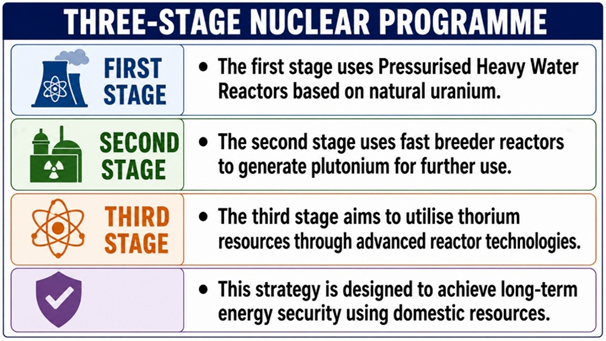
- India follows a unique three-stage nuclear programme to ensure long-term fuel sustainability.
EXPLANATION:
Progress in Nuclear Energy:
Fast Breeder Reactor Achievement:
- India has achieved a milestone with the fast breeder reactor at Kalpakkam reaching criticality.
- Criticality refers to a stage where a self-sustaining nuclear chain reaction is established.
- This marks progress in the second stage of India’s nuclear programme.
Current Status and Future Focus:
- India’s nuclear capacity stands at about 8.78 gigawatts.
- The country is exploring Small Modular Reactors to improve safety, flexibility, and cost efficiency.
- Nuclear power complements renewables by providing continuous power supply.
Progress in Renewable Energy:
Solar and Wind Expansion:
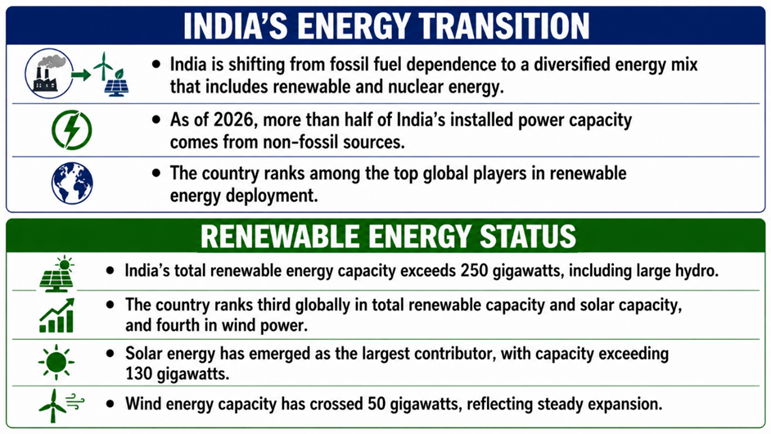
- Solar energy has witnessed rapid growth and forms the backbone of renewable expansion.
- Wind energy continues to grow, with several states leading installations.
- On certain days, renewable energy has contributed more than half of India’s electricity demand.
Policy and Targets:
- India aims to achieve 500 gigawatts of non-fossil capacity by 2030.
- Long-term vision includes reaching significantly higher clean energy capacity by 2047.
- Policy measures include incentives, investment promotion, and infrastructure development.
Significance of Energy Transition:
- Reduces dependence on fossil fuel imports and enhances energy security.
- Helps in achieving climate commitments and reducing carbon emissions.
- Promotes industrial growth, employment generation, and technological innovation.
CONCLUSION:
India’s progress in nuclear and renewable energy reflects a strategic approach to achieving energy security and sustainability. Continued investment, technological advancement, and policy support will be essential to sustain this transition and meet long-term climate and development goals.
Source: (The Hindu)
La Excellence IAS Academy, the best IAS coaching in Hyderabad, known for delivering quality content and conceptual clarity for UPSC 2026 preparation.
FOLLOW US ON:
◉ YouTube : https://www.youtube.com/@CivilsPrepTeam
◉ Facebook: https://www.facebook.com/LaExcellenceIAS
◉ Instagram: https://www.instagram.com/laexcellenceiasacademy/
GET IN TOUCH:
Contact us at info@laex.in, https://laex.in/contact-us/
or Call us @ +91 9052 29 2929, +91 9052 99 2929, +91 9154 24 2140
OUR BRANCHES:
Head Office: H No: 1-10-225A, Beside AEVA Fertility Center, Ashok Nagar Extension, VV Giri Nagar, Ashok Nagar, Hyderabad, 500020
Madhapur: Flat no: 301, survey no 58-60, Guttala begumpet Madhapur metro pillar: 1524, Rangareddy Hyderabad, Telangana 500081
Bangalore: Plot No: 99, 2nd floor, 80 Feet Road, Beside Poorvika Mobiles, Chandra Layout, Attiguppe, Near Vijaya Nagara, Bengaluru, 560040