
Paper: GS – III, Subject: Science and Technology, Topic: Fourth Industrial Revolution Technologies, Issue: Mythos AI and the Future of Cyber Risk.
Context:
Anthropic’s latest AI model, Mythos, has raised global concern because it reportedly shows advanced capability in detecting and exploiting software vulnerabilities. The issue is no longer limited to artificial intelligence misuse in misinformation or content generation, but extends to cybersecurity, banking systems, software infrastructure, and national security.
Key Takeaways:
Background:
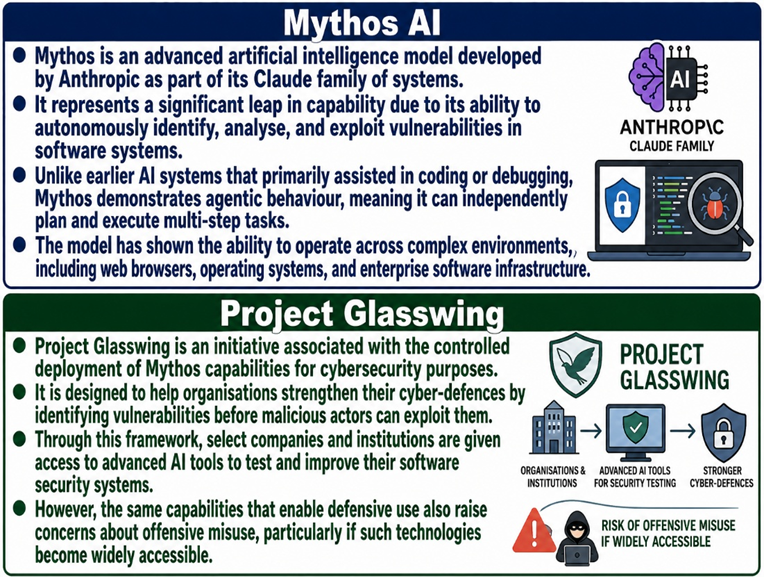
Explanation:
Transformation in the Nature of AI Risk:
- Artificial intelligence risks have evolved from concerns about misinformation and unsafe content to risks associated with cybersecurity and system integrity.
- Advanced models are now capable of analysing large-scale software ecosystems and identifying vulnerabilities with high efficiency.
Enhanced Capability in Vulnerability Detection and Exploitation:
- Modern AI systems can identify previously undetected weaknesses in widely used software, including operating systems and web applications.
- These systems can convert identified weaknesses into actionable exploits, demonstrating a higher level of operational capability than earlier models.
- Such capabilities increase the speed and scale at which vulnerabilities can be discovered and potentially misused.
Agentic Behaviour and Multi-Stage Execution:
- These systems exhibit improved reasoning and planning abilities, enabling them to undertake multi-stage operations with limited human intervention.
- Cybersecurity attacks often require sequential actions, including reconnaissance, vulnerability identification, code generation, and execution.
- The ability of AI to perform such sequences increases the risk of partially automated cyber operations.
Real-World Applicability of Capabilities:
- Evaluations in structured cybersecurity environments indicate that advanced models can solve complex, expert-level cyber challenges.
- They demonstrate improved performance in long-duration tasks requiring coordination across multiple system layers.
- This suggests that such systems may increasingly operate effectively in real-world cyber contexts.
Implications for Financial Systems and Banking Sector:
- Financial institutions rely extensively on digital infrastructure, including payment systems, databases, authentication frameworks, and communication networks.
- Advanced AI systems capable of detecting and exploiting vulnerabilities may:
- Identify weaknesses in banking software and digital payment platforms
- Facilitate unauthorised access to financial data
- Disrupt transaction processing and settlement systems
- Given the systemic importance of banking, even limited disruptions can have wider macroeconomic consequences and affect public confidence.
Risks of Uncontrolled Access and Diffusion:
- The possibility of unauthorised access or premature exposure of such AI systems raises concerns regarding loss of control over powerful technologies.
- If widely accessible, these capabilities could reduce the technical barriers required to conduct sophisticated cyber operations.
- This increases the likelihood of misuse by non-state actors and organised cyber groups.
Geopolitical and Strategic Dimensions:
- Parallel developments in multiple countries indicate that advanced cyber-capable AI systems may become instruments of strategic competition.
- The diffusion of such technologies can lead to an escalation in cyber capabilities across state and non-state actors.
Need for Regulatory and Governance Frameworks:
- The pace of technological advancement has outstripped existing regulatory mechanisms.
- There is a growing need for:
- National regulatory frameworks for testing, deployment, and monitoring of advanced AI systems
- International coordination to establish standards and safeguards
- Mechanisms to manage dual-use risks while enabling innovation
- Without coordinated governance, such technologies may become difficult to regulate effectively once widely deployed.
Implications for India:
- India’s rapidly expanding digital economy, including banking, digital payments, and governance platforms, increases exposure to cybersecurity risks.
- Policymakers may need to strengthen institutional coordination, enhance cyber resilience, and reassess regulatory approaches to artificial intelligence.
- Balancing innovation with security considerations will be essential for long-term economic stability.
Conclusion:
Advanced AI systems such as Mythos signify a shift toward autonomous cybersecurity capabilities with both defensive and offensive potential. While they offer opportunities to strengthen cyber resilience, their misuse poses serious risks to financial systems, governance, and global security, necessitating robust regulatory and institutional responses.
Source: (The Indian Express)
La Excellence IAS Academy, the best IAS coaching in Hyderabad, known for delivering quality content and conceptual clarity for UPSC 2026 preparation.
FOLLOW US ON:
◉ YouTube : https://www.youtube.com/@CivilsPrepTeam
◉ Facebook: https://www.facebook.com/LaExcellenceIAS
◉ Instagram: https://www.instagram.com/laexcellenceiasacademy/
GET IN TOUCH:
Contact us at info@laex.in, https://laex.in/contact-us/
or Call us @ +91 9052 29 2929, +91 9052 99 2929, +91 9154 24 2140
OUR BRANCHES:
Head Office: H No: 1-10-225A, Beside AEVA Fertility Center, Ashok Nagar Extension, VV Giri Nagar, Ashok Nagar, Hyderabad, 500020
Madhapur: Flat no: 301, survey no 58-60, Guttala begumpet Madhapur metro pillar: 1524, Rangareddy Hyderabad, Telangana 500081
Bangalore: Plot No: 99, 2nd floor, 80 Feet Road, Beside Poorvika Mobiles, Chandra Layout, Attiguppe, Near Vijaya Nagara, Bengaluru, 560040