
Paper: GS – I, Subject: Society and Social Justice, Topic: Population and Associated Issues, Issue: Falling Fertility, Delimitation and Tax Sharing (Demographic Performance).
Context:
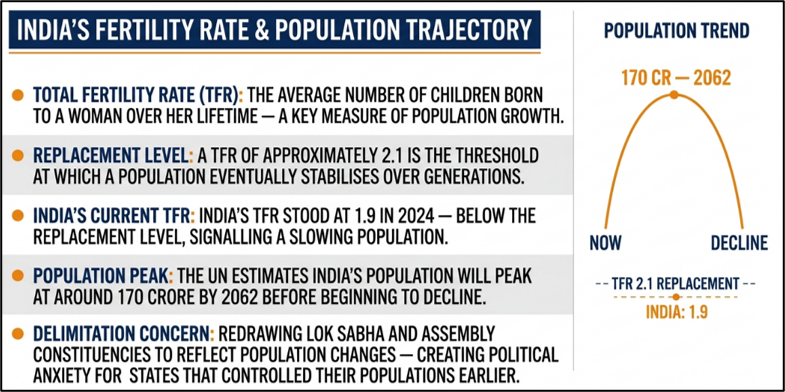
Recent Sample Registration System (SRS) and National Family Health Survey (NFHS – 6) data have reignited debate over India’s falling fertility and growing demographic divergence among states. Some low-fertility states, fearing reduced political representation and a smaller tax share, are considering incentives for larger families – an approach that is neither necessary nor sound.
Key Takeaways:
Explanation:
India’s Population Situation:
- India’s population will keep growing for several decades because it still has a large young population.
- The sex ratio at birth remains low at 918 girls per 1,000 boys, against a normal level of about 955, showing continued son preference.
Differences Among States:
- Bihar and Uttar Pradesh have TFRs of 2.9 and 2.6, compared with the national average of 1.9.
- Lower female education and limited contraception use are major reasons for higher fertility.
- Girls’ education, women’s empowerment and better family-planning services can reduce fertility in these States.
Should Low-Fertility States Encourage More Births?
- Andhra Pradesh has proposed cash support, nutrition assistance, free education and longer maternity leave for third and fourth children.
- Research shows that one-time financial incentives rarely produce lasting changes in family size.
- Fertility decisions depend more on jobs, housing, childcare, healthcare and work-life balance.
- Since India is still far from population decline, low-fertility States need not promote larger families.
Delimitation and Political Representation:
- Low-fertility States fear losing parliamentary seats after future delimitation.
- States that successfully reduced population growth should not lose political influence.
- The issue should be solved through fair constitutional arrangements, not by encouraging more births.
Tax Devolution:
- Similar concerns arise in sharing central taxes among States.
- The 15th Finance Commission considered both population and demographic performance while deciding State shares.
- A similar approach can make delimitation and tax sharing fairer than pro-natalist policies.
Conclusion:
More children are not the answer to delimitation or tax-sharing concerns. India should reduce regional demographic gaps and reward development, not population size. Reliable Census data will be important for future reforms.
Source: (The Indian Express)
La Excellence IAS Academy, the best IAS coaching in Hyderabad, known for delivering quality content and conceptual clarity for UPSC 2026 preparation.
FOLLOW US ON:
◉ YouTube : https://www.youtube.com/@CivilsPrepTeam
◉ Facebook: https://www.facebook.com/LaExcellenceIAS
◉ Instagram: https://www.instagram.com/laexcellenceiasacademy/
GET IN TOUCH:
Contact us at info@laex.in, https://laex.in/contact-us/
or Call us @ +91 9052 29 2929, +91 9052 99 2929, +91 9154 24 2140
OUR BRANCHES:
Head Office: H No: 1-10-225A, Beside AEVA Fertility Center, Ashok Nagar Extension, VV Giri Nagar, Ashok Nagar, Hyderabad, 500020
Madhapur: Flat no: 301, survey no 58-60, Guttala begumpet Madhapur metro pillar: 1524, Rangareddy Hyderabad, Telangana 500081
Bangalore: Plot No: 99, 2nd floor, 80 Feet Road, Beside Poorvika Mobiles, Chandra Layout, Attiguppe, Near Vijaya Nagara, Bengaluru, 560040