
Paper: GS – III, Subject: Science and Technology, Topic: Fourth Industrial Revolution Technologies, Issue: Rajasthan Shows Human-Centred AI Model.
Context:
Artificial Intelligence is increasingly being applied in governance and development to improve service delivery. A recent initiative in Rajasthan demonstrates how AI, when combined with community participation, can strengthen water resilience and enhance last-mile governance outcomes.
Key Takeaways:
BACKGROUND:
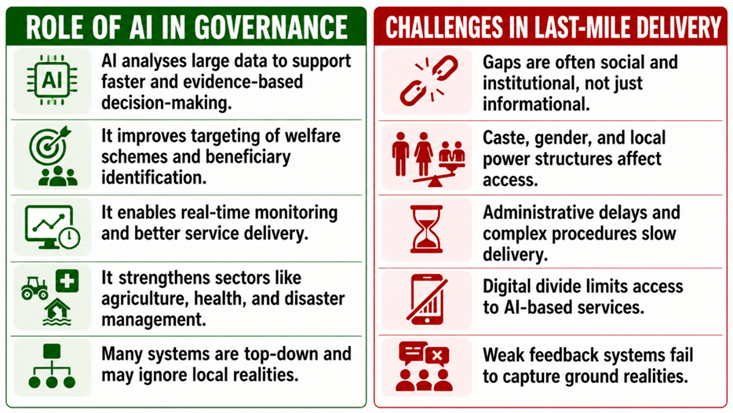
EXPLANATION:
Nature of the AI Intervention:
- The initiative in Rajasthan focused on improving water resilience in drought-prone districts.
- Instead of pushing information outward, the AI system was designed to listen to communities and gather feedback.
- It used simple technologies such as voice-based conversations in local languages through widely accessible platforms.
Community-Centric Approach:
- The system interacted with local stakeholders such as community volunteers, village leaders, and frontline workers.
- It enabled individuals, especially women, to share their experiences and concerns in a structured manner.
- This approach recognised that development outcomes depend on understanding local realities rather than imposing external solutions.
Key Findings from the Field:
- Communities reported tangible improvements such as better water availability.
- Women highlighted the burden of water collection and the impact of delays in local governance processes.
- The feedback revealed gaps in implementation, such as delays in approvals and lack of awareness of schemes.
Role of AI in Enhancing Governance:
- The AI system analysed large volumes of qualitative data to identify recurring patterns and issues.
- It enabled rapid synthesis of feedback, which would otherwise take months through traditional surveys.
- This allowed policymakers to make timely adjustments in programme design and implementation.
Importance of Human Intermediaries:
- The initiative emphasised that AI should support and not replace human intermediaries such as community workers.
- Trusted local actors facilitated participation and ensured that responses were genuine and contextually grounded.
- This hybrid model combined technological efficiency with social trust.
Shift from Passive to Active Participation:
- Traditional governance often treats beneficiaries as passive recipients of services.
- This model enabled communities to act as active contributors in co-designing solutions.
- It strengthened accountability by creating a feedback loop between citizens and institutions.
Limitations and Considerations:
- Digital divide issues, including access to smartphones and connectivity, can limit participation.
- Social inequalities may influence who participates and whose voices are heard.
- Effective scaling requires institutional capacity and sustained engagement.
CONCLUSION:
The Rajasthan experience demonstrates that AI can significantly enhance development outcomes when it is used as a tool for participatory governance. The key lesson is that technology must complement human systems and empower communities, rather than replace them, to achieve sustainable and inclusive development.
Source: (The Hindu)
La Excellence IAS Academy, the best IAS coaching in Hyderabad, known for delivering quality content and conceptual clarity for UPSC 2026 preparation.
FOLLOW US ON:
◉ YouTube : https://www.youtube.com/@CivilsPrepTeam
◉ Facebook: https://www.facebook.com/LaExcellenceIAS
◉ Instagram: https://www.instagram.com/laexcellenceiasacademy/
GET IN TOUCH:
Contact us at info@laex.in, https://laex.in/contact-us/
or Call us @ +91 9052 29 2929, +91 9052 99 2929, +91 9154 24 2140
OUR BRANCHES:
Head Office: H No: 1-10-225A, Beside AEVA Fertility Center, Ashok Nagar Extension, VV Giri Nagar, Ashok Nagar, Hyderabad, 500020
Madhapur: Flat no: 301, survey no 58-60, Guttala begumpet Madhapur metro pillar: 1524, Rangareddy Hyderabad, Telangana 500081
Bangalore: Plot No: 99, 2nd floor, 80 Feet Road, Beside Poorvika Mobiles, Chandra Layout, Attiguppe, Near Vijaya Nagara, Bengaluru, 560040