
Paper: GS – III, Subject: Science and Technology, Topic: Computer and ICT, Issue: Digital Public Infrastructure: India’s Path to Sovereignty.
Context:
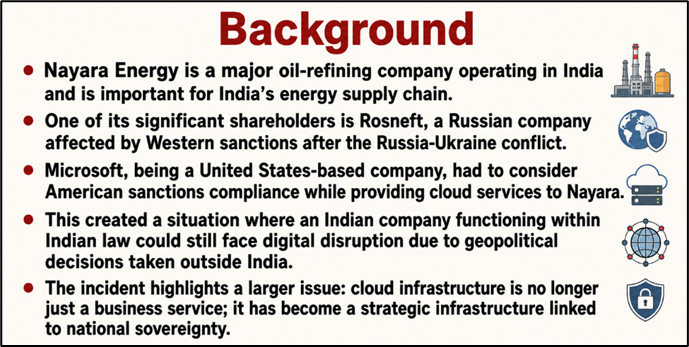
A recent controversy involving Nayara Energy and Microsoft has raised concerns about India’s dependence on foreign cloud infrastructure. Digital sovereignty has become a crucial dimension of national sovereignty in the age of cloud computing, artificial intelligence and data-driven governance. As critical services increasingly depend on digital infrastructure, control over cloud systems, data flows and AI capabilities has acquired strategic importance. For India, the challenge is to benefit from global technology while ensuring that essential digital systems remain secure, resilient and nationally accountable.
Key Takeaways:
Explanation:
- Cloud as the backbone of the digital economy: Modern cloud platforms store data, run software, host applications and support real-time digital services. Banks, hospitals, energy firms, start-ups, e-commerce platforms and government systems increasingly depend on cloud infrastructure for daily operations.
- From technical dependence to strategic vulnerability: When a critical Indian company uses a foreign cloud provider, the risk is not limited to technology failure. It can also face service restrictions due to foreign sanctions, foreign court orders, export controls, corporate policy changes or geopolitical pressure.
- Meaning of digital sovereignty: Digital sovereignty means the ability of a country to control its data, digital infrastructure, cloud systems, platforms and AI capacity. It ensures that essential public and economic services do not become helpless before external legal or political decisions.
- Why the Nayara case is significant: The case shows that territorial sovereignty alone is not enough. Even if a company operates in India, pays taxes in India and serves Indian consumers, its digital lifeline may be controlled by companies located abroad. This creates a new form of dependence.
- Digital tenancy and digital colonialism: If India builds applications, public services and businesses on infrastructure owned by others, it becomes a digital tenant. In such a situation, India may control the visible service layer but not the deeper infrastructure layer on which those services depend.
- Limits of private digital infrastructure: Global cloud platforms such as Microsoft Azure, Amazon Web Services and Google Cloud are efficient and technologically advanced. However, they are private entities governed by profit motives, shareholder interests and home-country laws. Their terms, pricing and access conditions can change.
- Importance of India’s Digital Public Infrastructure: India has developed strong Digital Public Infrastructure through Aadhaar, UPI, DigiLocker, CoWIN, ONDC, ABDM and eSign. These platforms are open, interoperable and public-purpose oriented. They reduce dependence on single private monopolies and allow many actors to innovate on common digital rails.
- AI as the next frontier of dependence: Artificial intelligence requires massive computing power, advanced chips, cloud capacity, datasets and data centres. If India’s AI systems depend mainly on foreign cloud and foreign models, then future governance, health, finance, education and security systems may become externally vulnerable.
- Way forward for strategic resilience: India should not follow digital isolationism, but it must build resilience. Sensitive data should be stored in India, critical workloads should have sovereign fallback systems, domestic cloud capacity should be strengthened, and Indian audit and regulatory control should be ensured.
- India’s global opportunity: India can also work with countries of the Global South to build open and trusted digital systems. This can create an alternative digital order that is not dominated only by a few Western or Chinese technology giants.
Conclusion:
Digital sovereignty has become a core part of national sovereignty because economic, social and governance systems now depend on digital infrastructure. India must engage with global technology companies, but critical sectors cannot remain completely dependent on foreign-controlled cloud and AI systems. A secure digital future requires domestic cloud capacity, resilient Digital Public Infrastructure and India-first AI capabilities.
Source: (The Indian Express)
La Excellence IAS Academy, the best IAS coaching in Hyderabad, known for delivering quality content and conceptual clarity for UPSC 2026 preparation.
FOLLOW US ON:
◉ YouTube : https://www.youtube.com/@CivilsPrepTeam
◉ Facebook: https://www.facebook.com/LaExcellenceIAS
◉ Instagram: https://www.instagram.com/laexcellenceiasacademy/
GET IN TOUCH:
Contact us at info@laex.in, https://laex.in/contact-us/
or Call us @ +91 9052 29 2929, +91 9052 99 2929, +91 9154 24 2140
OUR BRANCHES:
Head Office: H No: 1-10-225A, Beside AEVA Fertility Center, Ashok Nagar Extension, VV Giri Nagar, Ashok Nagar, Hyderabad, 500020
Madhapur: Flat no: 301, survey no 58-60, Guttala begumpet Madhapur metro pillar: 1524, Rangareddy Hyderabad, Telangana 500081
Bangalore: Plot No: 99, 2nd floor, 80 Feet Road, Beside Poorvika Mobiles, Chandra Layout, Attiguppe, Near Vijaya Nagara, Bengaluru, 560040