
Paper: GS –III, Subject: Economy , Topic: Trade and External sector, Issue: India’s Export Gains Amid Trade Weaknesses
Context: Recently, India’s merchandise trade deficit widened sharply in June 2026 as imports grew faster than exports. However, strong non-petroleum exports indicate improving manufacturing competitiveness.
Key Takeaways:
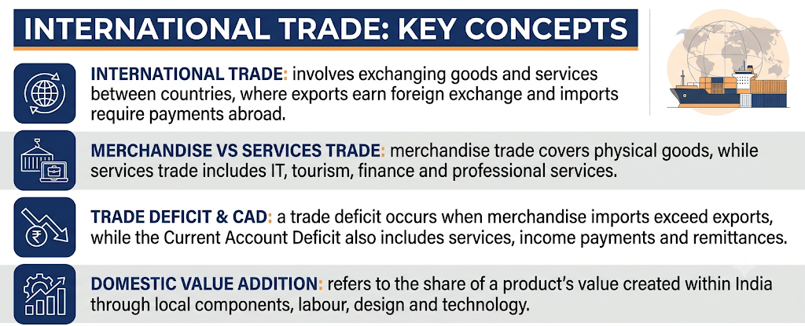
Explanation
Reasons for the Rising Deficit
- Costlier crude oil: West Asian tensions raised global oil prices. Since India imports most of its crude, the import bill increased.
- Rising gold demand: Geopolitical uncertainty increased gold purchases because investors consider it a safe asset during unstable periods.
- Fertiliser dependence: Natural-gas disruptions increased fertiliser imports because gas is an essential input for domestic urea production.
Encouraging Export Performance
- Merchandise growth: Merchandise exports grew by approximately 15.5% in June, while non-petroleum exports increased by around 16.5%.
- Volume expansion: India exported larger quantities of goods instead of benefiting only from higher international prices.
- Market diversification: Exports increased across most major regions except West Asia, reducing dependence on a few markets.
Structural Concerns
- Imported components: Electronics exports are expanding, but manufacturers still import semiconductors, batteries, displays and camera modules.
- Import-intensive growth: India exports finished electronic products, while foreign suppliers manufacture many of their high-value components.
- Slower services exports: India must convert Global Capability Centres into platforms for research, innovation and intellectual-property creation.
Government Measures and Way Forward
- Foreign Trade Policy 2023 simplifies procedures, promotes e-commerce and supports districts in developing specialised export products.
- Production-Linked Incentive schemes and the Electronics Component Manufacturing Scheme encourage domestic production of components.
- India must reduce logistics costs, expand export credit and secure reliable market access through balanced trade agreements.
- Greater investment in clean energy, research, product design and domestic supply chains can reduce long-term import dependence.
Conclusion
India’s wider trade deficit largely reflects temporary price shocks, while broad-based export growth provides cautious optimism. However, lasting competitiveness requires greater domestic value addition, technological ownership and diversified energy sources. India must convert export growth into deeper and more resilient economic capacity.
Source: (The Hindu)
La Excellence IAS Academy, the best IAS coaching in Hyderabad, known for delivering quality content and conceptual clarity for UPSC 2026 preparation.
FOLLOW US ON:
◉ YouTube : https://www.youtube.com/@CivilsPrepTeam
◉ Facebook: https://www.facebook.com/LaExcellenceIAS
◉ Instagram: https://www.instagram.com/laexcellenceiasacademy/
GET IN TOUCH:
Contact us at info@laex.in, https://laex.in/contact-us/
or Call us @ +91 9052 29 2929, +91 9052 99 2929, +91 9154 24 2140
OUR BRANCHES:
Head Office: H No: 1-10-225A, Beside AEVA Fertility Center, Ashok Nagar Extension, VV Giri Nagar, Ashok Nagar, Hyderabad, 500020
Madhapur: Flat no: 301, survey no 58-60, Guttala begumpet Madhapur metro pillar: 1524, Rangareddy Hyderabad, Telangana 500081
Bangalore: Plot No: 99, 2nd floor, 80 Feet Road, Beside Poorvika Mobiles, Chandra Layout, Attiguppe, Near Vijaya Nagara, Bengaluru, 560040