
Paper: GS – III, Subject: Science and Technology, Topic: Bio technology, Issue: The Synthetic Biology Revolution.
Context:
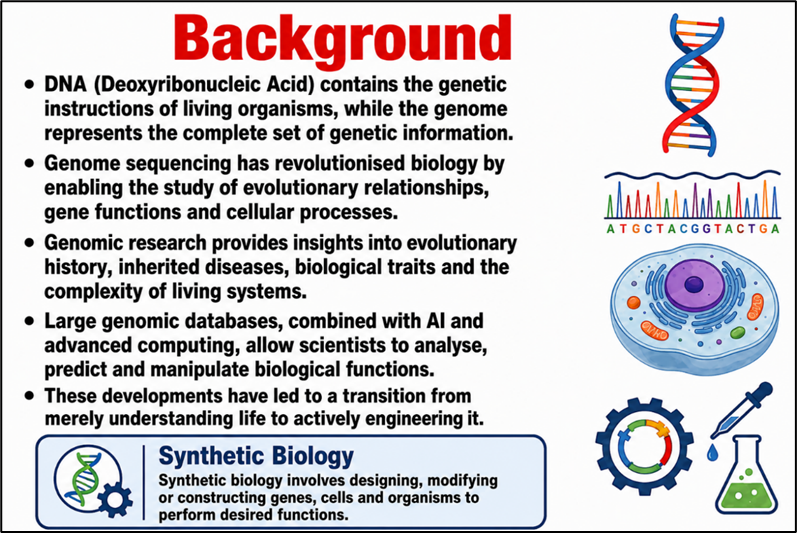
Synthetic biology is rapidly emerging as one of the most transformative fields of modern science. Advances in genome sequencing, artificial intelligence and biotechnology now enable scientists not only to understand life but also to redesign biological systems for specific purposes. While this offers immense opportunities in medicine, agriculture and industry, it also creates significant ethical, ecological and security challenges.
Key Takeaways:
Explanation:
Synthetic Biology and Biological Engineering:
- Synthetic biology involves designing, modifying or constructing genes, cells and organisms to perform desired functions.
- It seeks to apply engineering principles to biology, enabling the creation of novel biological systems and improved versions of existing organisms.
Applications of Synthetic Biology:
- Healthcare: Development of advanced vaccines, gene therapies, personalised medicine, engineered immune cells and novel treatments for genetic disorders.
- Agriculture: Creation of climate-resilient crops, pest-resistant varieties, enhanced nutritional content and reduced dependence on chemical inputs.
- Industrial Production: Use of engineered microbes to manufacture biofuels, chemicals, pharmaceuticals, enzymes and biodegradable materials in a sustainable manner.
- Environmental Management: Bioremediation of polluted ecosystems, carbon capture technologies and biological solutions for waste management.
- Scientific Research: Construction of minimal or synthetic cells to understand the origin, evolution and functioning of life.
Risks and Concerns:
- Ecological Risks: Accidental release of engineered organisms may disrupt ecosystems, biodiversity and food chains.
- Biosecurity Threats: Genetic engineering tools could be misused to create harmful pathogens or biological agents.
- Ethical Concerns: The ability to redesign or create life raises questions about human intervention in natural processes and moral boundaries.
- Unintended Consequences: Complex biological systems may behave unpredictably, producing outcomes that are difficult to foresee or control.
- Regulatory Challenges: Existing legal and governance frameworks often struggle to keep pace with rapid technological advances.
Conclusion:
Synthetic biology offers unprecedented opportunities to address challenges in health, food security, industry and environmental sustainability. However, its transformative potential must be balanced with robust regulation, ethical safeguards and international cooperation. The goal should be to harness innovation while preventing risks to society and the natural world.
Source: (The Hindu)
La Excellence IAS Academy, the best IAS coaching in Hyderabad, known for delivering quality content and conceptual clarity for UPSC 2026 preparation.
FOLLOW US ON:
◉ YouTube : https://www.youtube.com/@CivilsPrepTeam
◉ Facebook: https://www.facebook.com/LaExcellenceIAS
◉ Instagram: https://www.instagram.com/laexcellenceiasacademy/
GET IN TOUCH:
Contact us at info@laex.in, https://laex.in/contact-us/
or Call us @ +91 9052 29 2929, +91 9052 99 2929, +91 9154 24 2140
OUR BRANCHES:
Head Office: H No: 1-10-225A, Beside AEVA Fertility Center, Ashok Nagar Extension, VV Giri Nagar, Ashok Nagar, Hyderabad, 500020
Madhapur: Flat no: 301, survey no 58-60, Guttala begumpet Madhapur metro pillar: 1524, Rangareddy Hyderabad, Telangana 500081
Bangalore: Plot No: 99, 2nd floor, 80 Feet Road, Beside Poorvika Mobiles, Chandra Layout, Attiguppe, Near Vijaya Nagara, Bengaluru, 560040