
Paper: GS – III, Subject: Environment and Ecology, Topic: Climate Change, Issue: Beyond Environment Day: Building a Climate-Resilient and Low-Carbon India”.
Context:
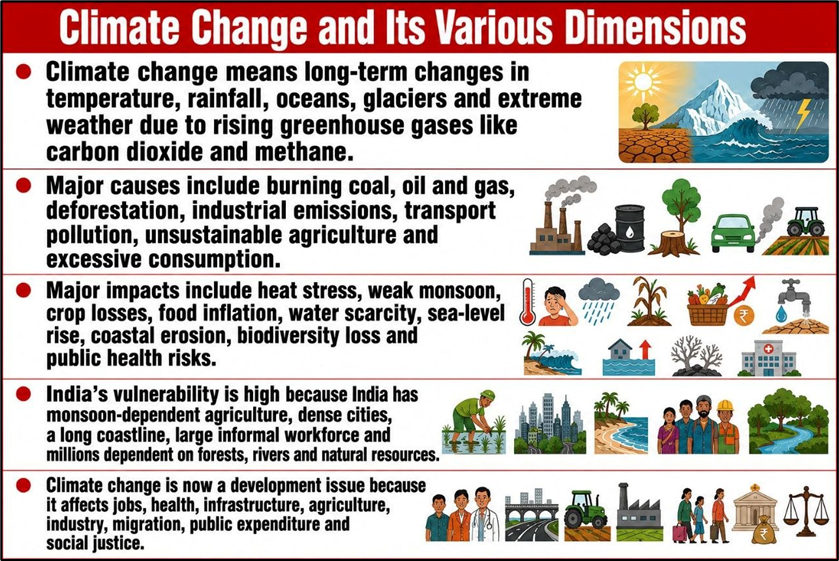
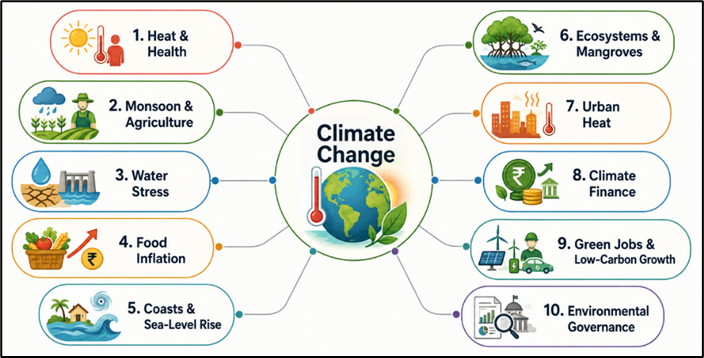
June 5 is observed as World Environment Day, reminding us that environmental protection is not separate from human development. Today, climate change threatens India through heat waves, erratic monsoons, floods, droughts, cyclones, air pollution, coastal erosion and biodiversity loss. Therefore, the conversation must broaden from simple environmental awareness to climate finance, adaptation, green jobs, environmental governance and climate justice.
Key Takeaways:
Explanation:
1. Climate Change as a Development Crisis:
- Climate change is not only about a warmer planet; it directly affects income, food, water, health and livelihoods.
- Heat waves reduce the working hours of construction workers, delivery workers, street vendors and agricultural labourers.
- Extreme heat cost India around 247 billion working hours in 2024, showing that climate change is also an economic productivity crisis.
- Fossil-fuel combustion is linked with about 0.95 million premature deaths in India annually, making clean energy a public health need too.
2. Need to Broaden the Climate Conversation:
- World Environment Day should not be limited to symbolic activities like tree plantation or pollution awareness.
- India must discuss climate change as a matter of growth, jobs, industrial policy, infrastructure, health and social protection.
- The key question is not only “How will India reduce emissions?” but also “How will India adapt and protect people?”
- Climate action should be seen as an opportunity to build a low-carbon, climate-resilient and employment-generating economy.
3. Climate Action as an Economic Opportunity:
- Climate action can create new industries in renewable energy, green mobility, cooling systems, water management and resilient infrastructure.
- India’s renewable energy and adaptation sectors can generate jobs in manufacturing, engineering, construction, digital services and urban planning.
- Renewable energy can generate around 3.4 million jobs by 2030, making climate action linked to employment generation.
- The transition to a low-carbon economy can reduce fossil-fuel dependence and improve India’s energy security.
4. Adaptation Economy:
- Adaptation means preparing society to face climate impacts that are already happening.
- The adaptation economy includes climate-resilient seeds, cold storage, water systems, cooling technologies, green buildings, early-warning systems and resilient transport.
- This is important because climate change is already affecting agriculture, cities, coasts and informal workers.
- Adaptation is not a substitute for mitigation; India needs both emission reduction and protection from unavoidable climate impacts.
5. Agriculture, Monsoon and Food Inflation:
- Indian agriculture depends heavily on the Southwest Monsoon, which supports crops, reservoirs and groundwater recharge.
- Weak or erratic rainfall increases sowing uncertainty, irrigation costs and groundwater extraction.
- Climate shocks can reduce food supply and increase prices of vegetables, pulses and essential food items.
- Thus, climate change becomes both a farmer crisis and a consumer inflation crisis.
6. El Niño, Heat and Water Stress:
- El Niño can disturb global weather patterns and often weakens India’s monsoon.
- A weak monsoon affects crops, rural incomes, reservoirs, aquifers and food prices.
- Heat waves worsen water demand and reduce outdoor work capacity.
- India needs drought insurance, climate-resilient crops, watershed management, aquifer recharge and better forecasting.
7. Urban Heat and Inequality:
- Cities become hotter due to concrete surfaces, vehicles, poor ventilation and loss of green cover.
- This creates the Urban Heat Island effect, where urban areas are hotter than surrounding rural areas.
- Poor households suffer more because they often live in overcrowded homes with poor access to water and cooling.
- Cities need cool roofs, urban forests, wetlands, permeable pavements, drinking water access and Heat Action Plans.
8. Coastal Vulnerability and Maladaptation:
- India’s coastline supports nearly 250 million people, along with fisheries, ports, tourism and agriculture.
- Sea-level rise, cyclones, storm surges, saline intrusion and coastal erosion threaten coastal livelihoods.
- Seawalls, embankments and tetrapods may protect one location but shift erosion and flood risk to nearby areas.
- This is called maladaptation, where a short-term solution increases long-term vulnerability.
9. Ecosystem-Based Adaptation:
- Ecosystem-Based Adaptation means using nature to protect people from climate risks.
- Mangroves, wetlands, coral reefs and seagrass meadows reduce storm surges, erosion, flooding and saline intrusion.
- The Sundarbans and Bhitarkanika show that mangroves protect coastal communities while supporting livelihoods.
- MISHTI, or Mangrove Initiative for Shoreline Habitats and Tangible Incomes, aims to restore about 540 sq. km of mangroves across 9 States.
10. Managed Retreat and Climate Justice:
- Managed retreat means planned relocation of people and assets from highly risky coastal or flood-prone areas.
- It must not become forced displacement of poor communities.
- Relocation should include land rights, housing, jobs, schools, public services and cultural dignity.
- Climate-displaced people should be treated as citizens needing protection, not as encroachers.
11. Climate Finance: The Trillion-Dollar Challenge:
- Climate action requires huge finance for clean energy, resilient infrastructure, sustainable transport, water systems and industrial decarbonisation.
- RBI estimates India needs at least an additional 2.5% of GDP annually in green investment till 2030.
- India’s Net Zero transition by 2070 requires very large investment, but it can also create jobs and reduce fossil-fuel dependence.
- Climate finance is therefore not charity; it is investment in India’s future resilience and competitiveness.
12. Global Climate Finance and NCQG:
- NCQG means New Collective Quantified Goal on climate finance.
- Developing countries need around US$5–6 trillion by 2030 for climate action.
- The Baku commitment of US$300 billion annually by 2035 is seen as insufficient by developing countries.
- This shows the gap between climate promises and actual finance required by developing economies.
13. Green Finance Architecture:
- India has instruments like Green Bonds, Sovereign Green Bonds, Sustainability-Linked Bonds, Transition Finance, Blended Finance and InvITs.
- The bigger problem is not absence of instruments but weak institutional architecture.
- India needs a Climate Finance Taxonomy to clearly define what is genuinely “green” and prevent greenwashing.
- Credit guarantees, first-loss public capital, green debt liquidity and regulatory incentives can attract private investment.
14. Role of RBI and Banks:
- Banks must treat climate change as a financial risk, not only an environmental concern.
- Loans to flood-prone, drought-prone or carbon-intensive sectors carry future climate and transition risks.
- Climate stress testing can help banks assess how climate events may affect loan portfolios.
- Green lending incentives can make sustainable projects cheaper than carbon-intensive investments.
15. State Climate Finance Gap:
- Many adaptation projects are implemented locally: coastal protection, drought-proofing, Heat Action Plans, flood control and spring rejuvenation.
- But States and municipalities often lack borrowing capacity and technical capacity to access climate finance.
- A State Climate Finance Facility can help States prepare bankable projects and access green debt markets.
- This is crucial because climate impacts are local, but climate finance is often centralised.
16. One Investment, Multiple Returns:
- Climate finance and development finance should not remain separate.
- Clean energy reduces emissions, lowers air pollution, improves health and creates jobs.
- Renewable energy for industrial clusters can reduce power costs, protect exports and safeguard employment.
- Biochar can improve soil fertility, raise farmer income, reduce fertiliser use and store carbon.
17. Need for National Environmental Survey:
- India has environmental data across ministries, universities, think tanks, civil society and government agencies, but it remains fragmented.
- An Annual Environmental Survey of India (EnvSI) can consolidate this information like the Economic Survey does for the economy.
- It should assess forests, rivers, air quality, biodiversity, land degradation, climate vulnerability, environmental compliance and fund utilisation.
- Such a survey can help evidence-based policymaking and make environmental governance more accountable.
18. Why EnvSI Matters:
- A Yale survey found that many Indians had recently experienced extreme climate events such as heat waves, air pollution, droughts, floods and landslides.
- India also faces concerns of river pollution, land degradation, deforestation, biodiversity loss and air pollution.
- EnvSI can identify hotspots early and help governments act before crises become severe.
- It must be independent, transparent and willing to highlight uncomfortable environmental realities.
Conclusion:
Climate change is not only an environmental problem; it is a challenge to India’s economy, society, governance and future development. India must reduce emissions, finance green growth, protect vulnerable communities, restore ecosystems and strengthen environmental accountability. On World Environment Day, the message is clear: the conversation must broaden from saving nature to building a resilient, inclusive and low-carbon India.
Source: (The Indian Express, The Hindu)
La Excellence IAS Academy, the best IAS coaching in Hyderabad, known for delivering quality content and conceptual clarity for UPSC 2026 preparation.
FOLLOW US ON:
◉ YouTube : https://www.youtube.com/@CivilsPrepTeam
◉ Facebook: https://www.facebook.com/LaExcellenceIAS
◉ Instagram: https://www.instagram.com/laexcellenceiasacademy/
GET IN TOUCH:
Contact us at info@laex.in, https://laex.in/contact-us/
or Call us @ +91 9052 29 2929, +91 9052 99 2929, +91 9154 24 2140
OUR BRANCHES:
Head Office: H No: 1-10-225A, Beside AEVA Fertility Center, Ashok Nagar Extension, VV Giri Nagar, Ashok Nagar, Hyderabad, 500020
Madhapur: Flat no: 301, survey no 58-60, Guttala begumpet Madhapur metro pillar: 1524, Rangareddy Hyderabad, Telangana 500081
Bangalore: Plot No: 99, 2nd floor, 80 Feet Road, Beside Poorvika Mobiles, Chandra Layout, Attiguppe, Near Vijaya Nagara, Bengaluru, 560040