
Paper: GS – I, Subject: Society and Social Justice, Topic: Population and associated issues, Issue: Total Fertility Rate Decline: Causes, Consequences and Policy Responses.
Context:
Across the world, fertility rates have declined sharply over the past few decades, affecting both developed and developing societies. The earlier concern of uncontrolled population growth is increasingly being replaced by worries about ageing populations, shrinking workforces and rising welfare burdens. India too is moving from a high-fertility society to one where many states are already below replacement level.
Key Takeaways:
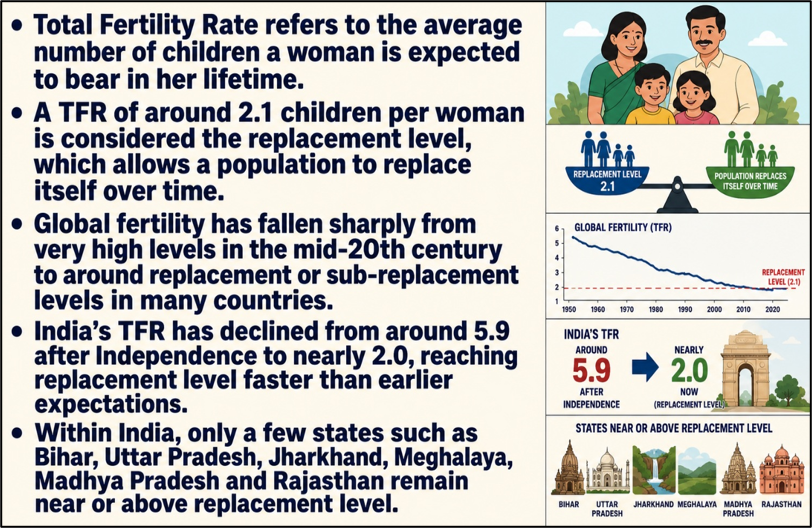
Explanation:
1. Factors Behind Fertility Decline:
- Economic factors: Urban living has increased the cost of housing, education, healthcare, nutrition and childcare. As a result, larger families are increasingly seen as economically difficult.
- Women-centric factors: Higher female education, workforce participation, delayed marriage, career aspirations and greater autonomy have reduced early and repeated childbearing.
- Developmental factors: Improved child survival, contraception, maternal healthcare and social security reduce the perceived need for large families.
- Family and social factors: Nuclear families, limited housing space, weaker community support and demanding work cultures have made child-rearing more difficult.
- Cultural and psychological factors: Marriage and parenthood are no longer viewed as compulsory life goals. Individual freedom, lifestyle choices and future anxieties increasingly shape reproductive decisions.
- Technological factors: Digital lifestyles, reduced face-to-face socialisation and changing relationship patterns may contribute to delayed marriage and lower fertility.
2. Consequences:
- Low fertility increases the share of elderly people and reduces the future working-age population.
- It may create labour shortages, lower productivity and increase dependence on migration or automation.
- It raises pension, healthcare and social-security burdens on governments.
- It increases demand for elder care, family-support systems and age-friendly infrastructure.
3. India-Specific Challenges:
- India’s demographic dividend is still available, but the window is narrowing.
- Regional imbalance may grow as some states age faster while others remain relatively younger.
- A rising elderly population will require stronger healthcare, pensions and social-care systems.
4. Policy Response:
- India should avoid coercive population-control measures because fertility is already falling naturally.
- Policy must focus on education, skilling, jobs, women’s workforce participation and healthcare.
- Family-friendly systems such as childcare, parental leave, flexible work and affordable housing are needed.
- India must also prepare for ageing through geriatric care, pension coverage and community support.
Conclusion:
Declining fertility is a structural demographic transformation driven by economic, social and cultural changes. India still has a demographic dividend, but this window is narrowing and must be used through human-capital development. The correct response is not coercive population policy, but evidence-based planning for both youth empowerment and an ageing society.
Source: (The Indian Express)
La Excellence IAS Academy, the best IAS coaching in Hyderabad, known for delivering quality content and conceptual clarity for UPSC 2026 preparation.
FOLLOW US ON:
◉ YouTube : https://www.youtube.com/@CivilsPrepTeam
◉ Facebook: https://www.facebook.com/LaExcellenceIAS
◉ Instagram: https://www.instagram.com/laexcellenceiasacademy/
GET IN TOUCH:
Contact us at info@laex.in, https://laex.in/contact-us/
or Call us @ +91 9052 29 2929, +91 9052 99 2929, +91 9154 24 2140
OUR BRANCHES:
Head Office: H No: 1-10-225A, Beside AEVA Fertility Center, Ashok Nagar Extension, VV Giri Nagar, Ashok Nagar, Hyderabad, 500020
Madhapur: Flat no: 301, survey no 58-60, Guttala begumpet Madhapur metro pillar: 1524, Rangareddy Hyderabad, Telangana 500081
Bangalore: Plot No: 99, 2nd floor, 80 Feet Road, Beside Poorvika Mobiles, Chandra Layout, Attiguppe, Near Vijaya Nagara, Bengaluru, 560040