
Paper: GS-III, Subject: Environment, Ecology and Disaster Management, Topic: Disaster Management, Issue: Industrial Safety and Resilient India 2047
Context:
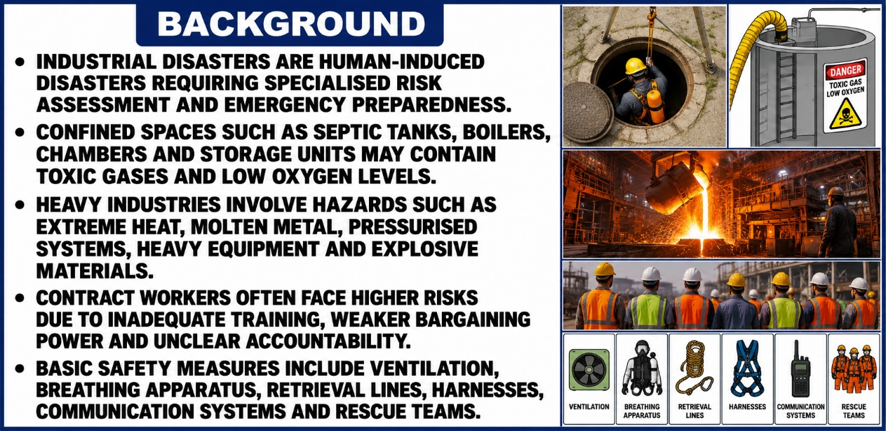
Industrial accidents in India are often treated as isolated mishaps, but many of them are foreseeable and preventable. Deaths in confined spaces, septic tanks and heavy industrial facilities reveal recurring failures in safety management. These incidents show that the real problem lies not merely in technical risk but in accumulated organisational weaknesses.
Explanation
Recurring Pattern of Confined-Space Deaths
- Many fatalities occur when workers enter hazardous spaces without protective equipment.
- Toxic gases can quickly render workers unconscious, and rescuers may also become victims if they enter without protection.
- Such deaths are rarely unforeseeable; they reflect failures of supervision, training and emergency preparedness.
Organisational Causes of Industrial Accidents
- Accidents often result from accumulated weaknesses such as reduced staffing, heavier workloads, ageing equipment and deferred maintenance.
- Financial stress and cost-cutting may weaken safety systems in industrial units.
- Dependence on contractual labour can create fragmented responsibility and reduce investment in worker safety.
Disaster Management Dimensions
- Prevention requires hazard identification, risk assessment, safety audits and strict prohibition of unsafe entry.
- Mitigation requires gas detectors, ventilation systems, fire-control systems, pressure-relief mechanisms and protective engineering.
- Preparedness requires mock drills, on-site and off-site emergency plans, trained rescue personnel and clear communication protocols.
- Response requires rapid rescue, medical evacuation, containment of hazards and coordination among industry, district administration, fire services and health agencies.
- Recovery requires compensation, rehabilitation, accountability, root-cause analysis and correction of safety failures.
Occupational Safety Code Perspective
- The Occupational Safety, Health and Working Conditions Code, 2020 seeks to ensure safe and healthy working conditions.
- Employers are expected to provide safety training, protective equipment, risk information and emergency arrangements.
- Hazardous industries must adopt stricter standards for health surveillance, safety committees, welfare facilities and emergency planning.
Related Information
- NDMA’s push for “Resilient India 2047” stresses hazard-specific response frameworks and Ministry-level disaster management plans.
- Sections 35 and 37 of the Disaster Management Act, 2005 require government action and Ministry Disaster Management Plans.
- This reinforces the need to integrate disaster risk reduction into industrial policy, labour regulation and development planning.
Conclusion
Industrial accidents must be understood as preventable governance and management failures, not unavoidable mishaps. A resilient India requires industries to move from reactive compensation to proactive risk prevention. Strong enforcement, worker training, accountable employers and disaster-ready institutions are essential for occupational safety.
Source: (The Hindu)
La Excellence IAS Academy, the best IAS coaching in Hyderabad, known for delivering quality content and conceptual clarity for UPSC 2026 preparation.
FOLLOW US ON:
◉ YouTube : https://www.youtube.com/@CivilsPrepTeam
◉ Facebook: https://www.facebook.com/LaExcellenceIAS
◉ Instagram: https://www.instagram.com/laexcellenceiasacademy/
GET IN TOUCH:
Contact us at info@laex.in, https://laex.in/contact-us/
or Call us @ +91 9052 29 2929, +91 9052 99 2929, +91 9154 24 2140
OUR BRANCHES:
Head Office: H No: 1-10-225A, Beside AEVA Fertility Center, Ashok Nagar Extension, VV Giri Nagar, Ashok Nagar, Hyderabad, 500020
Madhapur: Flat no: 301, survey no 58-60, Guttala begumpet Madhapur metro pillar: 1524, Rangareddy Hyderabad, Telangana 500081
Bangalore: Plot No: 99, 2nd floor, 80 Feet Road, Beside Poorvika Mobiles, Chandra Layout, Attiguppe, Near Vijaya Nagara, Bengaluru, 560040