
Paper: GS – II, Subject: Governance, Topic: Social Institutions-Civil society activism and NGO’s, Issue: FCRA Amendment Bill, 2026: Balancing Security and Civil Society Freedom.
Context:
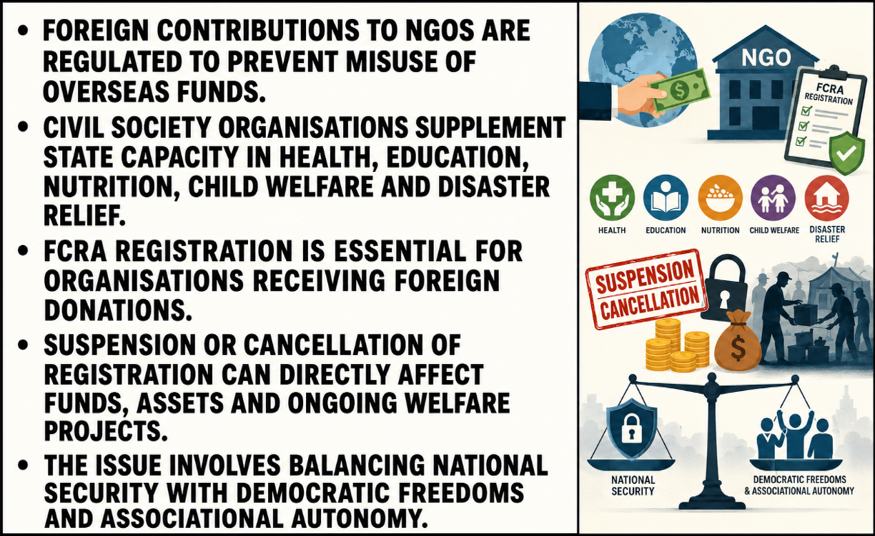
The Foreign Contribution (Regulation) Amendment (FCRA) Bill, 2026, introduced in March, seeks to further regulate foreign-funded civil society organisations. It aims to strengthen transparency, accountability and national security oversight. However, concerns arise that excessive executive control may affect civil society autonomy and constitutional freedoms.
Key Takeaways:
Explanation:
Stricter State Regulation:
- The framework seeks to monitor the source, use and purpose of foreign funds.
- It aims to prevent foreign influence in political, religious or public policy matters.
- Centralised approval and reporting requirements strengthen administrative oversight.
Concerns over Executive Discretion:
- Wide powers of suspension, cancellation and asset management may increase bureaucratic control.
- Automatic cancellation for procedural lapses can affect organisations even without proven misconduct.
- Absence of prior judicial scrutiny may raise concerns of arbitrariness.
Asset Control and Confiscation Concerns:
- If registration is cancelled or suspended, foreign-funded assets such as schools, hospitals, vehicles, buildings and equipment may come under state-designated control.
- Sale or transfer of such assets may permanently affect institutional continuity.
- This creates apprehension regarding property rights and organisational independence.
Impact on Welfare and Development:
- Many NGOs provide services in remote, tribal, minority and vulnerable regions.
- Disruption of foreign funding can affect healthcare, education, nutrition, child protection and livelihood programmes.
- Smaller organisations may suffer more due to weaker compliance capacity.
Civil Society and Constitutional Dimensions:
- Excessive control may create a chilling effect on advocacy, rights-based work and public participation.
- It may affect freedom of speech, association, religious management and property rights.
- Relevant constitutional values include Articles 19, 25, 26 and 300A.
Conclusion:
Foreign contribution regulation is necessary to protect sovereignty, transparency and national interest. However, regulatory powers must be proportionate, transparent and subject to independent oversight. A democratic state must ensure that accountability does not become a tool for weakening civil society, welfare institutions and constitutional freedoms.
Source: (The Hindu)
La Excellence IAS Academy, the best IAS coaching in Hyderabad, known for delivering quality content and conceptual clarity for UPSC 2026 preparation.
FOLLOW US ON:
◉ YouTube : https://www.youtube.com/@CivilsPrepTeam
◉ Facebook: https://www.facebook.com/LaExcellenceIAS
◉ Instagram: https://www.instagram.com/laexcellenceiasacademy/
GET IN TOUCH:
Contact us at info@laex.in, https://laex.in/contact-us/
or Call us @ +91 9052 29 2929, +91 9052 99 2929, +91 9154 24 2140
OUR BRANCHES:
Head Office: H No: 1-10-225A, Beside AEVA Fertility Center, Ashok Nagar Extension, VV Giri Nagar, Ashok Nagar, Hyderabad, 500020
Madhapur: Flat no: 301, survey no 58-60, Guttala begumpet Madhapur metro pillar: 1524, Rangareddy Hyderabad, Telangana 500081
Bangalore: Plot No: 99, 2nd floor, 80 Feet Road, Beside Poorvika Mobiles, Chandra Layout, Attiguppe, Near Vijaya Nagara, Bengaluru, 560040