
Paper: GS – II, Subject: Polity, Topic: Rights issues, Issue: Misuse of preventive detention powers by the state.
Context:
The Allahabad High Court, in Chander Pal Singh, highlighted systematic misuse of preventive detention powers in Uttar Pradesh. Around 2,500 people were detained in Ghaziabad between May 2025 and April 2026 without substantive criminal charges, prompting the court to critique the use of public order as a pretext to suppress individual liberty.
Key Takeaways:
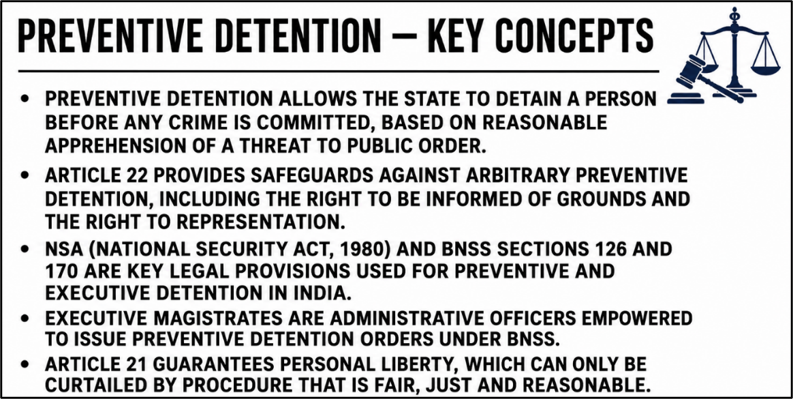
Explanation:
1. The Core Problem:
- Preventive detention powers are being used routinely, detaining people without substantive criminal charges.
- In Chander Pal Singh, a physically challenged Dalit advocate was arrested over a petty neighbour dispute with no credible threat to public order.
- This occurred despite a 2021 State policy designed to guide and limit such powers.
2. Specific Abuses Identified:
- Magistrates cited unspecified “communal tensions” to jail protesters without credible evidence.
- Authorities imposed unaffordable bonds for release, effectively imprisoning poor detainees even when legally entitled to bail.
- Preventive powers were misused in neighbourhood and property disputes where no genuine threat to public order existed.
3. Court Directions:
- Executive magistrates must justify decisions with specific, credible grounds.
- Compensation for unlawful detention can be recovered from the salary of the concerned magistrate or police officer after a disciplinary hearing.
- Appellate courts must actively scrutinise the compensation framework to ensure meaningful accountability.
4. Broader Significance:
- The ruling implicitly critiques detention of activists like Sonam Wangchuk under NSA, challenging the use of “peace” as pretext to silence dissent.
- It may apply to workers and activists detained under BNSS Sections 126 or 170 without valid grounds.
- The state must maintain peace with peaceful means, not by imprisoning those who question it.
5. Challenges in Implementation:
- The executive has historically been reluctant to penalise its own personnel, making salary-based recovery difficult.
- Executive magistrates’ careers depend on maintaining “peace” as the state defines it, creating institutional pressure against independent decision-making.
Conclusion:
Preventive detention powers exist to protect public order, not suppress dissent or resolve petty disputes. The ruling is a significant corrective, but genuine implementation requires administrative accountability and judicial vigilance. The state must internalise that peace cannot be maintained by sacrificing the very liberty it is meant to protect.
Source: (The Hindu)
La Excellence IAS Academy, the best IAS coaching in Hyderabad, known for delivering quality content and conceptual clarity for UPSC 2026 preparation.
FOLLOW US ON:
◉ YouTube : https://www.youtube.com/@CivilsPrepTeam
◉ Facebook: https://www.facebook.com/LaExcellenceIAS
◉ Instagram: https://www.instagram.com/laexcellenceiasacademy/
GET IN TOUCH:
Contact us at info@laex.in, https://laex.in/contact-us/
or Call us @ +91 9052 29 2929, +91 9052 99 2929, +91 9154 24 2140
OUR BRANCHES:
Head Office: H No: 1-10-225A, Beside AEVA Fertility Center, Ashok Nagar Extension, VV Giri Nagar, Ashok Nagar, Hyderabad, 500020
Madhapur: Flat no: 301, survey no 58-60, Guttala begumpet Madhapur metro pillar: 1524, Rangareddy Hyderabad, Telangana 500081
Bangalore: Plot No: 99, 2nd floor, 80 Feet Road, Beside Poorvika Mobiles, Chandra Layout, Attiguppe, Near Vijaya Nagara, Bengaluru, 560040