
Paper: GS – II, Subject: International Relations, Topic: Regional and Global Groupings, Issue: India’s role at the G7 Summit.
Context:
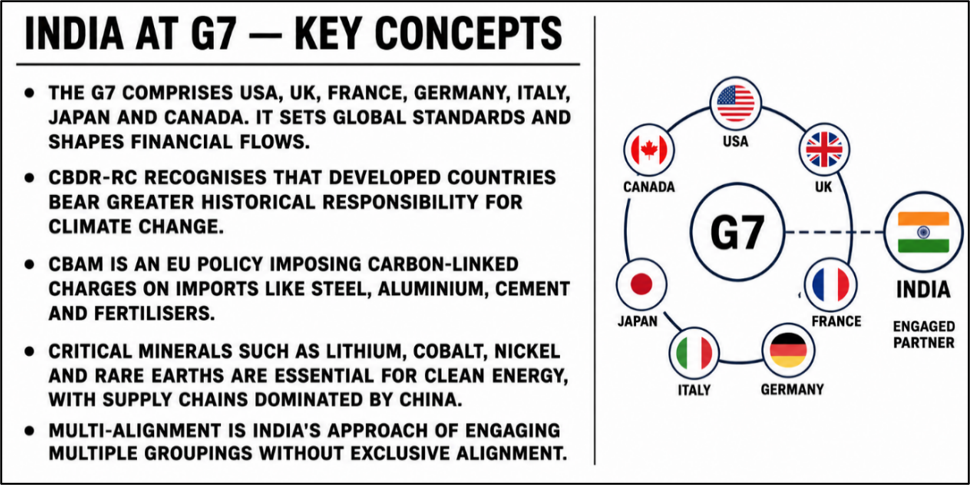
Prime Minister attended the G7 Summit at Evian-les-Bains, France, engaging on economic security, AI, energy transition, climate finance and development. India participates as an invited partner, using the platform to represent shared concerns of emerging economies. In a world where G7 discussions harden into global norms, early engagement is a strategic imperative.
Key Takeaways:
Explanation:
1. Critical Minerals and Supply Chain Security:
- India and G7 share interest in securing critical mineral supplies and reducing supply-chain dependence on China.
- India’s market size and processing capacity make it a key node in emerging global mineral partnerships.
2. Artificial Intelligence and Digital Governance:
- AI raises questions of governance, safety, standards and energy demand through data centre proliferation.
- India’s experience with DPI (Digital Public Infrastructure) gives it credibility in shaping global AI governance frameworks.
3. Energy Security:
- India embodies the dual reality of expanding renewable deployment while remaining guided by affordability and energy security.
- India can credibly represent the developing world’s position on the pace and financing of the clean energy transition.
4. Climate Finance and Development:
- Developed countries agreed at Baku (2024) to mobilise at least $300 billion annually by 2035, but this falls short of needs and arrives largely as loans rather than grants.
- India must emphasise CBDR-RC (Common but Differentiated Responsibilities and Respective Capabilities) and advocate for reform of multilateral development banks (MDBs).
5. CBAM and Trade Concerns:
- CBAM (Carbon Border Adjustment Mechanism) disproportionately impacts developing-country producers including India, whose industries remain coal-dependent due to lack of adequate finance and technology.
- Critics argue CBAM functions as a trade barrier protecting European industries rather than a genuine climate instrument.
6. Economic Security:
- Advanced economies increasingly use sanctions, coercive tools and forced trade measures that contradict free-trade principles they profess.
- India’s interest lies in resilience that broadens options rather than fragmentation that narrows them.
7. India’s Strategic Position:
- India’s G7 participation, months before hosting the BRICS Summit, reflects multi-alignment rather than exclusive bloc alignment.
- India must engage early to influence standards on technology, supply chains and minerals before they harden into global norms.
Conclusion:
The G7 Summit offers India a strategic platform to shape emerging global norms on AI, climate finance, trade and critical minerals. India’s multi-alignment approach and development credentials uniquely position it to bridge the G7 and the Global South. In a world where today’s discussions become tomorrow’s rules, shaping those rules is a national interest imperative.
Source: (The Indian Express)
La Excellence IAS Academy, the best IAS coaching in Hyderabad, known for delivering quality content and conceptual clarity for UPSC 2026 preparation.
FOLLOW US ON:
◉ YouTube : https://www.youtube.com/@CivilsPrepTeam
◉ Facebook: https://www.facebook.com/LaExcellenceIAS
◉ Instagram: https://www.instagram.com/laexcellenceiasacademy/
GET IN TOUCH:
Contact us at info@laex.in, https://laex.in/contact-us/
or Call us @ +91 9052 29 2929, +91 9052 99 2929, +91 9154 24 2140
OUR BRANCHES:
Head Office: H No: 1-10-225A, Beside AEVA Fertility Center, Ashok Nagar Extension, VV Giri Nagar, Ashok Nagar, Hyderabad, 500020
Madhapur: Flat no: 301, survey no 58-60, Guttala begumpet Madhapur metro pillar: 1524, Rangareddy Hyderabad, Telangana 500081
Bangalore: Plot No: 99, 2nd floor, 80 Feet Road, Beside Poorvika Mobiles, Chandra Layout, Attiguppe, Near Vijaya Nagara, Bengaluru, 560040
India at G7 and the Voice of Developing Nations