
Paper: GS – I/II, Subject: Society and Social Justice, Topic: Social sector – Health, Issue: NFHS-6 Findings: Progress and Persistent Nutrition Challenges.
Context:
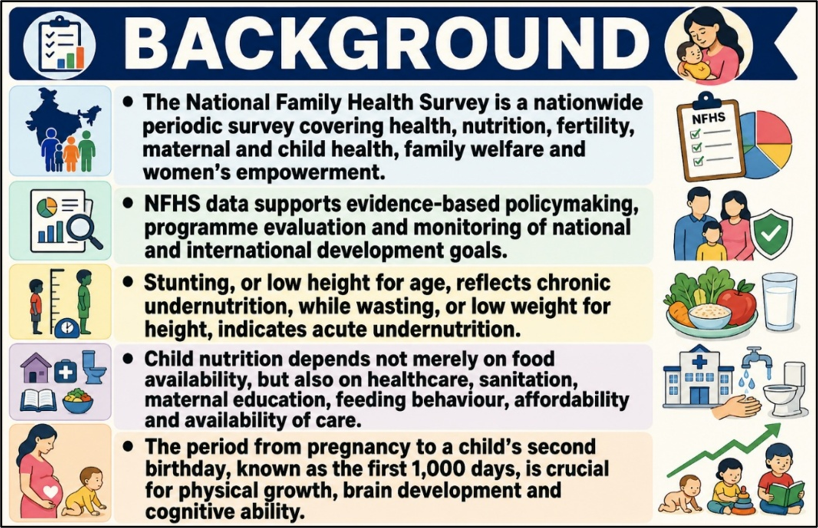
The National Family Health Survey-6 presents a mixed assessment of India’s health and nutrition outcomes. Significant progress has been achieved in institutional deliveries, maternal healthcare, immunisation and reduction of child stunting. However, wasting, inadequate feeding practices, poor dietary quality and unequal caregiving responsibilities continue to impede child development.
Key Takeaways:
Explanation:
Progress in Maternal and Child Health:
- Child stunting declined from 35.5% in NFHS-5 to 29.3% in NFHS-6, indicating improvement in long-term nutrition, healthcare access, maternal awareness, sanitation and immunisation.
- Nearly 90% of births occur in health institutions, with public facilities accounting for approximately 58% of deliveries, thereby reducing maternal and infant health risks.
- Around 95% of mothers receive antenatal care, while nearly 91% of deliveries are attended by skilled health personnel.
- Approximately 87% of children aged 12–23 months are fully immunised, reflecting the contribution of ASHAs, Anganwadi Workers and Auxiliary Nurse Midwives, although regional inequalities persist.
Persistent Nutrition Deficiencies:
- Only about half of newborns are breastfed within the first hour, despite early breastfeeding strengthening immunity and improving survival.
- Around 60% of children aged six to eight months receive solid or semi-solid food, but only 15% of children aged six to 23 months receive an adequate diet.
- Delayed or inadequate complementary feeding can cause growth faltering, while wasting continues to show limited improvement and raises child mortality risks.
Maternal Time Poverty:
- Women frequently combine paid employment, agriculture, livestock care, household work and childcare, leaving limited time for breastfeeding, timely feeding and growth monitoring.
- Nearly 30% of women report working outside the home, although informal and unpaid work remains underestimated.
- Inadequate crèche facilities often compel rural working mothers to leave young children with older relatives or siblings, making nutrition a question of both food and care availability.
Dietary Transition and Processed Foods:
- Household expenditure is shifting from cereals towards processed foods, packaged snacks and sugar-rich beverages.
- Such products are convenient, widely available and sometimes cheaper, but may be deficient in protein, micronutrients and dietary diversity.
- Affordable access to pulses, millets, fruits, vegetables, eggs and milk remains essential for nutritional adequacy.
Required Policy Response:
- Policy must prioritise early identification of growth faltering, breastfeeding, timely complementary feeding and preventive nutrition during the first 1,000 days.
- Frontline workers require better training, digital tools, local data analysis and culturally appropriate counselling material.
- Gram Sabhas and Panchayats should regularly review nutrition, drinking water, sanitation and Anganwadi infrastructure.
- Crèches, community childcare, male participation and shared household responsibilities are necessary to reduce women’s unpaid care burden.
Conclusion:
India’s nutrition challenge extends beyond food supply to dietary quality, feeding practices, maternal time and social infrastructure. Sustainable progress requires coordinated action across healthcare, childcare, sanitation, gender equality and local governance. Preventive and family-supportive interventions must therefore become central to nutrition policy.
Source: (The Indian Express, The Hindu, Live Mint)
La Excellence IAS Academy, the best IAS coaching in Hyderabad, known for delivering quality content and conceptual clarity for UPSC 2026 preparation.
FOLLOW US ON:
◉ YouTube : https://www.youtube.com/@CivilsPrepTeam
◉ Facebook: https://www.facebook.com/LaExcellenceIAS
◉ Instagram: https://www.instagram.com/laexcellenceiasacademy/
GET IN TOUCH:
Contact us at info@laex.in, https://laex.in/contact-us/
or Call us @ +91 9052 29 2929, +91 9052 99 2929, +91 9154 24 2140
OUR BRANCHES:
Head Office: H No: 1-10-225A, Beside AEVA Fertility Center, Ashok Nagar Extension, VV Giri Nagar, Ashok Nagar, Hyderabad, 500020
Madhapur: Flat no: 301, survey no 58-60, Guttala begumpet Madhapur metro pillar: 1524, Rangareddy Hyderabad, Telangana 500081
Bangalore: Plot No: 99, 2nd floor, 80 Feet Road, Beside Poorvika Mobiles, Chandra Layout, Attiguppe, Near Vijaya Nagara, Bengaluru, 560040