
Paper: GS – I, Subject: Society and Social Justice, Topic: Population and associated issues, Issue: Andhra Fertility Policy: A Misplaced Solution.
Context:
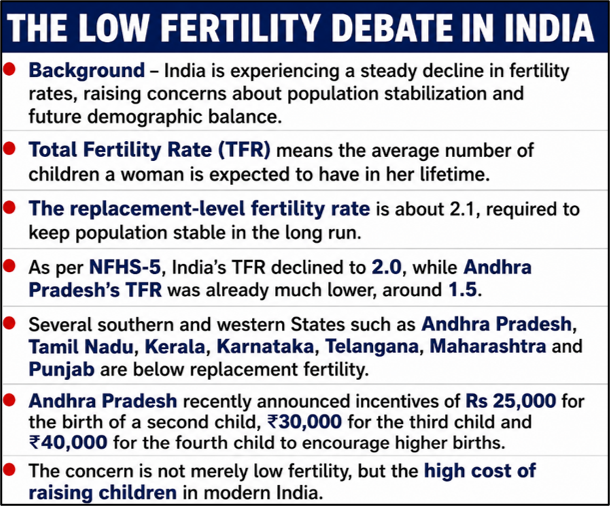
India is entering a new demographic phase where many States are facing fertility rates below the replacement level. Andhra Pradesh has responded by announcing cash incentives for third and fourth children, but the deeper issue is whether financial rewards can overcome the real economic and social barriers to larger families.
Key Takeaways:
Explanation:
Why fertility is falling:
- Fertility decline is not only due to “lack of desire” for children, it is mainly linked to economic insecurity and social change.
- Couples today face high costs of schooling, private healthcare, rent, nutrition, transport and childcare.
- Urbanisation, migration, nuclear families and women’s education have also changed family preferences.
- Women often bear the major burden of pregnancy, childcare, domestic work and career sacrifice, making larger families difficult.
Economic Barriers Are Stronger than Cash Incentives:
- Families today do not decide family size only on the basis of tradition or social pressure.
- Decisions are shaped by income, job security, housing cost, education cost, healthcare cost and childcare availability.
- A one-time cash incentive is too small when compared to the long-term cost of raising a child for 18–20 years.
Childbirth and Healthcare Costs Are High:
- Institutional deliveries increasingly occur in private hospitals, especially in urban areas.
- C-section deliveries are also high in private facilities, increasing the cost of childbirth.
- Therefore, the incentive may not even cover a significant part of delivery-related expenditure.
Household Consumption Burden Is Rising:
- Raising children requires continuous spending on food, education, healthcare, clothing, housing space and transport.
- In both rural and urban areas, the monthly expenditure required for a larger family is far higher than the proposed incentive.
Fertility Decline Is Linked to Social Change:
- Fertility falls when women become more educated, urbanisation rises, child survival improves and aspirations increase.
- Couples increasingly prefer fewer children so that they can invest better in each child’s health and education.
Global Experience Shows Limited Success:
- Countries such as Japan and South Korea have tried financial incentives, but fertility rates have remained very low.
- This shows that once fertility decline becomes linked to lifestyle, work culture, housing and gender roles, cash transfers alone are insufficient.
Better Policy Direction:
- Andhra Pradesh needs affordable childcare, maternity support, flexible work, women’s employment security, affordable housing and public healthcare.
- Pronatalist policy must reduce the real cost of parenting rather than only rewarding childbirth.
Conclusion:
Andhra Pradesh’s concern over declining fertility is valid, but a narrow cash incentive is unlikely to change family-size decisions. A sustainable fertility policy must support young families through affordable living, gender-sensitive workplaces, childcare infrastructure and stronger public services.
Source: (The Hindu)
La Excellence IAS Academy, the best IAS coaching in Hyderabad, known for delivering quality content and conceptual clarity for UPSC 2026 preparation.
FOLLOW US ON:
◉ YouTube : https://www.youtube.com/@CivilsPrepTeam
◉ Facebook: https://www.facebook.com/LaExcellenceIAS
◉ Instagram: https://www.instagram.com/laexcellenceiasacademy/
GET IN TOUCH:
Contact us at info@laex.in, https://laex.in/contact-us/
or Call us @ +91 9052 29 2929, +91 9052 99 2929, +91 9154 24 2140
OUR BRANCHES:
Head Office: H No: 1-10-225A, Beside AEVA Fertility Center, Ashok Nagar Extension, VV Giri Nagar, Ashok Nagar, Hyderabad, 500020
Madhapur: Flat no: 301, survey no 58-60, Guttala begumpet Madhapur metro pillar: 1524, Rangareddy Hyderabad, Telangana 500081
Bangalore: Plot No: 99, 2nd floor, 80 Feet Road, Beside Poorvika Mobiles, Chandra Layout, Attiguppe, Near Vijaya Nagara, Bengaluru, 560040