
Paper: GS – II, Subject: Society and Social Justice, Topic: Social Sector – Health, Issue: Water-Borne Diseases and Sewerage Infrastructure in Kerala.
Context:
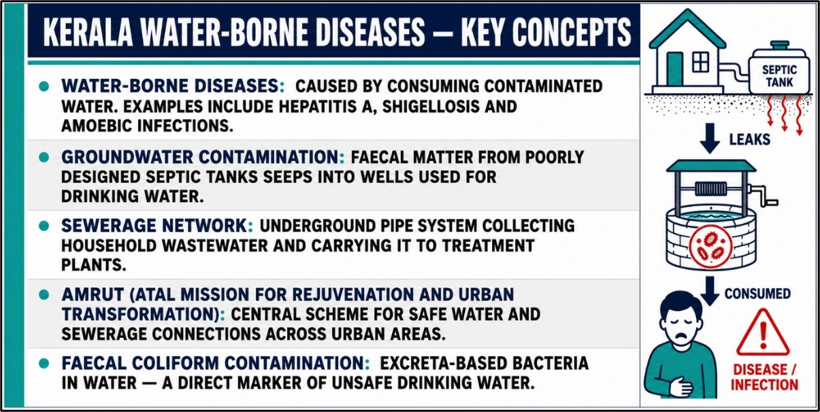
Recently, Kerala has reported repeated outbreaks of acute diarrhoeal diseases, Hepatitis A, shigellosis, norovirus and amoebic meningoencephalitis. This is worrying because Kerala is known for strong public-health services and effective control of diseases such as Nipah. The outbreaks show serious gaps in safe water, sewerage and sanitation systems.
Key Takeaways:
Explanation:
Scale of the Problem:
- Kerala reports around four to five lakh cases of acute diarrhoeal diseases every year.
- The State has faced repeated outbreaks of Hepatitis A, shigellosis and norovirus.
- Amoebic meningoencephalitis, a rare and dangerous brain infection, has also been linked to contaminated wells.
- These outbreaks mainly result from faecal matter entering drinking-water sources.
Root Causes of the Crisis:
- Kerala has less than 6% sewerage coverage; progress under the Atal Mission for Rejuvenation and Urban Transformation (AMRUT) for urban water and sewerage has remained poor.
- Septic tanks are badly designed, poorly maintained and located close to wells, causing direct faecal and coliform contamination of groundwater.
- Rural outbreaks are linked to local drinking water sources supplied without adequate filtration or chlorination.
- Water pipelines often run near sewage drains, allowing contamination through cracks and leaks; wells are also not cleaned or chlorinated regularly.
- Kerala has invested more in hospitals and disease treatment than in sewerage and environmental health infrastructure.
- Responsibility is divided among health departments, local bodies, water authorities and planning agencies, creating coordination gaps.
- The crisis is not a health-sector failure alone but a result of weak urban planning and long-term under-investment in sanitation.
Way Forward:
- Kerala must expand sewerage networks and wastewater-treatment plants.
- Septic-tank standards, well testing, filtration and chlorination should be strictly enforced.
- Health agencies, municipalities and water authorities must work together.
Conclusion:
Kerala’s experience shows that good hospitals alone cannot ensure good public health. Clean water, safe sewerage and regular monitoring are equally essential. Environmental health must become a central development priority.
Source: (The Hindu)
La Excellence IAS Academy, the best IAS coaching in Hyderabad, known for delivering quality content and conceptual clarity for UPSC 2026 preparation.
FOLLOW US ON:
◉ YouTube : https://www.youtube.com/@CivilsPrepTeam
◉ Facebook: https://www.facebook.com/LaExcellenceIAS
◉ Instagram: https://www.instagram.com/laexcellenceiasacademy/
GET IN TOUCH:
Contact us at info@laex.in, https://laex.in/contact-us/
or Call us @ +91 9052 29 2929, +91 9052 99 2929, +91 9154 24 2140
OUR BRANCHES:
Head Office: H No: 1-10-225A, Beside AEVA Fertility Center, Ashok Nagar Extension, VV Giri Nagar, Ashok Nagar, Hyderabad, 500020
Madhapur: Flat no: 301, survey no 58-60, Guttala begumpet Madhapur metro pillar: 1524, Rangareddy Hyderabad, Telangana 500081
Bangalore: Plot No: 99, 2nd floor, 80 Feet Road, Beside Poorvika Mobiles, Chandra Layout, Attiguppe, Near Vijaya Nagara, Bengaluru, 560040