
Paper: GS – III, Subject: Environment, Ecology and Disaster Management, Topic: Green Revolution and Sustainable Agriculture, Issue: Biochar for Soil Health and Climate Resilience.
Context:
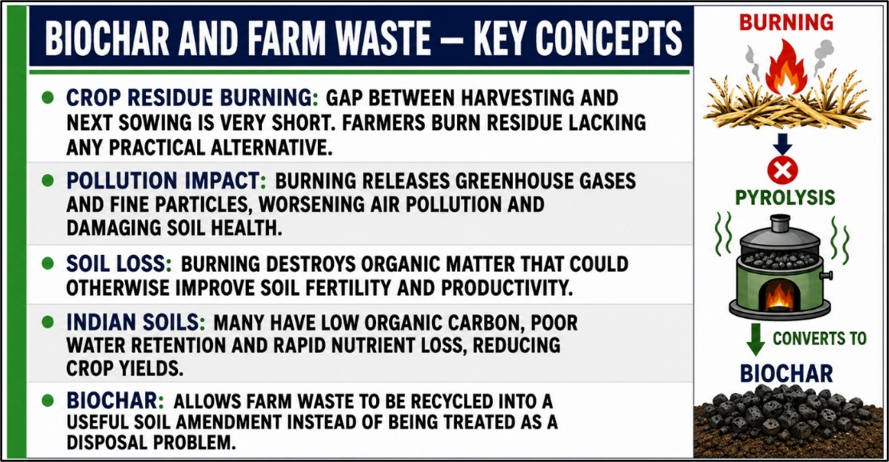
Recently, biochar has gained attention as a solution to crop-residue burning and declining soil health. Punjab and Haryana burn over 20 million tonnes of paddy straw annually, causing air pollution and loss of useful organic matter. Converting this waste into biochar can improve soil and create income for farmers.
Key Takeaways:
Explanation:
What is Biochar?
- Biochar is a carbon-rich material made by heating agricultural waste in limited oxygen through pyrolysis.
- It decomposes slowly and stores carbon in soil for a long period.
- Its porous structure helps retain water, nutrients and useful microorganisms.
Benefits and Opportunities:
- Biochar improves soil fertility, structure and nutrient-use efficiency; studies suggest crop productivity rises by 10–30% and water-holding capacity by 10–25%.
- Trials in Maharashtra and Kerala using maize and coconut waste confirmed improved soil quality and drought resilience.
- It prevents emissions from residue burning and locks carbon in soil, while reducing dependence on costly fertilisers.
- Certified biochar projects can earn carbon credits – one tonne generates approximately 2 to 2.8 tonnes of CO2-equivalent credits – creating income for farmers and rural enterprises.
- Biochar can also be made from rice husk, sugarcane bagasse, sewage sludge and biodegradable municipal waste, supporting the circular economy.
- Experiences from Kenya, Thailand and Brazil show that scaling biochar requires suitable pyrolysis technology, certification systems and robust monitoring.
Challenges and Way Forward:
- Biochar remains limited mainly to research trials and is unfamiliar to many farmers.
- It should be linked with natural farming, soil-health and carbon-farming programmes.
- Farmers need affordable kilns, training, finance, market access and cooperative support.
Conclusion:
Biochar can turn farm and organic waste into a valuable soil resource. It can reduce pollution, improve crop resilience and create new income opportunities. India needs an integrated policy to turn waste biomass into genuine “black gold”.
Source: (The The Hindu)
La Excellence IAS Academy, the best IAS coaching in Hyderabad, known for delivering quality content and conceptual clarity for UPSC 2026 preparation.
FOLLOW US ON:
◉ YouTube : https://www.youtube.com/@CivilsPrepTeam
◉ Facebook: https://www.facebook.com/LaExcellenceIAS
◉ Instagram: https://www.instagram.com/laexcellenceiasacademy/
GET IN TOUCH:
Contact us at info@laex.in, https://laex.in/contact-us/
or Call us @ +91 9052 29 2929, +91 9052 99 2929, +91 9154 24 2140
OUR BRANCHES:
Head Office: H No: 1-10-225A, Beside AEVA Fertility Center, Ashok Nagar Extension, VV Giri Nagar, Ashok Nagar, Hyderabad, 500020
Madhapur: Flat no: 301, survey no 58-60, Guttala begumpet Madhapur metro pillar: 1524, Rangareddy Hyderabad, Telangana 500081
Bangalore: Plot No: 99, 2nd floor, 80 Feet Road, Beside Poorvika Mobiles, Chandra Layout, Attiguppe, Near Vijaya Nagara, Bengaluru, 560040