
Paper: GS – II, Subject: Polity, Topic: Rights issues, Issue: Pedestrian Rights as a Fundamental Right.
Context:
Recently, the Supreme Court declared that walking on properly marked and maintained footpaths is a fundamental right. The ruling came in a case involving a five-year-old boy who was killed by a truck while walking to school in Karnataka. The Court held that pedestrian safety must receive priority over the convenience of motor vehicles.
Key Takeaways:
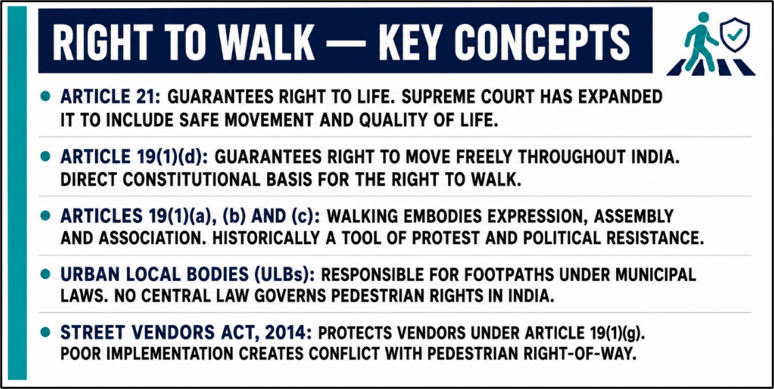
Explanation:
What the Supreme Court Held:
- Wherever a road is built, authorities must provide and maintain a clearly marked footpath.
- This is an enforceable public duty and not an optional municipal service.
- The right of pedestrians to use footpaths must override the convenience of motor vehicles.
- The Court described walking as a basic human activity closely connected with life and liberty.
Problems Faced by Pedestrians:
- Many Indian cities do not have continuous and safe footpaths.
- Existing pavements are often blocked by parked vehicles, vendors, utility poles, construction material and waste.
- Road widening generally gives more space to vehicles while reducing space for walkers.
- Children, elderly persons, persons with disabilities and low-income workers face greater danger.
Why Law Alone Is Not Enough:
- A legal right has little meaning if governments do not build and maintain footpaths.
- The Street Vendors Act, 2014 shows that laws may fail when surveys, vending zones and town vending committees are not properly created.
- Public smoking declined through regular awareness campaigns and immediate fines, not only through legal restrictions.
- Similarly, pedestrian safety needs public awareness and a culture that respects walkers.
Need for Balanced Implementation:
- The judgment should not be used only to remove vendors and poor workers from public spaces.
- Sudden eviction may destroy livelihoods and make streets accessible only to richer groups.
- Cities should create regulated vending areas while keeping enough space for pedestrians.
- Governments must fund continuous pavements, crossings, lighting, ramps and accessible street design.
Conclusion:
The judgment gives constitutional recognition to safe walking. However, compensation after accidents cannot replace prevention. The right will become meaningful only when governments build inclusive and well-maintained footpaths.
Source: (The Hindu)
La Excellence IAS Academy, the best IAS coaching in Hyderabad, known for delivering quality content and conceptual clarity for UPSC 2026 preparation.
FOLLOW US ON:
◉ YouTube : https://www.youtube.com/@CivilsPrepTeam
◉ Facebook: https://www.facebook.com/LaExcellenceIAS
◉ Instagram: https://www.instagram.com/laexcellenceiasacademy/
GET IN TOUCH:
Contact us at info@laex.in, https://laex.in/contact-us/
or Call us @ +91 9052 29 2929, +91 9052 99 2929, +91 9154 24 2140
OUR BRANCHES:
Head Office: H No: 1-10-225A, Beside AEVA Fertility Center, Ashok Nagar Extension, VV Giri Nagar, Ashok Nagar, Hyderabad, 500020
Madhapur: Flat no: 301, survey no 58-60, Guttala begumpet Madhapur metro pillar: 1524, Rangareddy Hyderabad, Telangana 500081
Bangalore: Plot No: 99, 2nd floor, 80 Feet Road, Beside Poorvika Mobiles, Chandra Layout, Attiguppe, Near Vijaya Nagara, Bengaluru, 560040