
Paper: GS – III, Subject: Science and Technology, Topic: Achievements of India in the field of Science and Technology, Issue: From Invention and Start-Ups to Globally Competitive Technology Scale-Ups.
Context:
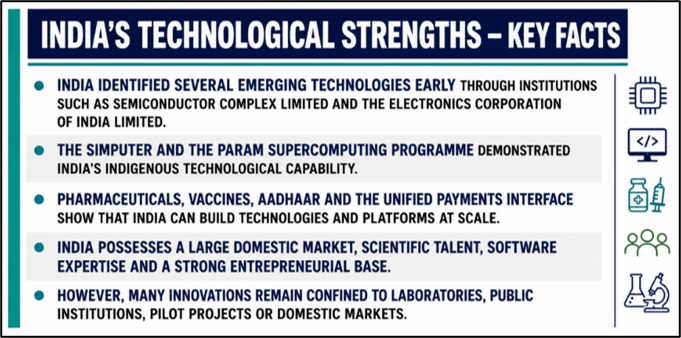
India has established considerable capabilities in semiconductors, electronics, pharmaceuticals, digital public infrastructure, space technology and software. It has also emerged as one of the world’s largest start-up ecosystems. Nevertheless, relatively few Indian inventions or companies have developed into globally dominant technological and commercial enterprises.
Key Takeaways:
Explanation:
The Core Problem:
- India’s weakness is not the absence of ideas or entrepreneurs, but the inability to convert innovation into mass production, commercial success and global expansion.
- Technological leadership requires an entire ecosystem of finance, suppliers, manufacturing, skilled workers, product design, marketing and distribution.
Lessons from Earlier Initiatives:
- Semiconductor Complex Limited entered semiconductor manufacturing early, but India failed to create the supplier networks and industrial ecosystem later developed by Taiwan and South Korea.
- The Electronics Corporation of India Limited built indigenous computers and strategic electronics, but remained focused mainly on government requirements rather than global commercial markets.
- The Simputer anticipated several features of modern smart devices, but lacked sufficient capital, software applications, components, branding and consumer reach.
From Start-Ups to Scale-Ups:
- Start-ups promote experimentation, but only scale-ups can expand production, revenues, research and international presence.
- A scale-up requires patient capital, affordable finance, professional management, manufacturing capacity and access to overseas markets.
- India must therefore move beyond celebrating the number of start-ups and focus on creating globally competitive companies.
Why Corporate Scale Matters?
- Large, well-managed firms can invest in research and development, attract specialised talent, absorb failures, create patents and establish global supply chains.
- They also generate high-productivity employment, exports, technological spillovers and internationally recognised brands.
Structural Barriers:
- Indian firms face low research spending, expensive capital, fragmented regulations, weak university-industry collaboration and inadequate intellectual-property protection.
- Many companies remain dependent on domestic demand, imported components and traditional sectors rather than frontier technologies.
Future Opportunities and Way Forward:
- Artificial intelligence, quantum computing, semiconductors and space technology offer India another opportunity for global leadership.
- India can specialise in affordable, energy-efficient and multilingual artificial-intelligence systems, practical quantum applications and commercial space services.
- Public procurement, scale-up finance, export support, regulatory certainty and stronger research-industry linkages must form a single policy framework.
- Success should be measured through global brands, high-value exports, technological ownership and firms capable of influencing international standards.
Conclusion:
India has proved that it can invent and innovate. Its next challenge is to convert isolated achievements and domestic success into globally competitive enterprises and industrial ecosystems. Technological leadership ultimately belongs to countries that can commercialise, manufacture and scale effectively.
Source: (The Indian Express, The Hindu, Live Mint)
La Excellence IAS Academy, the best IAS coaching in Hyderabad, known for delivering quality content and conceptual clarity for UPSC 2026 preparation.
FOLLOW US ON:
◉ YouTube : https://www.youtube.com/@CivilsPrepTeam
◉ Facebook: https://www.facebook.com/LaExcellenceIAS
◉ Instagram: https://www.instagram.com/laexcellenceiasacademy/
GET IN TOUCH:
Contact us at info@laex.in, https://laex.in/contact-us/
or Call us @ +91 9052 29 2929, +91 9052 99 2929, +91 9154 24 2140
OUR BRANCHES:
Head Office: H No: 1-10-225A, Beside AEVA Fertility Center, Ashok Nagar Extension, VV Giri Nagar, Ashok Nagar, Hyderabad, 500020
Madhapur: Flat no: 301, survey no 58-60, Guttala begumpet Madhapur metro pillar: 1524, Rangareddy Hyderabad, Telangana 500081
Bangalore: Plot No: 99, 2nd floor, 80 Feet Road, Beside Poorvika Mobiles, Chandra Layout, Attiguppe, Near Vijaya Nagara, Bengaluru, 560040