
Paper: GS – II, Subject: Polity, Topic: Legislature, Issue: Reimagining India’s Anti-Defection Framework.
Context:
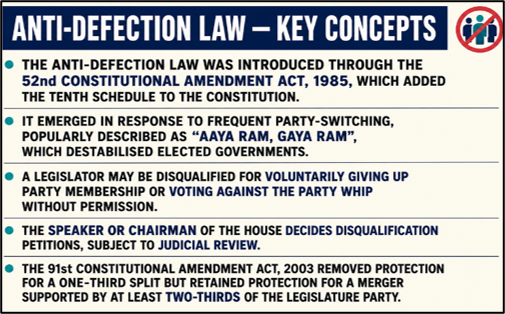
India’s anti-defection law was introduced to prevent political instability caused by legislators changing parties for personal or political benefits. However, repeated defections, delayed decisions and large-scale political mergers have weakened its effectiveness. The central issue is whether the law should be retained, reformed or replaced by a system based on greater legislative freedom and political accountability.
Key Takeaways:
Explanation:
Objectives and Working of the Law:
- The law seeks to maintain government stability, prevent horse-trading, preserve party discipline and protect the electoral mandate received by political parties.
- It assumes that legislators elected on a party ticket must ordinarily remain loyal to that party throughout the term of the House.
Impact on Representative Democracy:
- Frequent use of the party whip restricts legislators from exercising independent judgment on ordinary legislative matters.
- Representatives may be unable to defend constituency interests or disagree with their party even when genuine policy differences exist.
- The law has strengthened the authority of the party high command and weakened internal party democracy, debate and dissent.
- Legislators may consequently become more accountable to party leaders than to voters or constitutional principles.
Loopholes and Political Manipulation:
- The law has not eliminated defections; political actors have adapted through collective resignations, mergers and large-scale shifts of allegiance.
- Individual defections are punished, while a group comprising two-thirds of the legislature party may avoid disqualification through the merger provision.
- This creates the paradox of penalising small defections while indirectly permitting organised mass defections.
- Defections supported by ruling parties may be followed by re-election, ministerial positions or entry into another political organisation.
Institutional and Judicial Concerns:
- Since the Speaker usually belongs to a political party, questions may arise regarding impartiality in deciding disqualification petitions.
- Delayed decisions may allow defecting legislators to influence confidence motions, government formation and the remaining tenure of the House.
- In Kihoto Hollohan v. Zachillhu, the Supreme Court upheld the Tenth Schedule but made the Speaker’s decision subject to judicial review.
- Courts may intervene where decisions involve illegality, mala fide action or violation of constitutional principles.
Reform and Alternative Approaches:
- The party whip may be restricted to confidence motions, no-confidence motions and essential financial business.
- Disqualification petitions may be decided by an independent constitutional authority within a fixed time limit.
- Legislators may be permitted to vote openly according to their judgment and remain answerable to voters in subsequent elections.
- However, complete abolition without safeguards may revive opportunistic defections, inducements and frequent governmental instability.
Conclusion:
The anti-defection law has promoted stability but has also weakened legislative independence and internal party democracy. Reform must distinguish principled dissent from opportunistic political switching. A balanced framework should protect elected governments while preserving the representative role of legislators.
Source: (The Hindu)
La Excellence IAS Academy, the best IAS coaching in Hyderabad, known for delivering quality content and conceptual clarity for UPSC 2026 preparation.
FOLLOW US ON:
◉ YouTube : https://www.youtube.com/@CivilsPrepTeam
◉ Facebook: https://www.facebook.com/LaExcellenceIAS
◉ Instagram: https://www.instagram.com/laexcellenceiasacademy/
GET IN TOUCH:
Contact us at info@laex.in, https://laex.in/contact-us/
or Call us @ +91 9052 29 2929, +91 9052 99 2929, +91 9154 24 2140
OUR BRANCHES:
Head Office: H No: 1-10-225A, Beside AEVA Fertility Center, Ashok Nagar Extension, VV Giri Nagar, Ashok Nagar, Hyderabad, 500020
Madhapur: Flat no: 301, survey no 58-60, Guttala begumpet Madhapur metro pillar: 1524, Rangareddy Hyderabad, Telangana 500081
Bangalore: Plot No: 99, 2nd floor, 80 Feet Road, Beside Poorvika Mobiles, Chandra Layout, Attiguppe, Near Vijaya Nagara, Bengaluru, 560040