
Paper: GS – II, Subject: Polity, Topic: Governance, Issue: Reforming India’s Ultrasound Laws.
Context:
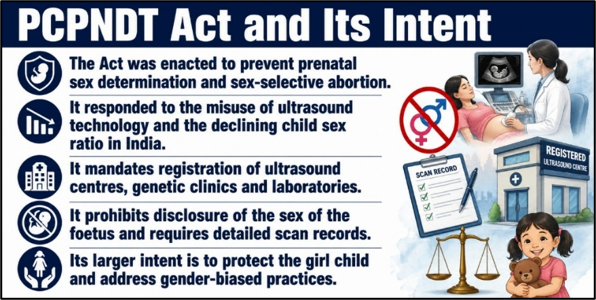
The new portable and AI-enabled ultrasound devices technology has created new possibilities for community-based cancer screening. However, the PCPNDT Act, 1994 restricts the movement and use of ultrasound machines outside registered centres, raising the need for careful reform.
Key Takeaways:
Problems with Old Provisions:
- The law was framed when ultrasound technology was largely centre-based and less advanced.
- It does not clearly distinguish between obstetric ultrasound (pregnancy-related ultrasound) and non-obstetric diagnostic uses.
- Moving machines outside registered centres can attract strict legal action.
- But now this is discouraging genuine medical outreach in rural and remote areas.
- Illegal sex-determination networks continue, showing that law alone cannot remove son preference.
- Excessive restrictions may unintentionally reduce access to useful diagnostic care.
Possible Benefits of Relaxation:
- Portable ultrasound enables community screening in large numbers, which can help screen breast lumps and support early cancer detection.
- Rural patients can avoid long travel, high costs and delayed diagnosis.
- As it is AI-enabled, these AI tools can assist trained health workers in image capture, identifying suspicious lumps and making referral decisions.
- High-frequency linear probes are useful for superficial body parts such as breast tissue and are not suitable for foetal sex determination.
Recommendations:
- Permit approved community use of ultrasound for non-obstetric purposes like cancer screening.
- Clearly separate cancer screening devices from obstetric ultrasound machines.
- Continue registration, authorised operators, digital tracking and audit trails.
- Build safeguards to prevent foetal sex determination.
- Retain strict penalties for misuse while enabling genuine healthcare access.
Conclusion:
The PCPNDT Act remains essential for preventing sex selection. But technology and healthcare needs have changed. A balanced reform can protect the girl child while expanding early diagnosis and rural healthcare access.
Source: (The Hindu)
La Excellence IAS Academy, the best IAS coaching in Hyderabad, known for delivering quality content and conceptual clarity for UPSC 2026 preparation.
FOLLOW US ON:
◉ YouTube : https://www.youtube.com/@CivilsPrepTeam
◉ Facebook: https://www.facebook.com/LaExcellenceIAS
◉ Instagram: https://www.instagram.com/laexcellenceiasacademy/
GET IN TOUCH:
Contact us at info@laex.in, https://laex.in/contact-us/
or Call us @ +91 9052 29 2929, +91 9052 99 2929, +91 9154 24 2140
OUR BRANCHES:
Head Office: H No: 1-10-225A, Beside AEVA Fertility Center, Ashok Nagar Extension, VV Giri Nagar, Ashok Nagar, Hyderabad, 500020
Madhapur: Flat no: 301, survey no 58-60, Guttala begumpet Madhapur metro pillar: 1524, Rangareddy Hyderabad, Telangana 500081
Bangalore: Plot No: 99, 2nd floor, 80 Feet Road, Beside Poorvika Mobiles, Chandra Layout, Attiguppe, Near Vijaya Nagara, Bengaluru, 560040