
Paper: GS – III, Subject: Economy, Topic: Services, Issue: India as the World’s Office: Rise of Global Capability Centres.
Context:
Recently, India’s Global Capability Centre ecosystem crossed 2,100 centres and employed nearly 23 lakh professionals. These centres now earn close to $100 billion every year. Their rise shows India’s strength in high-value services, but it also exposes weak manufacturing growth and regional concentration.
Key Takeaways:
Explanation:
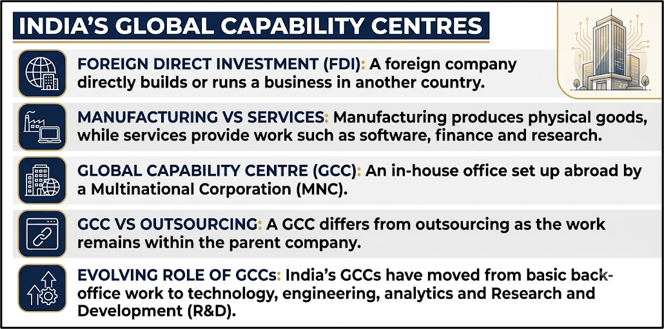
Why India Became the “World’s Office”?
- India has a large pool of English-speaking engineers, managers and finance professionals.
- Labour costs are lower than in many developed countries.
- India also has a strong Information Technology (IT) sector and digital infrastructure.
- These advantages attracted foreign companies to set up their own offices (GCCs).
- China became the “world’s factory” through manufacturing. India became the “world’s office” through services.
Changing Nature of GCCs:
- Earlier, GCCs mainly handled data entry, accounting and customer support.
- Today, many develop software platforms and digital products.
- They also conduct engineering research, clinical research and Artificial Intelligence-based drug discovery.
- This shift has increased the quality and value of work done in India.
- It has also improved skill development and knowledge transfer.
Economic Importance:
- GCCs create high-paying jobs and bring foreign exchange.
- They strengthen India’s services exports.
- India has a large merchandise trade deficit because goods imports exceed goods exports.
- At the same time, India earns a strong surplus from services trade.
- This surplus helps reduce pressure on the overall external account.
Major Concerns:
- GCC jobs mainly benefit highly skilled and educated workers.
- They cannot provide enough jobs for India’s large less-skilled workforce.
- Most GCCs are concentrated in Bengaluru, Hyderabad, Chennai, Pune, Mumbai and Delhi-National Capital Region.
- Smaller cities often lack airports, office space, transport and skilled workers.
- Heavy dependence on foreign companies also creates risks during global recessions or corporate restructuring.
Way Forward:
- Tier-2 and Tier-3 cities need better universities, transport and digital infrastructure.
- India should link GCCs with domestic start-ups, research institutions and local suppliers.
- Labour-intensive sectors such as textiles, leather and food processing must also grow.
- India needs both high-skill services and large-scale manufacturing jobs.
Conclusion:
India’s rise as the world’s office is a major economic strength. However, services alone cannot meet its employment and regional development needs. India must expand GCC-led innovation while strengthening labour-intensive manufacturing. A balanced model will make growth more inclusive, resilient and widely shared.
Source: (The Indian Express)
La Excellence IAS Academy, the best IAS coaching in Hyderabad, known for delivering quality content and conceptual clarity for UPSC 2026 preparation.
FOLLOW US ON:
◉ YouTube : https://www.youtube.com/@CivilsPrepTeam
◉ Facebook: https://www.facebook.com/LaExcellenceIAS
◉ Instagram: https://www.instagram.com/laexcellenceiasacademy/
GET IN TOUCH:
Contact us at info@laex.in, https://laex.in/contact-us/
or Call us @ +91 9052 29 2929, +91 9052 99 2929, +91 9154 24 2140
OUR BRANCHES:
Head Office: H No: 1-10-225A, Beside AEVA Fertility Center, Ashok Nagar Extension, VV Giri Nagar, Ashok Nagar, Hyderabad, 500020
Madhapur: Flat no: 301, survey no 58-60, Guttala begumpet Madhapur metro pillar: 1524, Rangareddy Hyderabad, Telangana 500081
Bangalore: Plot No: 99, 2nd floor, 80 Feet Road, Beside Poorvika Mobiles, Chandra Layout, Attiguppe, Near Vijaya Nagara, Bengaluru, 560040