
Paper: GS – I, Subject: Social and Social Justice, Topic: Issues of women, Issue: From Classrooms to Careers: India’s Gender Gap.
Context:
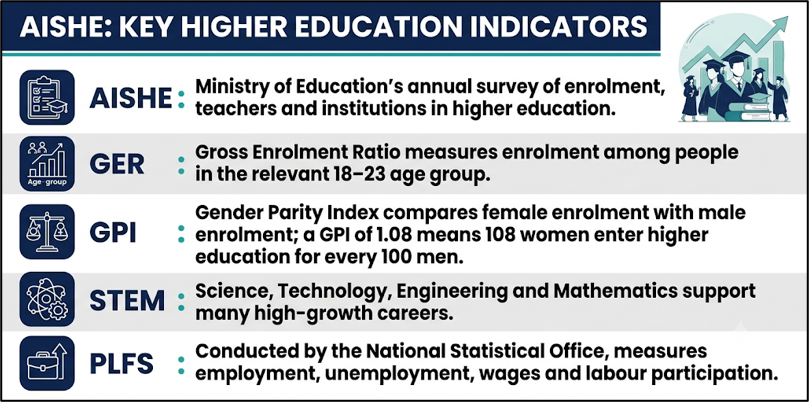
Recently, the All India Survey on Higher Education (AISHE) 2023–24 showed that women have achieved near-equal representation in higher education. However, the Periodic Labour Force Survey (PLFS) 2025 revealed that their participation, wages and access to regular jobs remain much lower.
Key Takeaways:
Explanation:
Progress in Higher Education:
- Female enrolment increased from 1.57 crore in 2014–15 to 2.24 crore in 2023–24.
- This represents a 42.2% rise, which was faster than the growth in male enrolment.
- Female GER reached 31.2%, compared with 28.9% for men.
- Women have maintained a higher GER than men for seven consecutive years.
- Progress was especially strong among Scheduled Caste and Scheduled Tribe women.
- These gains show that financial support, social change and wider institutional access have improved educational participation.
Unequal Distribution Across Courses:
- Women form about 44% of total STEM enrolment, but this figure hides important differences.
- Their presence is stronger in general and life sciences.
- However, women remain under-represented in engineering, technology, software and other high-value technical fields.
- This limits their entry into sectors such as artificial intelligence, advanced manufacturing and digital services.
Weak Education-to-Employment Pipeline:
- Educational progress has not produced equal labour-market outcomes.
- In 2025, male labour-force participation was 79.1%, while female participation was only 40%.
- Women also have lower representation in regular salaried employment.
- Many women are classified as self-employed, but this category includes unpaid family workers.
- Therefore, higher female employment figures may not always represent independent or secure incomes.
- Women also face wage gaps, weaker campus placements and fewer leadership opportunities.
Structural Barriers:
- Unsafe transport and workplaces discourage women from accepting distant jobs.
- Household duties and inadequate childcare often interrupt their careers.
- Limited workplace flexibility makes paid employment difficult after marriage or childbirth.
- Colleges also need more women teachers, deans and vice-chancellors as visible role models.
Way Forward:
- India should encourage more women to enter engineering and technology programmes.
- Colleges must ensure equal internships, placements and career counselling.
- Affordable childcare, safe transport and flexible workplaces can improve job retention.
- Policy must track women from enrolment to graduation, employment and leadership.
Conclusion:
India has made major progress in bringing women into higher education. However, educational equality remains incomplete without equal access to secure, well-paid and degree-matched work. The next priority must be to repair the pipeline from classrooms to careers.
Source: (The Hindu)
La Excellence IAS Academy, the best IAS coaching in Hyderabad, known for delivering quality content and conceptual clarity for UPSC 2026 preparation.
FOLLOW US ON:
◉ YouTube : https://www.youtube.com/@CivilsPrepTeam
◉ Facebook: https://www.facebook.com/LaExcellenceIAS
◉ Instagram: https://www.instagram.com/laexcellenceiasacademy/
GET IN TOUCH:
Contact us at info@laex.in, https://laex.in/contact-us/
or Call us @ +91 9052 29 2929, +91 9052 99 2929, +91 9154 24 2140
OUR BRANCHES:
Head Office: H No: 1-10-225A, Beside AEVA Fertility Center, Ashok Nagar Extension, VV Giri Nagar, Ashok Nagar, Hyderabad, 500020
Madhapur: Flat no: 301, survey no 58-60, Guttala begumpet Madhapur metro pillar: 1524, Rangareddy Hyderabad, Telangana 500081
Bangalore: Plot No: 99, 2nd floor, 80 Feet Road, Beside Poorvika Mobiles, Chandra Layout, Attiguppe, Near Vijaya Nagara, Bengaluru, 560040