
Paper: GS – II, Subject: Social and Social Justice, Topic: Welfare schemes, mechanisms, laws and institutions related to children, Issue: Social Media Regulation (Platforms vs. Users).
Context:
Recently, the Prime Minister, during the Australia–India Summit in Melbourne, appreciated Australia’s under-16 social media ban and said India was “taking lessons” from it. Around the same time, the European Union (EU) initiated action against Meta for using addictive platform designs, highlighting two different approaches to protecting children online.
Key Takeaways:
Explanation:
Why the Issue is Complex?
- Protecting children online is a wicked problem with no single solution.
- Governments must balance child safety, mental health, digital inclusion and freedom of expression.
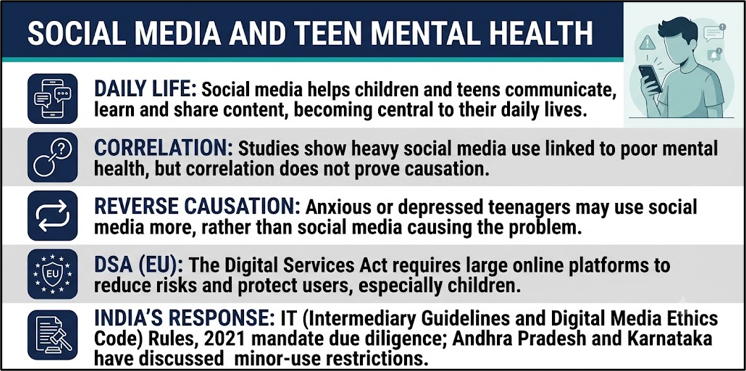
- Scientific evidence is still evolving. Most studies are observational and cannot conclusively establish a cause-and-effect relationship.
- Australia’s ban is a natural experiment because its long-term impact is still being evaluated.
Limitations of Age-Based Bans:
- Age verification is difficult because children can bypass restrictions using shared or false accounts.
- Reports suggest that many Australian teenagers continue to access social media despite the ban.
- Blanket bans may also reduce access to educational content and positive online communities.
- They address who uses social media rather than how platforms influence user behaviour.
Platform-Based Regulation:
- The European Union is focusing on platform accountability through the Digital Services Act (DSA).
- The law places a duty of care on platforms to reduce foreseeable harm to users.
- Platforms are expected to redesign addictive features such as infinite scroll, autoplay and excessive notifications.
- Social media algorithms recommend content that keeps users online for longer. These systems should instead prioritise safe and age-appropriate content for children.
- Platforms can provide chronological feeds for minors. Users then see posts in time order instead of content selected by engagement algorithms.
- Stronger privacy settings, parental controls and content moderation can further improve child safety.
Way Forward:
- India should adopt evidence-based regulation instead of relying only on blanket bans.
- Platform accountability should be strengthened through clear legal obligations.
- Schools should promote digital literacy and responsible online behaviour.
- Regular research should guide future policy as technology and user behaviour continue to evolve.
Conclusion:
Protecting children online requires balanced and evidence-based regulation. Making platforms safer can reduce risks without denying young people the benefits of digital access. India should combine platform accountability, digital literacy and child protection to create a safer online ecosystem.
Source: (The Hindu)
La Excellence IAS Academy, the best IAS coaching in Hyderabad, known for delivering quality content and conceptual clarity for UPSC 2026 preparation.
FOLLOW US ON:
◉ YouTube : https://www.youtube.com/@CivilsPrepTeam
◉ Facebook: https://www.facebook.com/LaExcellenceIAS
◉ Instagram: https://www.instagram.com/laexcellenceiasacademy/
GET IN TOUCH:
Contact us at info@laex.in, https://laex.in/contact-us/
or Call us @ +91 9052 29 2929, +91 9052 99 2929, +91 9154 24 2140
OUR BRANCHES:
Head Office: H No: 1-10-225A, Beside AEVA Fertility Center, Ashok Nagar Extension, VV Giri Nagar, Ashok Nagar, Hyderabad, 500020
Madhapur: Flat no: 301, survey no 58-60, Guttala begumpet Madhapur metro pillar: 1524, Rangareddy Hyderabad, Telangana 500081
Bangalore: Plot No: 99, 2nd floor, 80 Feet Road, Beside Poorvika Mobiles, Chandra Layout, Attiguppe, Near Vijaya Nagara, Bengaluru, 560040