
Paper: GS – I, Subject: Society and Social Justice, Topic: Social empowerment, Issue: Marriage, Consent and Learned Helplessness.
Context:
Recently, cases of dowry-related violence and crimes within intimate relationships have renewed debate on consent and personal choice in marriage. They also raise a deeper concern about how family pressure shapes major life decisions. The issue is not only whom young people marry, but whether they feel free to choose at all.
Key Takeaways:
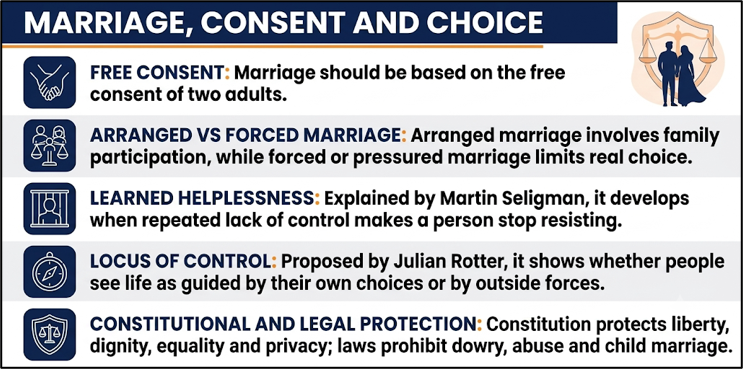
Explanation:
Compromise and Compliance:
- Compromise means both people express their views and adjust willingly.
- Compliance means agreeing because refusal feels unsafe, useless or disrespectful.
- Society often praises silent obedience as adjustment.
- However, adjustment without freedom is not genuine consent.
How Helplessness Develops:
- Many young people face strict control over education, careers, friendships and relationships.
- Their refusal may be ignored or treated as disobedience.
- Repeated dismissal can teach them that speaking up has no value.
- Marriage then appears as a deadline or family duty. It stops being a personal decision.
External Locus of Control:
- Some young adults feel that parents, fate, caste or family honour control their future.
- They may fear losing emotional or financial support. They may also worry about social shame.
- This weakens personal agency and confidence.
- It can make boundary-setting difficult in later relationships.
Role of Families and Matchmaking:
- Family involvement can provide guidance and social support.
- Many arranged marriages are happy and fully consensual.
- The problem begins when choice is replaced by pressure.
- Matrimonial systems may focus too much on caste, income, age, appearance and horoscope.
- Compatibility and emotional safety may receive less attention.
Social Consequences:
- People with weak agency may find it harder to recognise abuse.
- They may also struggle to leave unsafe relationships.
- Pressure-based marriages can create resentment, fear and unequal power.
- Women often face greater pressure because family honour is closely linked to their choices.
Way Forward:
- Families should treat disagreement as a sign of maturity.
- Young adults must have a real right to refuse.
- Schools and colleges should teach consent, emotional health and healthy relationships.
- Counselling, legal aid and confidential support must be easily available.
- Marriage decisions should allow time, direct interaction and informed choice.
Conclusion:
The real debate is not love marriage versus arranged marriage. It is genuine consent versus conditioned compliance. Families should guide young adults without controlling their lives. A healthy marriage culture must respect choice, boundaries, dignity and personal agency.
Source: (The Indian Express)
La Excellence IAS Academy, the best IAS coaching in Hyderabad, known for delivering quality content and conceptual clarity for UPSC 2026 preparation.
FOLLOW US ON:
◉ YouTube : https://www.youtube.com/@CivilsPrepTeam
◉ Facebook: https://www.facebook.com/LaExcellenceIAS
◉ Instagram: https://www.instagram.com/laexcellenceiasacademy/
GET IN TOUCH:
Contact us at info@laex.in, https://laex.in/contact-us/
or Call us @ +91 9052 29 2929, +91 9052 99 2929, +91 9154 24 2140
OUR BRANCHES:
Head Office: H No: 1-10-225A, Beside AEVA Fertility Center, Ashok Nagar Extension, VV Giri Nagar, Ashok Nagar, Hyderabad, 500020
Madhapur: Flat no: 301, survey no 58-60, Guttala begumpet Madhapur metro pillar: 1524, Rangareddy Hyderabad, Telangana 500081
Bangalore: Plot No: 99, 2nd floor, 80 Feet Road, Beside Poorvika Mobiles, Chandra Layout, Attiguppe, Near Vijaya Nagara, Bengaluru, 560040