
Paper: GS – II, Subject: Polity, Topic: Rights issues, Issue: Right to Protest in India & Section 163 BNSS.
Context:
Recently, police stopped a protest march towards Parliament in New Delhi using barricades, tear gas and reportedly a lathi charge. The incident has renewed debate over the constitutional right to protest, police powers and Section 163 of the Bharatiya Nagarik Suraksha Sanhita (BNSS).
Key Takeaways:
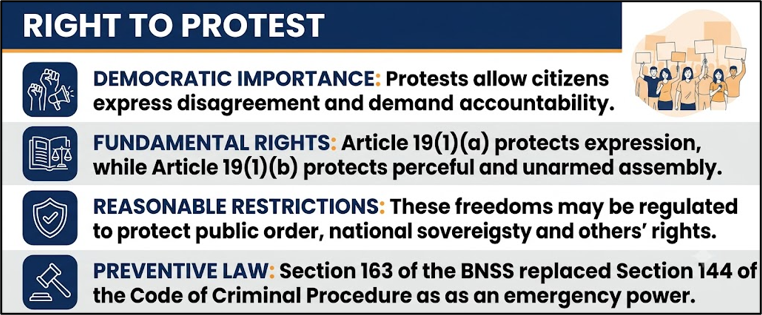
Explanation:
Constitutional and Legal Position:
- Regulated freedom: Citizens may protest peacefully but cannot claim unrestricted use of every public place. Authorities may regulate routes, timings, crowd size and access to sensitive locations.
- Section 163: An Executive Magistrate may issue written directions to prevent obstruction, danger, riots or disturbance of public tranquillity. Orders generally remain effective for two months and must be based on specific facts.
Concerns over Misuse:
- Routine use: A 2023 study examined nearly 5,400 Section 144 orders issued in Delhi during 2021–22. Only about 1.5% concerned unlawful assemblies, showing its wider administrative use.
- Repeated orders: Renewing identical orders can convert temporary restrictions into permanent prohibitions. Every fresh order must consider present conditions and provide clear reasons.
Supreme Court’s Position:
- Reasonable regulation: In Himat Lal K. Shah v. Commissioner of Police (1973), the Supreme Court permitted regulation of street meetings but rejected arbitrary exclusion.
- No blanket ban: In Mazdoor Kisan Shakti Sangathan v. Union of India (2018), the Court ruled that emergency orders cannot permanently eliminate protests. Authorities must balance protesters’ freedoms with residents’ rights.
- Public roads: In Amit Sahni v. Commissioner of Police (2020), the Court held that public roads cannot be occupied indefinitely. Protests should generally occur in identified areas without causing prolonged inconvenience.
Way Forward:
- Authorities should provide suitable protest spaces and regularly review restrictions. Police should prefer warnings and dialogue. Any use of force must be necessary, minimal and proportionate.
Conclusion:
Peaceful protest is essential for democracy, but it must respect public order and other citizens’ rights. Section 163 should remain an exceptional power. Transparent regulation and restrained policing must protect meaningful democratic dissent.
Source: (The Indian Express)
La Excellence IAS Academy, the best IAS coaching in Hyderabad, known for delivering quality content and conceptual clarity for UPSC 2026 preparation.
FOLLOW US ON:
◉ YouTube : https://www.youtube.com/@CivilsPrepTeam
◉ Facebook: https://www.facebook.com/LaExcellenceIAS
◉ Instagram: https://www.instagram.com/laexcellenceiasacademy/
GET IN TOUCH:
Contact us at info@laex.in, https://laex.in/contact-us/
or Call us @ +91 9052 29 2929, +91 9052 99 2929, +91 9154 24 2140
OUR BRANCHES:
Head Office: H No: 1-10-225A, Beside AEVA Fertility Center, Ashok Nagar Extension, VV Giri Nagar, Ashok Nagar, Hyderabad, 500020
Madhapur: Flat no: 301, survey no 58-60, Guttala begumpet Madhapur metro pillar: 1524, Rangareddy Hyderabad, Telangana 500081
Bangalore: Plot No: 99, 2nd floor, 80 Feet Road, Beside Poorvika Mobiles, Chandra Layout, Attiguppe, Near Vijaya Nagara, Bengaluru, 560040