
Paper: GS-I, Subject: Geography, Topic: Important Geophysical Phenomena, Issue: Changing Himalayan Hazards and Climate-Resilient Disaster Management
Context
Recently, a sudden flood struck Nepal’s Rasuwa district in August 2026, showing the growing unpredictability of Himalayan disasters. A high-altitude ice-rock or moraine collapse may have released large volumes of water, debris and mud downstream.
Explanation
Changing Geophysical Features and Emerging Risks
- The Hindu Kush-Himalaya is a young and fragile mountain system with steep slopes, glaciers, high seismicity and fast-flowing rivers.
- Climate change is altering glaciers, snow cover, permafrost, slopes and river flows. Rising temperatures accelerate glacier retreat and permafrost thaw, increasing landslides, avalanches, debris flows and glacial-lake formation.
- A Glacial Lake Outburst Flood (GLOF) occurs when a glacier-fed lake suddenly drains after failure of its natural moraine barrier.
- Himalayan disasters may occur without obvious local warning signs such as heavy rainfall. Before the Rasuwa event, local weather had reportedly remained stable for nearly two days.
- Thus, high-altitude ice-rock or moraine failure can trigger severe downstream flooding even under apparently normal local weather.
- The western Himalaya, particularly Ladakh, Jammu and Kashmir and Himachal Pradesh, is increasingly vulnerable to warming, snow loss and slope instability.
Cascading and Transboundary Consequences
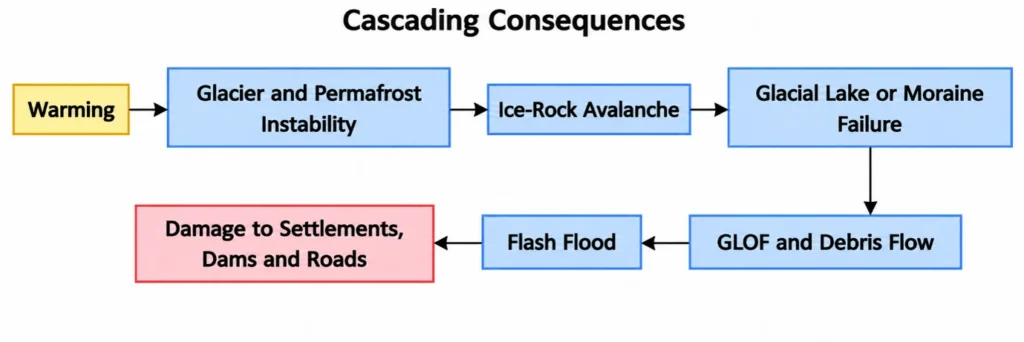
- Such cascading hazards can simultaneously damage settlements, hydropower projects, roads, bridges and strategic border infrastructure.
- Himalayan rivers and glaciers are transboundary systems; hazards originating in Nepal or Tibet can affect downstream India and Bangladesh and threaten the Indus-Ganga-Brahmaputra systems.
Managing the Emerging Himalayan Risk
Future-Oriented Hazard Zoning
- Climate non-stationarity means past rainfall and flood records may no longer represent future extremes; hazard maps must therefore incorporate glacier change, slope instability, floodplains and climate projections.
- Risk-sensitive land-use planning should restrict construction in vulnerable river corridors and flood-prone zones.
Prevention, Preparedness and Dam Safety
- Disaster management must shift from post-disaster relief to anticipatory risk reduction, in line with the Sendai Framework for Disaster Risk Reduction, 2015–2030.
- India’s Disaster Management Act, 2005 provides the institutional framework through the National Disaster Management Authority and State and district authorities.
- Satellite and ground monitoring must be linked with last-mile alerts, safe evacuation routes and community drills, because warnings are useful only when people can act quickly.
- Hydropower projects are not the sole cause of Himalayan disasters. However, existing dams may require retrofitting, while new projects must account for larger floods, debris flows and sediment loads.
Way Forward
- India, Nepal and neighbouring countries need shared glacier data, coordinated hazard maps and cross-border early-warning systems.
- Dam standards should use future climate scenarios, while technology and financial support for vulnerable mountain communities should reflect climate justice.
Conclusion
Climate change is creating a new Himalayan risk environment in which past experience and older engineering assumptions are increasingly inadequate. Future policy must combine scientific monitoring, resilient infrastructure, community preparedness and regional cooperation to anticipate rather than merely respond to disasters.
Source: (Down To Earth)
La Excellence IAS Academy, the best IAS coaching in Hyderabad, known for delivering quality content and conceptual clarity for UPSC 2026 preparation.
FOLLOW US ON:
◉ YouTube : https://www.youtube.com/@CivilsPrepTeam
◉ Facebook: https://www.facebook.com/LaExcellenceIAS
◉ Instagram: https://www.instagram.com/laexcellenceiasacademy/
GET IN TOUCH:
Contact us at info@laex.in, https://laex.in/contact-us/
or Call us @ +91 9052 29 2929, +91 9052 99 2929, +91 9154 24 2140
OUR BRANCHES:
Head Office: H No: 1-10-225A, Beside AEVA Fertility Center, Ashok Nagar Extension, VV Giri Nagar, Ashok Nagar, Hyderabad, 500020
Madhapur: Flat no: 301, survey no 58-60, Guttala begumpet Madhapur metro pillar: 1524, Rangareddy Hyderabad, Telangana 500081
Bangalore: Plot No: 99, 2nd floor, 80 Feet Road, Beside Poorvika Mobiles, Chandra Layout, Attiguppe, Near Vijaya Nagara, Bengaluru, 560040