
Paper: GS-III, Subject: Economy, Topic: Trade and External Sector, Issue: Expanding United States Tariffs and India’s Trade Strategy
Context
Recently, the United States Senate advanced a Russia sanctions Bill permitting tariffs of up to 100% on countries purchasing Russian oil. Alongside expanding American trade restrictions, this has raised concerns about India’s exports and the proposed India US Trade Agreement.
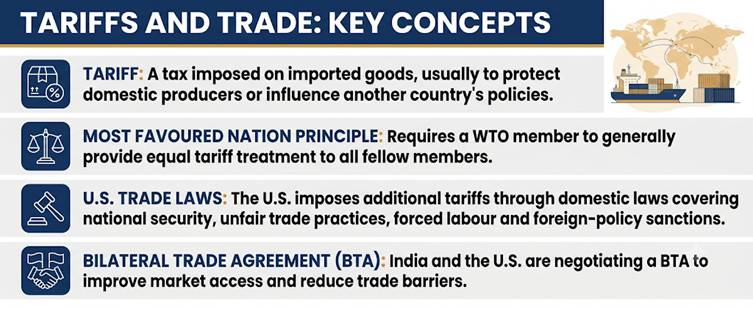
Explanation
Key Developments and Implications
- American tariffs are becoming more permanent because both the President and Congress increasingly support their use.
- Different duties may apply simultaneously under normal customs rates, national-security provisions, trade investigations and sanctions legislation.
- Such layered tariffs increase costs and uncertainty for Indian exporters, particularly in pharmaceuticals, textiles, steel and petrochemicals.
- Proposed sanctions on Russian oil buyers could convert geopolitical disagreements into direct commercial penalties against Indian goods.
- American investigations increasingly examine domestic regulations, including digital payments, data localisation, intellectual property and public procurement.
- Consequently, India’s Unified Payments Interface (UPI) and other public-interest regulations could face external commercial pressure.
Challenges for India
- India has reduced duties on several American products without receiving stable and comparable market-access benefits.
- Unilateral concessions weaken bargaining power because benefits already granted cannot be exchanged during final negotiations.
- Even a trade agreement may not prevent future American tariffs imposed through separate security or trade laws.
- Immediate retaliation could escalate tensions, increase input costs and harm Indian industries dependent on American markets.
Way Forward
- India should seek reciprocal, enforceable and durable commitments before offering further tariff or regulatory concessions.
- It must pursue export diversification across Europe, Africa, West Asia and Southeast Asia to reduce dependence on one market.
- Domestic competitiveness should be strengthened through improved logistics, technology, standards compliance and affordable credit.
- India should preserve its regulatory autonomy while continuing patient dialogue through bilateral and multilateral institutions.
Conclusion
The expanding American tariff system creates both economic uncertainty and diplomatic pressure for India. India should continue negotiations without accepting an unbalanced agreement. Stable market access, mutual concessions and export competitiveness must guide its long-term trade strategy.
Source: (The Indian Express)
La Excellence IAS Academy, the best IAS coaching in Hyderabad, known for delivering quality content and conceptual clarity for UPSC 2026 preparation.
FOLLOW US ON:
◉ YouTube : https://www.youtube.com/@CivilsPrepTeam
◉ Facebook: https://www.facebook.com/LaExcellenceIAS
◉ Instagram: https://www.instagram.com/laexcellenceiasacademy/
GET IN TOUCH:
Contact us at info@laex.in, https://laex.in/contact-us/
or Call us @ +91 9052 29 2929, +91 9052 99 2929, +91 9154 24 2140
OUR BRANCHES:
Head Office: H No: 1-10-225A, Beside AEVA Fertility Center, Ashok Nagar Extension, VV Giri Nagar, Ashok Nagar, Hyderabad, 500020
Madhapur: Flat no: 301, survey no 58-60, Guttala begumpet Madhapur metro pillar: 1524, Rangareddy Hyderabad, Telangana 500081
Bangalore: Plot No: 99, 2nd floor, 80 Feet Road, Beside Poorvika Mobiles, Chandra Layout, Attiguppe, Near Vijaya Nagara, Bengaluru, 560040