
Paper: GS-III, Subject: Economy, Topic: Agriculture, Issue: Monsoon Revival, Kharif Sowing and India’s Food-Security Concerns
Context
The Southwest Monsoon revived in July 2026 after a weak June, improving reservoir storage and enabling farmers to accelerate kharif sowing. However, delayed cultivation, a continuing rainfall deficit, strengthening El Niño and rising international food prices still threaten agricultural output and inflation.
Explanation
Monsoon Revival
- Heavy July rainfall reversed part of June’s severe shortfall, replenished reservoirs and enabled farmers to complete delayed sowing.
- By August 10, total kharif acreage was approximately 985.89 lakh hectares, about 1.82% below the previous year.
- Oilseed sowing improved, while acreage under rice, pulses, coarse cereals and cotton remained uneven.
Crop-wise Position
- Rice acreage stood at 344.78 lakh hectares, 4.41% lower than the previous year.
- Pulses covered 103.78 lakh hectares, registering a 1.84% decline.
- Oilseed acreage increased by 2.97% to 180.20 lakh hectares.
- Cotton acreage remained nearly stable at 106.01 lakh hectares, while small-millet acreage declined by 14.95%.
Why Concerns Persist
- A national rainfall recovery can conceal major regional and temporal disparities; excessive rain in one region cannot compensate for drought elsewhere.
- Delayed sowing compresses the crop-growth period and may reduce yields by exposing flowering or harvesting stages to unsuitable weather.
- Crops require rainfall at critical stages, particularly during August and September. A late-season “monsoon break” can therefore damage otherwise healthy fields.
- Excess rain can also cause floods, waterlogging, pest attacks and crop diseases.
El Niño and Rabi Risk
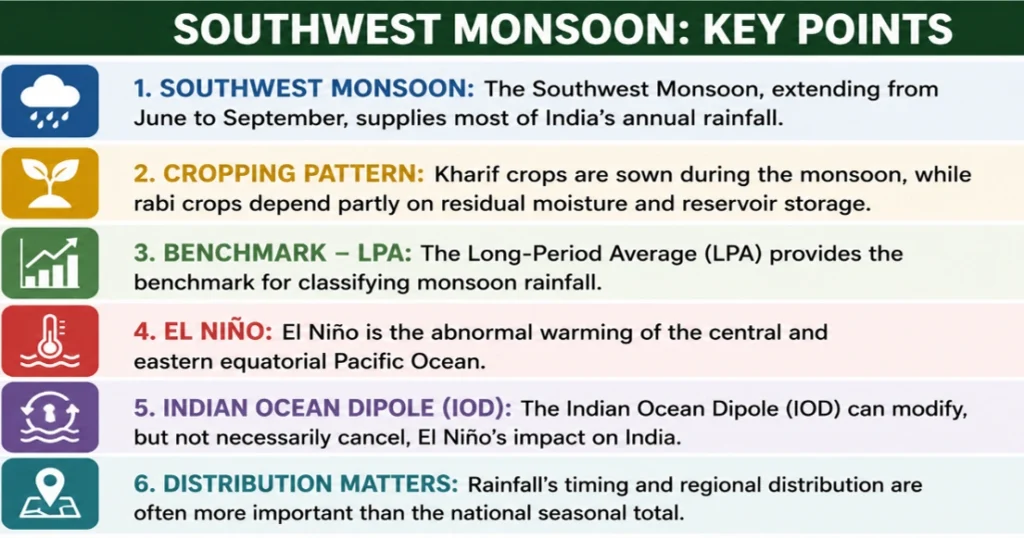
- Moderate El Niño conditions are strengthening and commonly weaken monsoon circulation, although their effects are not automatic.
- The IMD forecasts below-normal rainfall during August–September 2026.
- Poor late-season rainfall may reduce reservoirs and soil moisture, adversely affecting winter wheat, mustard and other rabi crops.
Food-Price Dimension
- Weather disruptions, geopolitical conflicts and biofuel policies can increase international prices of edible oils and other commodities.
- Since India imports large quantities of vegetable oils, global price increases may transmit into domestic food inflation.
- Adequate buffer stocks, calibrated imports, irrigation management and timely crop advisories are therefore essential.
Conclusion
The July revival has improved immediate kharif prospects, but the agricultural season is not yet secure. Policy must focus on rainfall distribution, crop-stage conditions, reservoir management and price stability rather than relying only on the all-India rainfall total.
Source: (The Indian Express)
La Excellence IAS Academy, the best IAS coaching in Hyderabad, known for delivering quality content and conceptual clarity for UPSC 2026 preparation.
FOLLOW US ON:
◉ YouTube : https://www.youtube.com/@CivilsPrepTeam
◉ Facebook: https://www.facebook.com/LaExcellenceIAS
◉ Instagram: https://www.instagram.com/laexcellenceiasacademy/
GET IN TOUCH:
Contact us at info@laex.in, https://laex.in/contact-us/
or Call us @ +91 9052 29 2929, +91 9052 99 2929, +91 9154 24 2140
OUR BRANCHES:
Head Office: H No: 1-10-225A, Beside AEVA Fertility Center, Ashok Nagar Extension, VV Giri Nagar, Ashok Nagar, Hyderabad, 500020
Madhapur: Flat no: 301, survey no 58-60, Guttala begumpet Madhapur metro pillar: 1524, Rangareddy Hyderabad, Telangana 500081
Bangalore: Plot No: 99, 2nd floor, 80 Feet Road, Beside Poorvika Mobiles, Chandra Layout, Attiguppe, Near Vijaya Nagara, Bengaluru, 560040