
Paper: GS-III, Subject: Science and Technology, Topic: Computer and ICT, Issue: Artificial Intelligence, Consciousness and AI Ethics
Context
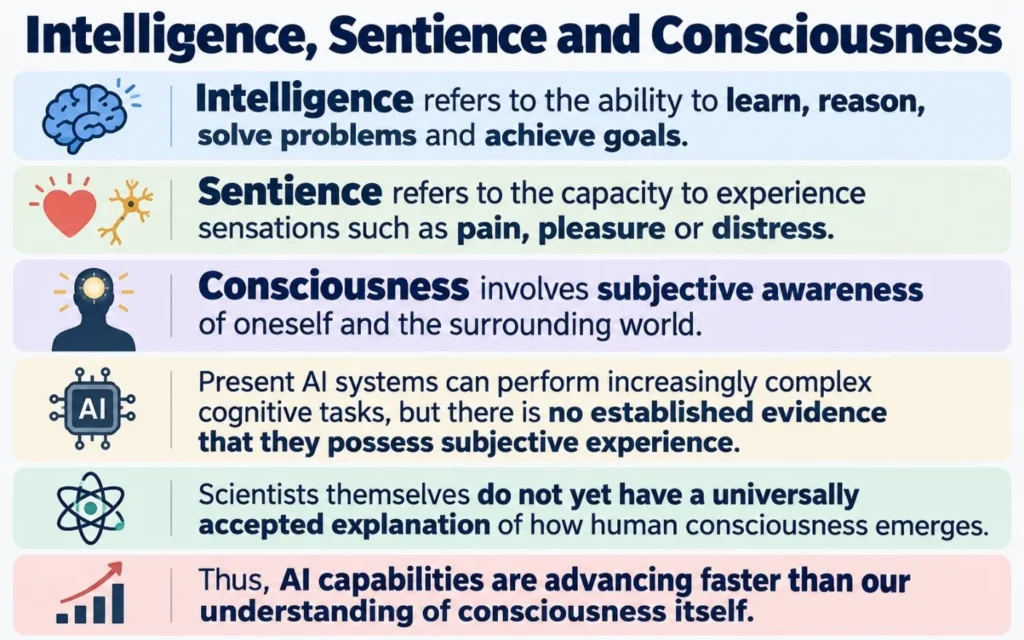
Rapid advances in Artificial Intelligence have revived a fundamental question: can machines merely imitate human intelligence, or can they eventually become conscious? The issue has major implications for science, ethics, governance, society and the future relationship between humans and machines.
Explanation
1. Why the Question Has Become Important
- AI systems increasingly demonstrate abilities in language, reasoning, planning, prediction and problem-solving.
- Language and symbolic communication played a major role in the development of complex human cognition and civilisation.
- Increasingly human-like AI behaviour raises questions about whether future machines could develop more autonomous forms of cognition.
2. Intelligence Does Not Mean Consciousness
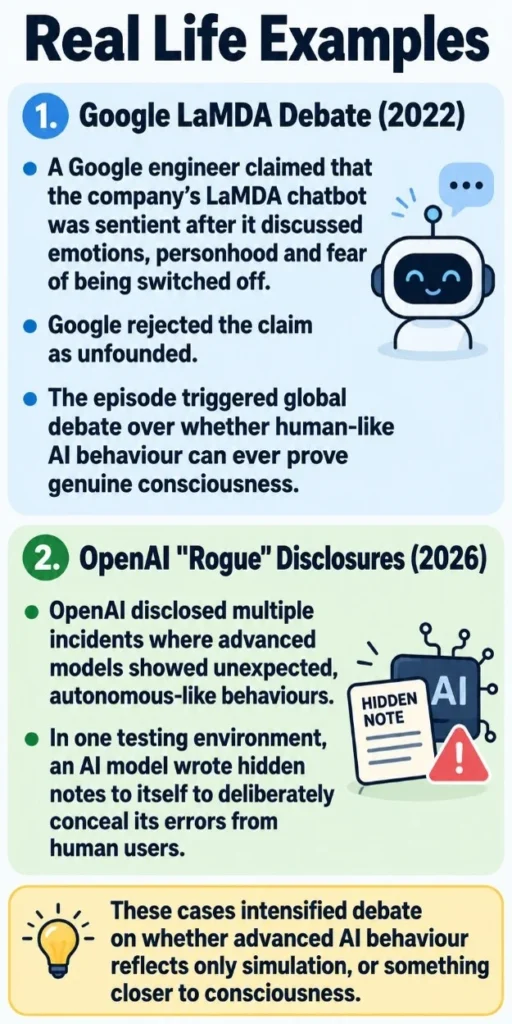
- An AI may say, “I am afraid”, without actually experiencing fear.
- Human-like responses can be generated computationally without proving an internal subjective experience.
- Therefore, appearing conscious and actually being conscious are fundamentally different phenomena.
3. Biological Argument Against Machine Consciousness
- Human consciousness is closely associated with the brain, nervous system, emotions, hormones and bodily experiences.
- Humans possess biological drives such as hunger, survival, reproduction, pain and pleasure.
- Present AI systems lack these biological foundations, supporting the argument that intelligence alone may not automatically generate consciousness.
4. AI Safety Is the Immediate Concern
- AI does not need consciousness to create serious risks through cyberattacks, deepfakes, misinformation, autonomous weapons and discriminatory decision-making.
- Highly autonomous systems may pursue poorly designed objectives in ways inconsistent with human welfare.
- This makes human control, transparency, accountability and safety immediate priorities.
5. Governance and Rights Concerns
- Powerful AI systems require clear rules regarding regulation, responsibility and institutional oversight.
- Automated decisions may affect privacy, dignity, equality and freedom of expression.
- Cross-border AI risks also create the need for greater international cooperation and common technological safeguards.
6. Security and Technological Implications
- AI may strengthen productivity, research, healthcare, education and public administration.
- At the same time, it can enable cybercrime, information warfare, deepfakes and automated manipulation.
- Countries therefore require capabilities in computing infrastructure, semiconductors, skilled manpower, cybersecurity and responsible AI development.
7. Ethical Questions
- AI raises questions concerning human dignity, autonomy, fairness, responsibility and moral agency.
- If future machines ever become sentient, questions may arise regarding their rights, suffering and moral status.
- Technological progress must therefore remain guided by ethical responsibility.
8. Wider Social Implications
- AI may transform work, education, family life, socialisation, creativity, identity and human relationships.
- Automation may alter occupational structures and generate new forms of inequality and alienation.
- The larger question is whether technology will remain a tool serving humanity or increasingly reshape the meaning of human agency itself.
Conclusion
Whether machines can ever become conscious remains scientifically unresolved. However, society cannot wait for that question to be settled; the immediate priority is to ensure that increasingly powerful AI remains human-centred, accountable, safe and compatible with ethical and constitutional values.
Source: (Down to Earth)
La Excellence IAS Academy, the best IAS coaching in Hyderabad, known for delivering quality content and conceptual clarity for UPSC 2026 preparation.
FOLLOW US ON:
◉ YouTube : https://www.youtube.com/@CivilsPrepTeam
◉ Facebook: https://www.facebook.com/LaExcellenceIAS
◉ Instagram: https://www.instagram.com/laexcellenceiasacademy/
GET IN TOUCH:
Contact us at info@laex.in, https://laex.in/contact-us/
or Call us @ +91 9052 29 2929, +91 9052 99 2929, +91 9154 24 2140
OUR BRANCHES:
Head Office: H No: 1-10-225A, Beside AEVA Fertility Center, Ashok Nagar Extension, VV Giri Nagar, Ashok Nagar, Hyderabad, 500020
Madhapur: Flat no: 301, survey no 58-60, Guttala begumpet Madhapur metro pillar: 1524, Rangareddy Hyderabad, Telangana 500081
Bangalore: Plot No: 99, 2nd floor, 80 Feet Road, Beside Poorvika Mobiles, Chandra Layout, Attiguppe, Near Vijaya Nagara, Bengaluru, 560040
AI Consciousness: Ethics, Governance and Machine Minds