
Paper: GS-III, Subject: Economy, Topic: Sustainable Agriculture, Issue: Regenerative Agriculture for Smallholder Resilience
Context
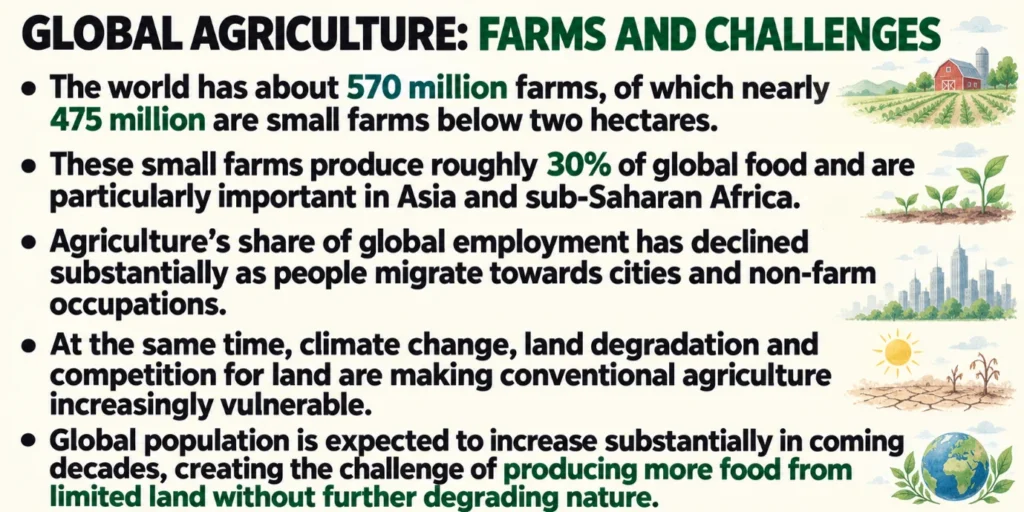
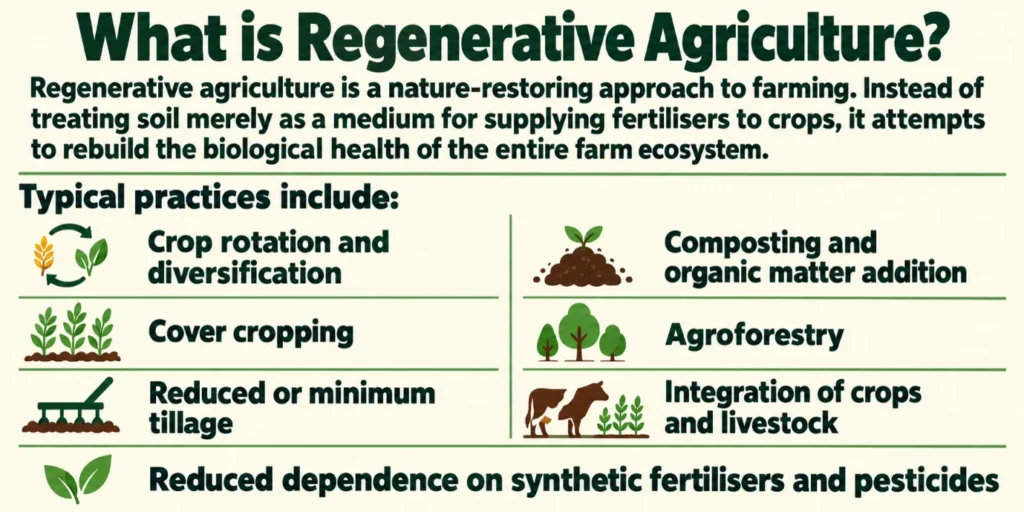
Smallholder agriculture faces a simultaneous crisis of climate change, declining soil fertility, rising input costs, shrinking farm populations and growing food demand. Regenerative agriculture is emerging as an approach that seeks to increase farm productivity while restoring the ecological systems on which agriculture ultimately depends.

Why Can It Help Small Farmers?
1. Lower Input Dependence
Improving natural soil fertility can gradually reduce dependence on expensive external fertilisers and other chemical inputs.
2. Climate Resilience
Soils rich in organic matter absorb and retain more water, helping farms withstand droughts, irregular rainfall and extreme weather.
3. Higher and More Stable Incomes
A programme involving more than 10,000 small farmers in Haiti reportedly increased average crop yields by about 40%, while household incomes rose by 50–100%.
4. Food Security
Supporting around 240 million smallholder families to adopt regenerative farming and agroforestry has been proposed as a pathway for meeting much of the additional food demand arising from population growth up to 2050.
5. Environmental Co-benefits
Regenerative farming can increase soil carbon storage, restore biodiversity and reduce synthetic fertiliser use. Large-scale adoption by smallholders has been estimated to potentially remove up to 0.72 gigatonnes of CO₂ annually, though actual sequestration would depend on local soils, crops and farming practices.
Challenges
- Transition is not automatic. Farmers may face initial costs, temporary yield uncertainty, lack of technical knowledge, insecure land tenure, inadequate credit and weak markets.
- Measuring soil-carbon gains consistently is also difficult.
Conclusion
Regenerative agriculture shifts the objective from merely extracting maximum production from land to maintaining the productive capacity of the land itself. For smallholders, its real promise lies in combining food security, farm income, climate resilience and ecological restoration, provided farmers receive adequate knowledge, finance, market support and institutional assistance.
Source: (Down to Earth)
La Excellence IAS Academy, the best IAS coaching in Hyderabad, known for delivering quality content and conceptual clarity for UPSC 2026 preparation.
FOLLOW US ON:
◉ YouTube : https://www.youtube.com/@CivilsPrepTeam
◉ Facebook: https://www.facebook.com/LaExcellenceIAS
◉ Instagram: https://www.instagram.com/laexcellenceiasacademy/
GET IN TOUCH:
Contact us at info@laex.in, https://laex.in/contact-us/
or Call us @ +91 9052 29 2929, +91 9052 99 2929, +91 9154 24 2140
OUR BRANCHES:
Head Office: H No: 1-10-225A, Beside AEVA Fertility Center, Ashok Nagar Extension, VV Giri Nagar, Ashok Nagar, Hyderabad, 500020
Madhapur: Flat no: 301, survey no 58-60, Guttala begumpet Madhapur metro pillar: 1524, Rangareddy Hyderabad, Telangana 500081
Bangalore: Plot No: 99, 2nd floor, 80 Feet Road, Beside Poorvika Mobiles, Chandra Layout, Attiguppe, Near Vijaya Nagara, Bengaluru, 560040