
Paper: GS-II, Subject: Governance, Topic: Government Policies and Accountability, Issue: State Regulation, Platform Accountability and Digital Rights (Digital Governance).
Context
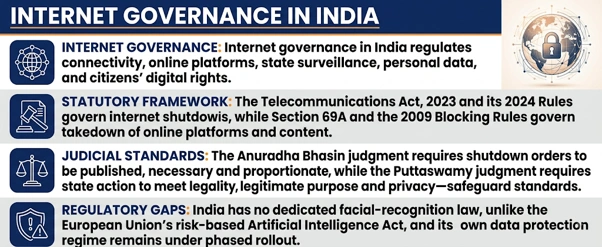
Recently, NEET protests saw Telegram blocking, internet suspension, BitChat code removal, facial surveillance and pressure on Meta. This exposed gaps between constitutional doctrine and digital governance.
Explanation
Government response
- Telegram was blocked and message editing disabled to prevent fabricated NEET paper-leak evidence.
- Protesters adopted BitChat offline messaging, prompting reported removal requests for its open-source code.
- Facial recognition reportedly identified protesters, while Meta faced safe-harbour pressure after a moderation error.
Constitutional and democratic concerns
- Virtual Private Networks enable circumvention, making the ban overbroad and ineffective while still curbing free expression (Art. 19(1)(a)).
- Treating temporariness as proof of least restrictive means weakens the proportionality test from Anuradha Bhasin and risks arbitrary restrictions under Article 14.
- Shutdowns, loss of communication alternatives, and facial tracking can chill lawful protest, implicating free expression and peaceful assembly (Art. 19(1)(a)–(b)).
- Facial recognition without impact assessments, reliable thresholds, or retention limits risks misidentification and violates informational privacy under Article 21.
Technological, institutional and economic concerns
- Removing source-code repositories doesn’t disable installed apps, but weakens open-source scrutiny, cybersecurity research, and innovation.
- Safe-harbour threats may push platforms to over-remove lawful content; opaque private moderation needs the same transparency, reasoned decisions, and accessible appeals.
- Repeated restrictions disrupt digital businesses and livelihoods, adding economic and reputational costs that undercut India’s Digital India goals.
Way forward
- Reform shutdown orders: Mandate published reasons, proof of least-restrictive action and independent, time-bound review.
- Regulate facial recognition: Require impact assessments, accuracy standards, retention limits and remedies against misidentification.
- Ensure graded platform accountability: Replace safe-harbour threats with transparent obligations, reasoned orders and accessible appeals.
Conclusion
Operational speed during emergencies cannot replace legality and proportionality. India needs narrowly tailored restrictions, independent oversight and enforceable privacy safeguards to reconcile public order with democratic digital rights.
Source: (The Indian Express)
La Excellence IAS Academy, the best IAS coaching in Hyderabad, known for delivering quality content and conceptual clarity for UPSC 2026 preparation.
FOLLOW US ON:
◉ YouTube : https://www.youtube.com/@CivilsPrepTeam
◉ Facebook: https://www.facebook.com/LaExcellenceIAS
◉ Instagram: https://www.instagram.com/laexcellenceiasacademy/
GET IN TOUCH:
Contact us at info@laex.in, https://laex.in/contact-us/
or Call us @ +91 9052 29 2929, +91 9052 99 2929, +91 9154 24 2140
OUR BRANCHES:
Head Office: H No: 1-10-225A, Beside AEVA Fertility Center, Ashok Nagar Extension, VV Giri Nagar, Ashok Nagar, Hyderabad, 500020
Madhapur: Flat no: 301, survey no 58-60, Guttala begumpet Madhapur metro pillar: 1524, Rangareddy Hyderabad, Telangana 500081
Bangalore: Plot No: 99, 2nd floor, 80 Feet Road, Beside Poorvika Mobiles, Chandra Layout, Attiguppe, Near Vijaya Nagara, Bengaluru, 560040