
Paper: GS-I/II, Subject: Society and Social Justice, Topic: Social Sector – Education, Issue: Strengthening Indian Higher Education: From Policy to Institutional Excellence
Context:
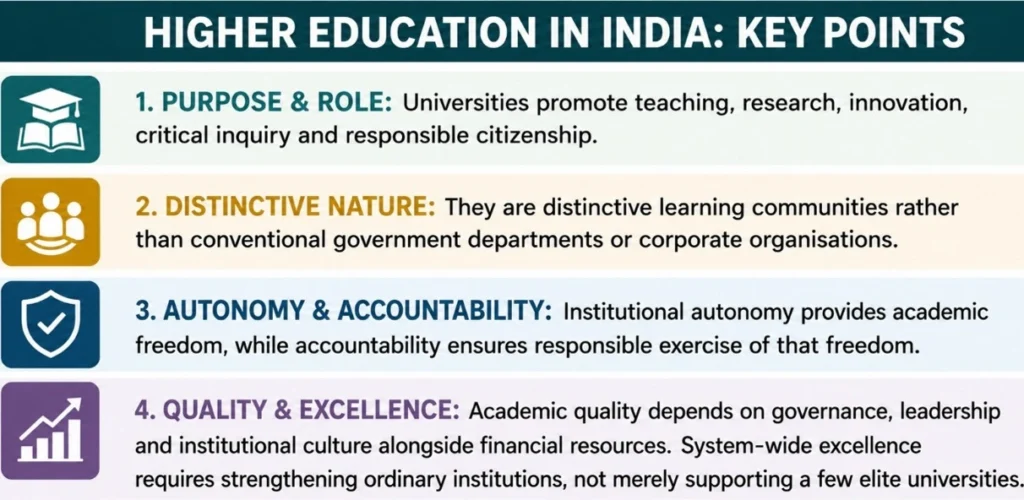
India has built one of the world’s largest higher-education systems and consistently produces globally successful professionals. Yet, relatively few Indian universities achieve international academic distinction, revealing that the deeper challenge lies not merely in resources but also in institutional integrity, policy design and effective execution.
Explanation
Ethical Intention
- Admissions, appointments and promotions should prioritise merit, integrity, fairness and long-term institutional interests.
- Favouritism and dishonesty weaken academic standards, public trust and the values absorbed by students.
Context – Sensitive Policy
- Excessive administrative control suppresses creativity, initiative and academic freedom.
- Universities require autonomy accompanied by transparency, responsibility and commitment to institutional objectives.
- Students should be treated as responsible adults and provided reasonable freedom to make academic choices.
- Uniform policies can produce unfair outcomes because teaching colleges, research universities, professional institutes and arts institutions perform different functions.
- Recruitment, promotion and performance assessment should recognise disciplinary differences. Scientific publications, teaching contributions and artistic performances cannot be evaluated identically.
- Institutional geography and resource constraints must also inform workload and staffing policies.
Effective Execution
- Good policy requires capable leaders, robust processes, continuous evaluation and timely correction of mistakes.
- A fear-driven culture discourages experimentation, whereas responsible learning from failure promotes innovation.
- Academic leaders need systematic training, mentoring and institutional support, subject expertise alone does not guarantee leadership competence.
System-Wide Reform
- Strong institutions cannot improve the entire system through isolated excellence.
- Weaker institutions require targeted support rather than rigidly uniform regulation.
- Funding, infrastructure and regulation are necessary but cannot substitute for ethical governance, institutional trust and implementation capacity.
Conclusion
Sustainable improvement in Indian higher education requires alignment between sound intentions, context-sensitive policies and capable execution. Merit-based governance, responsible autonomy, differentiated evaluation and leadership development must operate together to create an equitable and globally competitive system.
Source: (The Indian Express)
La Excellence IAS Academy, the best IAS coaching in Hyderabad, known for delivering quality content and conceptual clarity for UPSC 2026 preparation.
FOLLOW US ON:
◉ YouTube : https://www.youtube.com/@CivilsPrepTeam
◉ Facebook: https://www.facebook.com/LaExcellenceIAS
◉ Instagram: https://www.instagram.com/laexcellenceiasacademy/
GET IN TOUCH:
Contact us at info@laex.in, https://laex.in/contact-us/
or Call us @ +91 9052 29 2929, +91 9052 99 2929, +91 9154 24 2140
OUR BRANCHES:
Head Office: H No: 1-10-225A, Beside AEVA Fertility Center, Ashok Nagar Extension, VV Giri Nagar, Ashok Nagar, Hyderabad, 500020
Madhapur: Flat no: 301, survey no 58-60, Guttala begumpet Madhapur metro pillar: 1524, Rangareddy Hyderabad, Telangana 500081
Bangalore: Plot No: 99, 2nd floor, 80 Feet Road, Beside Poorvika Mobiles, Chandra Layout, Attiguppe, Near Vijaya Nagara, Bengaluru, 560040