
Paper: GS – III, Subject: Disaster Management, Topic: Disasters and Disaster Management, Issue: Himalayan Flash Floods and Shared Early-Warning Systems.
Context:
Recently, a devastating flash flood in Nepal’s Bhote Koshi–Trishuli river system killed hundreds and severely damaged settlements, roads, bridges and hydropower facilities. Preliminary evidence points to an ice-rock avalanche, temporary river blockage and its sudden failure, although the exact sequence remains under investigation.
Key Takeaways:
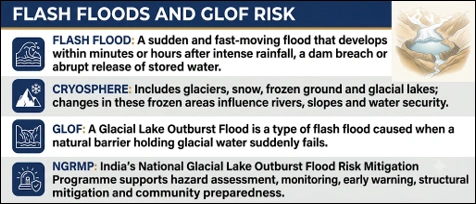
Explanation:
How Himalayan Floods Become Cascading Disasters?
- A glacier, rock mass or mountain slope may collapse because of internal stress, heavy rainfall, an avalanche, an earthquake or thawing frozen ground.
- Ice and rocks may temporarily block a river. Water then accumulates behind this unstable natural dam and rushes downstream when it fails.
- The flood erodes riverbanks, triggers landslides and collects mud, boulders and trees. It consequently becomes a cascading disaster downstream.
Climate Change and Growing Risk:
- Rising temperatures accelerate glacier retreat, enlarge glacial lakes and thaw permafrost, which is ground remaining frozen for at least two years.
- Climate change increases background instability, but it cannot automatically be identified as the direct cause of every individual disaster.
- Population growth, tourism, roads, dams and settlements in vulnerable valleys increase human exposure and convert natural hazards into major disasters.
Lessons from Earlier Events:
- The Kedarnath disaster of 2013 showed how extreme rainfall and sudden water release can devastate densely used mountain valleys.
- The Chamoli disaster of 2021 demonstrated that a rock-and-ice avalanche can generate a destructive debris flow without an initial lake breach.
- The South Lhonak disaster of 2023 showed how a collapse into a glacial lake can trigger a GLOF, severe erosion and secondary landslides.
Monitoring and Governance Challenges:
- Satellite images help track inaccessible glaciers, but they cannot always measure lake depth, internal fractures, seepage or moraine strength.
- Exact glacier-collapse timing remains difficult to predict. Warning systems must therefore combine sensors, scientific assessment and local observations.
- Hydropower projects and monitoring stations located inside narrow valleys may themselves become early casualties, weakening emergency response.
Way Forward:
- Himalayan countries must share real-time information on rainfall, river levels, glaciers, landslides, earthquakes and temporary upstream blockages.
- Governments should enforce construction codes, restrict development in vulnerable zones and assess the cumulative impact of dams and roads.
- Early warnings must be connected with evacuation routes, safe shelters, multilingual alerts, community volunteers and regular mock drills.
Conclusion:
Himalayan hazards cannot be completely prevented, but their human consequences can be greatly reduced. Scientific monitoring, regulated development, community preparedness and transboundary cooperation must replace passive neglect as the foundation of Himalayan disaster management.
Source: (The Hindu)
La Excellence IAS Academy, the best IAS coaching in Hyderabad, known for delivering quality content and conceptual clarity for UPSC 2026 preparation.
FOLLOW US ON:
◉ YouTube : https://www.youtube.com/@CivilsPrepTeam
◉ Facebook: https://www.facebook.com/LaExcellenceIAS
◉ Instagram: https://www.instagram.com/laexcellenceiasacademy/
GET IN TOUCH:
Contact us at info@laex.in, https://laex.in/contact-us/
or Call us @ +91 9052 29 2929, +91 9052 99 2929, +91 9154 24 2140
OUR BRANCHES:
Head Office: H No: 1-10-225A, Beside AEVA Fertility Center, Ashok Nagar Extension, VV Giri Nagar, Ashok Nagar, Hyderabad, 500020
Madhapur: Flat no: 301, survey no 58-60, Guttala begumpet Madhapur metro pillar: 1524, Rangareddy Hyderabad, Telangana 500081
Bangalore: Plot No: 99, 2nd floor, 80 Feet Road, Beside Poorvika Mobiles, Chandra Layout, Attiguppe, Near Vijaya Nagara, Bengaluru, 560040