
Paper: GS – III, Subject: Economy, Topic: Food Security, Issue: Building a Climate-Resilient Food System.
Context:
Recently, India’s foodgrain production crossed 350 million tonnes in 2024–25, even as heat, erratic rainfall and water scarcity created risks. This underlines the need to climate-proof production, procurement, storage and distribution.
Key Takeaways:
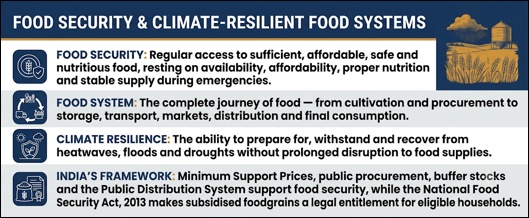
Explanation:
Why is the Existing System Vulnerable?
- India’s rice–wheat system overcame food shortages, but procurement remains concentrated in a few crops and regions.
- Several producing regions face groundwater depletion, while heat and irregular monsoons threaten crop yields.
- Extreme weather can damage warehouses and transport, reduce supplies, raise prices and restrict access to food.
Building Resilience:
- Procurement should include suitable millets, pulses, oilseeds and nutri-cereals, without abandoning rice and wheat.
- A diversified Public Distribution System basket can improve nutrition and encourage climate-suitable farming.
- India Meteorological Department forecasts should guide procurement, buffer-stock placement and contingency planning before shocks.
- Farmers need climate-resilient seeds, micro-irrigation, watershed development, digital advisories, precision farming and weather-indexed insurance.
- Flood-resistant warehouses, heat-appropriate storage, cold chains and stronger transport can reduce food losses.
Financing and Governance:
- Green bonds and adaptation finance fund environmental and resilience projects, including agricultural value chains and insurance.
- Food-system targets should support India’s net-zero goal of balancing emissions with removals and strengthening climate resilience.
Way Forward:
- India should create a “climate buffer” combining crop diversity, regional procurement, resilient infrastructure, climate information and insurance.
- Climate risk must shape food policy from the outset, instead of being addressed only after damage occurs.
- The National Commission on Farmers, chaired by M.S. Swaminathan, recommended an “evergreen revolution” that raises productivity without damaging soil, water or biodiversity.
Conclusion:
India need not replace its food-security framework; it must adapt and expand it. Crop diversification, resilient infrastructure and climate planning can move the country from cereal-centred food security towards sustainable food and nutrition security.
Source: (The Hindu)
La Excellence IAS Academy, the best IAS coaching in Hyderabad, known for delivering quality content and conceptual clarity for UPSC 2026 preparation.
FOLLOW US ON:
◉ YouTube : https://www.youtube.com/@CivilsPrepTeam
◉ Facebook: https://www.facebook.com/LaExcellenceIAS
◉ Instagram: https://www.instagram.com/laexcellenceiasacademy/
GET IN TOUCH:
Contact us at info@laex.in, https://laex.in/contact-us/
or Call us @ +91 9052 29 2929, +91 9052 99 2929, +91 9154 24 2140
OUR BRANCHES:
Head Office: H No: 1-10-225A, Beside AEVA Fertility Center, Ashok Nagar Extension, VV Giri Nagar, Ashok Nagar, Hyderabad, 500020
Madhapur: Flat no: 301, survey no 58-60, Guttala begumpet Madhapur metro pillar: 1524, Rangareddy Hyderabad, Telangana 500081
Bangalore: Plot No: 99, 2nd floor, 80 Feet Road, Beside Poorvika Mobiles, Chandra Layout, Attiguppe, Near Vijaya Nagara, Bengaluru, 560040