
Paper: GS-II, Subject: Polity, Topic: Federalism, Issue: Mining amendment is unfair to States (MMDR Amendment Act, 2026).
Context
The Mines and Minerals (Development and Regulation) Amendment Act, 2026 restricts States from independently imposing taxes, cesses and similar levies on mineral rights and mineral-bearing land. The debate is about balancing predictable taxation for mining investment with the fiscal autonomy of mineral-rich States. The 2026 amendment’s new restrictions apply to major minerals; minor minerals such as sand, gravel and several building materials continue to remain under State control.
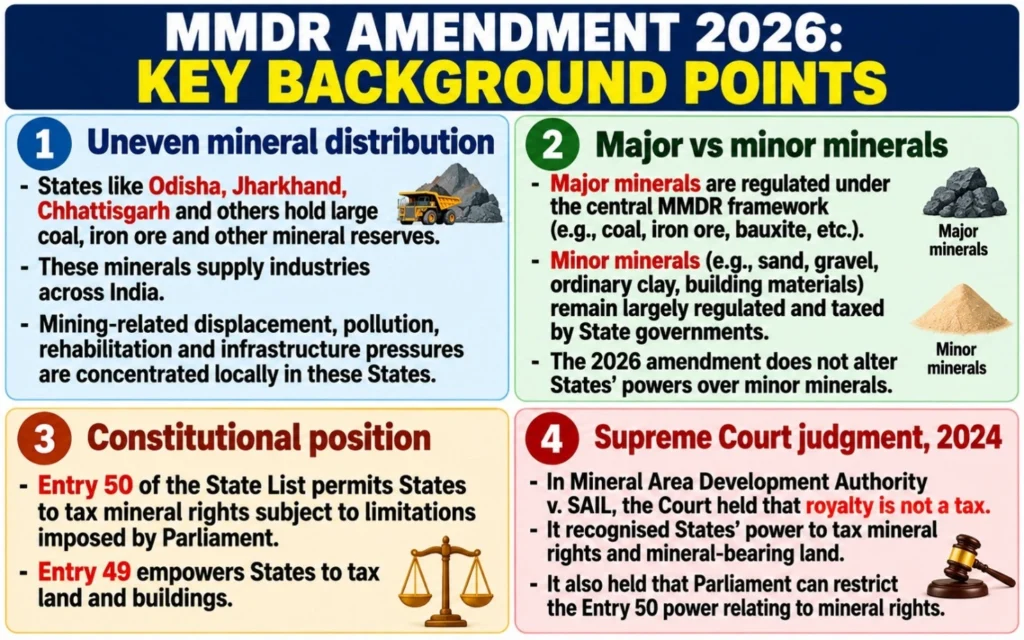
What does MMDR (Amendment Act) 2026 change?
- States cannot impose taxes, cesses or similar levies on mineral rights or mineral-bearing land involving major minerals except within conditions or restrictions prescribed by the Centre.
- Certain earlier levies that were not collected before the amendment became operative are treated as invalid, while money already collected need not be refunded.
Why does the Centre support the change?
- Investment certainty: Mines require huge upfront investment and often operate for decades. Frequent or unpredictable additional State taxes can alter project economics.
- High additional taxation – Jharkhand example: Jharkhand raised its mineral-bearing-land cess in 2025 to ₹250 per tonne of coal and ₹400 per tonne of iron ore, in addition to royalty and other statutory payments. This illustrates the Centre’s concern that multiple large levies can increase mining costs and discourage investment.
- Uniformity: Very different State-level levies can create a fragmented fiscal regime for companies operating across several States.
- The Centre also argues that States already receive a large share of mining revenues through royalty, auction premiums, DMF and other payments.
Why are mineral-rich States concerned?
- Loss of future fiscal autonomy: The issue is not only current revenue, but whether States can independently design new mineral-related taxes in the future.
- Possible revenue impact – Tamil Nadu example: Tamil Nadu introduced a mineral-bearing-land tax covering 32 minerals, with rates ranging from ₹40 per tonne for clay to ₹7,000 per tonne for sillimanite. The State estimated additional revenue of about ₹2,400 crore annually. Restrictions on similar levies involving major minerals can therefore reduce States’ ability to mobilise additional mining revenue.
- Local costs: Mining States bear pollution, road damage, land degradation, displacement and rehabilitation costs even though minerals are used across the country.
- Benefit sharing: States therefore argue that they should retain a meaningful fiscal share of the economic value generated from resources located within their territory.
Way Forward
A balanced framework should provide predictable taxation for investors while protecting sufficient fiscal space and revenue-sharing for mineral-producing States, particularly for environmental restoration, infrastructure and affected communities.
Conclusion
The issue goes beyond mining taxation. It concerns how India balances investment certainty, State fiscal capacity, natural-resource development and cooperative federalism, while ensuring that the regions bearing the costs of mineral extraction receive an appropriate share of its benefits.
Source: (The Hindu)
La Excellence IAS Academy, the best IAS coaching in Hyderabad, known for delivering quality content and conceptual clarity for UPSC 2026 preparation.
FOLLOW US ON:
◉ YouTube : https://www.youtube.com/@CivilsPrepTeam
◉ Facebook: https://www.facebook.com/LaExcellenceIAS
◉ Instagram: https://www.instagram.com/laexcellenceiasacademy/
GET IN TOUCH:
Contact us at info@laex.in, https://laex.in/contact-us/
or Call us @ +91 9052 29 2929, +91 9052 99 2929, +91 9154 24 2140
OUR BRANCHES:
Head Office: H No: 1-10-225A, Beside AEVA Fertility Center, Ashok Nagar Extension, VV Giri Nagar, Ashok Nagar, Hyderabad, 500020
Madhapur: Flat no: 301, survey no 58-60, Guttala begumpet Madhapur metro pillar: 1524, Rangareddy Hyderabad, Telangana 500081
Bangalore: Plot No: 99, 2nd floor, 80 Feet Road, Beside Poorvika Mobiles, Chandra Layout, Attiguppe, Near Vijaya Nagara, Bengaluru, 560040