
Paper: GS-II, Subject: International Relations, Topic: Agreements involving India and/or affecting India’s interests, Issue: USA sanctions on Russia oil
Context
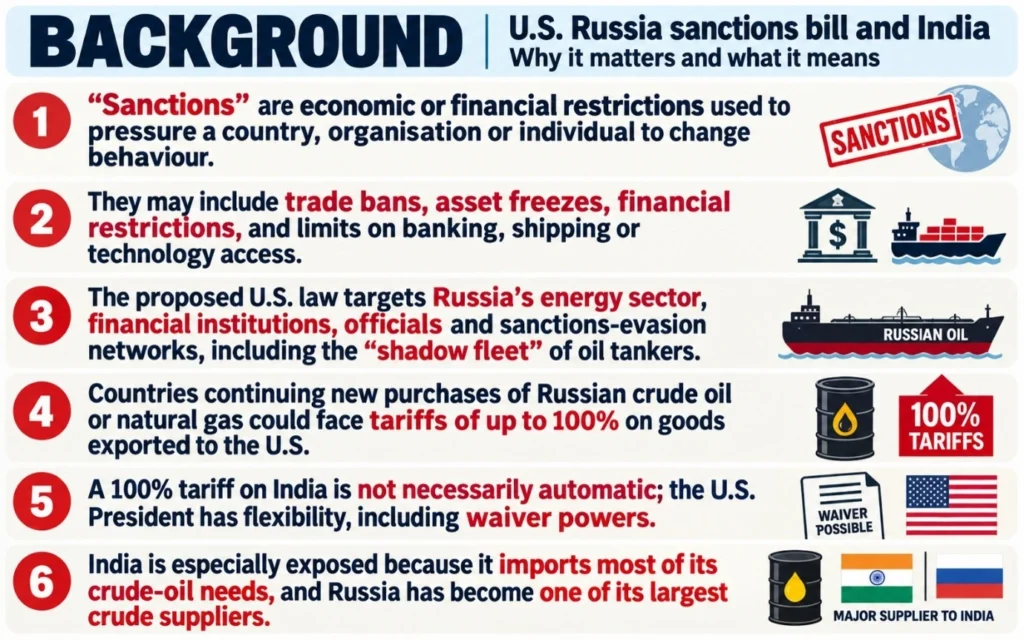
The U.S. Congress has passed the Lindsey O. Graham Sanctioning Russia and Iran Act of 2026. The Bill, currently awaiting President Donald Trump’s signature, could expose major buyers of Russian energy, including India, to tariffs of up to 100%, creating a challenge involving energy security, trade and foreign policy.
Why the Bill Matters for India
1. Energy-security dilemma
- Russian crude became important because it was competitively priced and provided an alternative during disruptions in West Asian supplies.
- Abruptly reducing Russian purchases could push refiners towards other suppliers, potentially increasing freight and crude-acquisition costs.
- If several major buyers shift simultaneously, greater competition for non-Russian oil could push global crude prices upward.
2. Trade and inflation risk
- The tariff authority creates a double vulnerability: pressure on India’s oil sourcing as well as on Indian exports entering the U.S.
- Costlier oil can worsen the trade deficit and current-account deficit, pressure the rupee and increase transport, fertiliser and manufacturing costs.
- India may therefore have to balance affordable energy access against continued access to the large U.S. export market.
3. ‘Weaponised interdependence’
- Modern sanctions operate through interconnected banks, dollar-payment networks, insurers, shipping companies and ports, rather than through direct trade bans alone.
- Thus, even transactions permitted under Indian law can face difficulties if a foreign bank, insurer or shipping company fears sanctions.
- Economic dependence on foreign-controlled networks can therefore become a strategic vulnerability.
What India Can Do
- Diversify energy sources across Russia, West Asia, Africa, Latin America and the U.S., avoiding excessive reliance on one supplier or route.
- Expand strategic petroleum and LPG reserves, alternative shipping arrangements and domestic maritime-insurance capacity.
- Strengthen rupee and other non-dollar settlement mechanisms where commercially feasible.
- Establish a permanent Economic Security and Sanctions Coordination mechanism involving MEA, Finance, Commerce, Petroleum, Shipping, RBI and market regulators.
- Continue engagement with Washington for waivers or exemptions, while clearly communicating India’s energy-security requirements.
Conclusion
The challenge extends beyond “Russian oil versus U.S. pressure”. India needs greater economic resilience so that affordable energy, trade access and strategic autonomy can be protected even when geopolitical tensions disrupt global financial and supply networks.
Source: (The Indian Express)
La Excellence IAS Academy, the best IAS coaching in Hyderabad, known for delivering quality content and conceptual clarity for UPSC 2026 preparation.
FOLLOW US ON:
◉ YouTube : https://www.youtube.com/@CivilsPrepTeam
◉ Facebook: https://www.facebook.com/LaExcellenceIAS
◉ Instagram: https://www.instagram.com/laexcellenceiasacademy/
GET IN TOUCH:
Contact us at info@laex.in, https://laex.in/contact-us/
or Call us @ +91 9052 29 2929, +91 9052 99 2929, +91 9154 24 2140
OUR BRANCHES:
Head Office: H No: 1-10-225A, Beside AEVA Fertility Center, Ashok Nagar Extension, VV Giri Nagar, Ashok Nagar, Hyderabad, 500020
Madhapur: Flat no: 301, survey no 58-60, Guttala begumpet Madhapur metro pillar: 1524, Rangareddy Hyderabad, Telangana 500081
Bangalore: Plot No: 99, 2nd floor, 80 Feet Road, Beside Poorvika Mobiles, Chandra Layout, Attiguppe, Near Vijaya Nagara, Bengaluru, 560040