
Paper: GS-III, Subject: Economy, Topic: Agricultural Marketing, Storage, Supply Chains and Food Processing, Issue: Agricultural Value Chain Financing and Rural Prosperity
Introduction
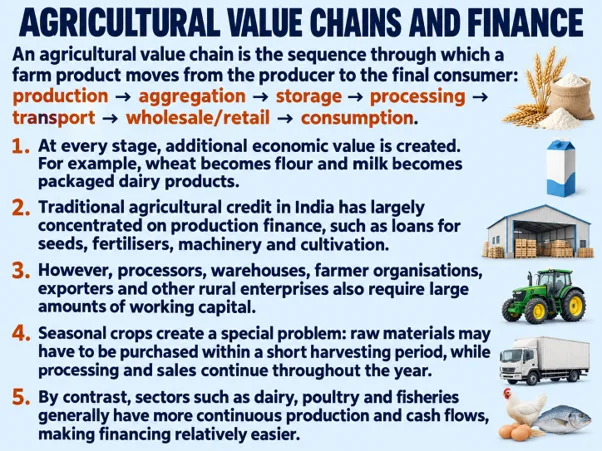
India’s agricultural progress has largely focused on increasing farm production and ensuring food security. The next transformation must help farmers and rural enterprises capture more value after the crop leaves the farm. This requires moving beyond traditional crop loans towards financing the entire agricultural value chain—from aggregation and storage to processing, transport, branding and marketing.
Why Agricultural Finance Must Move Beyond the Farm
- Value addition: Processing, grading, packaging and branding can substantially increase the value of agricultural produce.
- Reduction of post-harvest losses: Better financing enables investment in warehouses, cold chains, transportation and processing facilities.
- Higher farmer income: Farmers can gain better market access and avoid distress sales immediately after harvest.
- Rural employment: Food processing, logistics, warehousing and retail create non-farm jobs within rural areas.
- Private investment: Reliable financing can attract entrepreneurs into agricultural infrastructure and processing.
- Industrialisation of rural areas: Strong farm-linked enterprises can connect villages with domestic and global markets.
The Financing Problem
- A processor may need to purchase almost an entire year’s agricultural raw material during a short harvest season.
- Large amounts of money can therefore remain locked in stored inventory for months before finished products are sold.
- Ordinary bank lending based mainly on fixed collateral may not suit such businesses.
- Small processors, Farmer Producer Organisations and aggregators may possess viable businesses but insufficient conventional collateral.
- Financing must therefore increasingly consider expected cash flows, inventories, contracts and receivables rather than land or property alone.
New Financing Mechanisms
- Warehouse receipt finance: Stored agricultural produce can support borrowing while the commodity remains in a recognised warehouse.
- Receivables finance: Businesses can borrow against payments due from buyers.
- Inventory finance: Credit can be linked to the value of securely stored raw materials or products.
- Supply-chain finance: Banks can finance farmers, suppliers, processors and distributors based on established commercial relationships.
- Risk-sharing mechanisms: Credit guarantees and insurance can reduce lenders’ exposure.
- Commodity-specific finance: Different financial structures can be designed for crops, dairy, fisheries, horticulture and other value chains.
Conclusion
India’s next agricultural transformation must therefore be a value-chain transformation. A financial system that follows agricultural produce from the farm to the final market can improve processing, reduce losses, expand rural enterprises and ensure that farmers receive a larger share of the value created from their produce.
Source: (The Hindu)
La Excellence IAS Academy, the best IAS coaching in Hyderabad, known for delivering quality content and conceptual clarity for UPSC 2026 preparation.
FOLLOW US ON:
◉ YouTube : https://www.youtube.com/@CivilsPrepTeam
◉ Facebook: https://www.facebook.com/LaExcellenceIAS
◉ Instagram: https://www.instagram.com/laexcellenceiasacademy/
GET IN TOUCH:
Contact us at info@laex.in, https://laex.in/contact-us/
or Call us @ +91 9052 29 2929, +91 9052 99 2929, +91 9154 24 2140
OUR BRANCHES:
Head Office: H No: 1-10-225A, Beside AEVA Fertility Center, Ashok Nagar Extension, VV Giri Nagar, Ashok Nagar, Hyderabad, 500020
Madhapur: Flat no: 301, survey no 58-60, Guttala begumpet Madhapur metro pillar: 1524, Rangareddy Hyderabad, Telangana 500081
Bangalore: Plot No: 99, 2nd floor, 80 Feet Road, Beside Poorvika Mobiles, Chandra Layout, Attiguppe, Near Vijaya Nagara, Bengaluru, 560040