
Paper: GS-IV, Subject: Ethics, Topic: Human values and lessons from the lives of great people, Issue: Gandhian history, Ethics and relevance.
Context
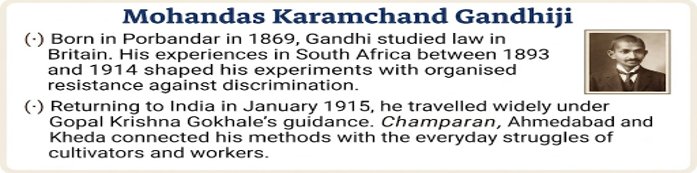
Gandhi Jayanti on 2 October 2026 marks the 157th birth anniversary of Mohandas Karamchand Gandhi. Also observed as the International Day of Non-Violence, the occasion invites reflection on his contribution to freedom, social reform and ethical public action. His enduring question is how power can serve human dignity.
1. Transforming the Freedom Struggle
- Mass participation: Gandhi brought peasants, workers, women, traders and village communities into national politics. Accessible symbols, including salt and khadi, connected colonial domination with ordinary experience.
- Local struggles: Champaran in 1917 challenged oppressive conditions affecting indigo cultivators. The Ahmedabad mill strike and Kheda campaign in 1918 addressed wages and revenue relief respectively. Investigation, negotiation and disciplined collective action supported these interventions.
- National mobilisation: The Rowlatt Satyagraha of 1919 opposed restrictions on civil liberties. Non-Cooperation, launched in 1920, encouraged boycotts of colonial institutions, titles and foreign goods. Gandhi withdrew the movement after the Chauri Chaura violence in 1922.
- Salt and independence: The Dandi March of 1930 challenged the salt monopoly and helped launch Civil Disobedience. In August 1942, Quit India demanded immediate British withdrawal, accompanied by Gandhi’s call to ‘Do or Die’.
- Organisation mattered as much as symbolism. Boycott, public meetings and constructive work created opportunities for people without formal political power to participate. Gandhi’s leadership thus changed both the scale of nationalism and the relationship between political action and everyday life.

2. Ethical Ideas in Practice
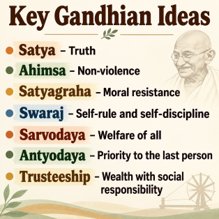
- Truth required honest inquiry and accountability. At Champaran, Gandhi resisted the order to leave while appearing before the court and accepting responsibility. Conscience did not become an excuse to evade consequences.
- Non-violence demanded courage and restraint. Suspending Non-Cooperation demonstrated his conviction that violent methods could damage a worthy political objective.
- During Partition, his presence and fasting in affected communities sought to rebuild trust.
- Satyagraha joined persuasion, civil disobedience and willingness to suffer. Its purpose was to confront injustice without treating opponents as less than human.
- For Gandhi, the character of the means shaped the outcome.
- Swaraj extended political freedom into everyday conduct.
- Village participation and accountable authority needed citizens capable of self-discipline, independent judgement and responsibility. Independence therefore required changes in institutions and personal habits.

3. Social Reconstruction
- Gandhi’s constructive programme connected national freedom with communal unity, sanitation, village industries, basic education and the removal of untouchability. These activities sustained public participation beyond moments of protest.
- His campaigns widened women’s political participation and emphasised the dignity of manual work. Nai Talim integrated productive activity with intellectual and moral development, bringing education closer to community life.
- His anti-untouchability work challenged exclusion, although his approach to caste differed significantly from Ambedkar’s demand for its annihilation. Recognising this disagreement allows a critical understanding of reform and social justice.
- Communal harmony was central to this project. Gandhi supported Hindu-Muslim cooperation during the Khilafat and Non-Cooperation period and later opposed retaliatory violence. His insistence on shared citizenship challenged the idea that religious identity should determine whose suffering deserved public concern.


4. Economic Justice and the Last Person
- Swadeshi linked local production with livelihoods and reduced dependence. Khadi gave households a practical role in the freedom struggle while highlighting the value of labour. Its wider lesson concerns the social consequences of economic choices.
- Trusteeship asked wealth holders to recognise obligations towards society. It offered an ethical challenge to unrestricted accumulation, although voluntary responsibility alone cannot guarantee redistribution. Fair institutions and effective public policy remain necessary.
- The Talisman shifts attention from aggregate achievement to lived outcomes. A welfare scheme should be assessed by whether excluded people can actually access it and gain greater control over their lives.
Gandhi’s Talisman – “Recall the face of the poorest and the weakest man whom you may have seen, and ask yourself, if the step you contemplate is going to be of any use to him.” — Excerpt
5. Constitutional Connections
- Several Directive Principles reflect concerns associated with Gandhi. Article 40 addresses village panchayats; Article 43 includes rural cottage industries; Article 46 concerns weaker sections, particularly Scheduled Castes and Scheduled Tribes.
- Article 47 addresses nutrition, public health and prohibition, while Article 48 concerns agriculture and animal husbandry. Together, these provisions connect governance with community welfare, livelihoods and social improvement. They translate related concerns into constitutional objectives.
6. Environment and Sustainable Living
- Gandhi’s criticism of limitless wants gives his thought ecological significance. Simplicity, restraint and responsible resource use question consumption that transfers environmental costs to poorer communities and future generations.
- Applied today, these ideas support reducing waste, repairing goods and considering the environmental consequences of production. Local production is not automatically sustainable; its effects must be judged through actual resource use and social outcomes.
“Earth has enough to satisfy every man’s needs, but not every man’s greed.” —Gandhi
7. Applying Gandhi Today
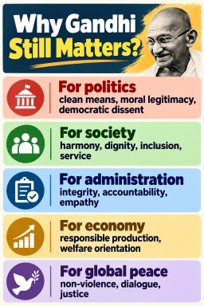
- Digital conduct: Truthfulness requires checking claims before forwarding them, correcting errors openly and resisting misleading content. Non-violence encourages disagreement without abuse, humiliation or deliberate incitement against communities.
- Public service: Officials can apply his example through accessible grievance systems, respectful treatment and transparent decisions. Personal integrity becomes meaningful when it improves institutional behaviour and the experience of vulnerable citizens.
- Democratic action: Peaceful protest can expose injustice and widen participation. Its credibility depends on disciplined conduct, willingness to engage and clarity about demands. Moral conviction should remain open to evidence and criticism.
- Practical limits: Gandhian methods require adaptation to unequal power, entrenched discrimination and coercive actors. Ethical appeals should work alongside enforceable rights, representative institutions and safeguards against the misuse of authority.
- Leadership also involves consistency between public commitments and personal behaviour. A leader who asks others to accept sacrifice must demonstrate accountability. Such example cannot replace institutional checks, but it can strengthen public trust and make collective action more credible, especially when difficult decisions impose unequal burdens over time.

Conclusion
Gandhi made freedom a question of both political power and moral responsibility. His legacy remains useful when examined critically and applied through concrete action. Remembering him means asking whether our decisions protect dignity, restrain domination and improve the lives of those with the least power.
Source: (The Indian Express, The Hindu, Live Mint)
La Excellence IAS Academy, the best IAS coaching in Hyderabad, known for delivering quality content and conceptual clarity for UPSC 2026 preparation.
FOLLOW US ON:
◉ YouTube : https://www.youtube.com/@CivilsPrepTeam
◉ Facebook: https://www.facebook.com/LaExcellenceIAS
◉ Instagram: https://www.instagram.com/laexcellenceiasacademy/
GET IN TOUCH:
Contact us at info@laex.in, https://laex.in/contact-us/
or Call us @ +91 9052 29 2929, +91 9052 99 2929, +91 9154 24 2140
OUR BRANCHES:
Head Office: H No: 1-10-225A, Beside AEVA Fertility Center, Ashok Nagar Extension, VV Giri Nagar, Ashok Nagar, Hyderabad, 500020
Madhapur: Flat no: 301, survey no 58-60, Guttala begumpet Madhapur metro pillar: 1524, Rangareddy Hyderabad, Telangana 500081
Bangalore: Plot No: 99, 2nd floor, 80 Feet Road, Beside Poorvika Mobiles, Chandra Layout, Attiguppe, Near Vijaya Nagara, Bengaluru, 560040