
Paper: GS Paper II, Subject: Society and Social Justice, Topic: Social Sector – Education, Issue: Higher Education Regulation.
Context:
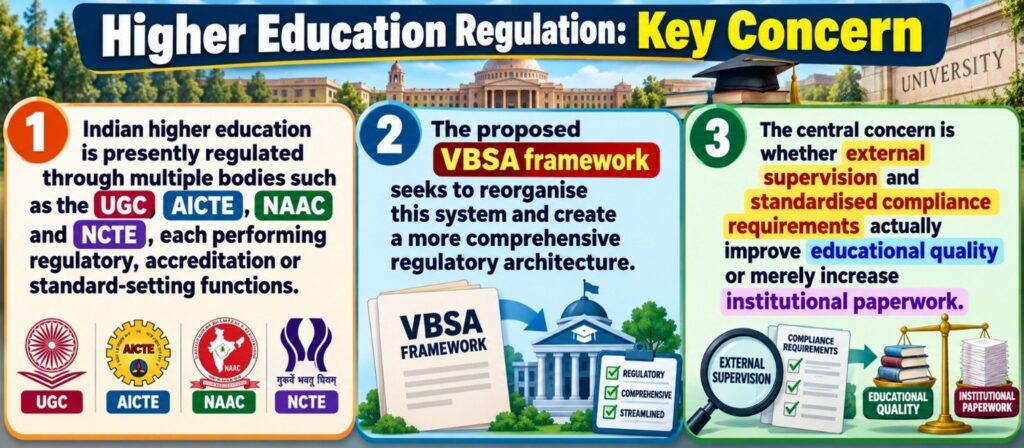
The proposed Viksit Bharat Shiksha Adhishthan (VBSA) Bill, 2025, currently under legislative review, seeks to overhaul the regulatory system governing higher education. The reform aims to ensure quality and accountability, but the key concern is whether excessive regulation may itself weaken institutional autonomy, innovation and academic quality.
How Excessive Regulation Affects Higher Education
1. Compliance can replace genuine academic quality
- HEIs may focus on satisfying inspection requirements rather than improving teaching and learning.
- Faculty members may spend excessive time generating reports, records and accreditation documents.
- This creates a “paper blizzard”, where documentary evidence becomes more important than actual intellectual engagement.
- Institutional success can then become linked to scores and documentation rather than classroom quality.
2. Uniform rules can ignore institutional diversity
- Universities differ in objectives, disciplines, student profiles and institutional capacities.
- Standardised formulas may not capture differences in teaching methods, research cultures or academic needs.
- Rigid rules on workload, attendance and documentation can reduce academic functioning to an arithmetic exercise.
- Such regulation may reward procedural conformity rather than educational excellence.
3. Excessive surveillance can create a trust deficit
- Continuous inspection may signal that regulators do not trust institutions or faculty members.
- Teachers may become more concerned with demonstrating compliance than experimenting with new teaching practices.
- Institutions may prefer conventional methods because they are safer under strict regulatory scrutiny.
- This produces risk aversion, which can suppress innovation and creativity.
4. Regulation may weaken institutional autonomy
- Excessive control can restrict decisions relating to curriculum, recruitment, resource allocation and academic priorities.
- By contrast, institutions such as the IISc, IITs, IIMs, NITs and IISERs have traditionally enjoyed greater operational freedom.
- Their performance suggests that autonomy combined with accountability can support high-quality teaching and research.
- Excessive standardisation may therefore undermine the very quality that regulation seeks to improve.
What Should Regulation Focus On?
- Regulators should ensure minimum academic standards, transparency, accountability and student protection.
- They should prevent malpractice without micromanaging everyday academic functioning.
- Evaluation should focus more on learning outcomes, teaching quality, research and institutional performance.
- Institutions should receive greater freedom in academic and administrative decision-making.
Conclusion
India needs a system of autonomy with accountability, not regulation through excessive surveillance. Higher education will improve when regulation creates an enabling framework for teaching, research and innovation rather than making compliance itself the main institutional objective.
Source: (The Hindu)
La Excellence IAS Academy, the best IAS coaching in Hyderabad, known for delivering quality content and conceptual clarity for UPSC 2026 preparation.
FOLLOW US ON:
◉ YouTube : https://www.youtube.com/@CivilsPrepTeam
◉ Facebook: https://www.facebook.com/LaExcellenceIAS
◉ Instagram: https://www.instagram.com/laexcellenceiasacademy/
GET IN TOUCH:
Contact us at info@laex.in, https://laex.in/contact-us/
or Call us @ +91 9052 29 2929, +91 9052 99 2929, +91 9154 24 2140
OUR BRANCHES:
Head Office: H No: 1-10-225A, Beside AEVA Fertility Center, Ashok Nagar Extension, VV Giri Nagar, Ashok Nagar, Hyderabad, 500020
Madhapur: Flat no: 301, survey no 58-60, Guttala begumpet Madhapur metro pillar: 1524, Rangareddy Hyderabad, Telangana 500081
Bangalore: Plot No: 99, 2nd floor, 80 Feet Road, Beside Poorvika Mobiles, Chandra Layout, Attiguppe, Near Vijaya Nagara, Bengaluru, 560040