
Paper: GS Paper I, Subject: History-World, Topic: Revolutions – American, French, Russia, Issue: Legacy of Socialist Revolutions.
Context:
Two major twentieth-century revolutions are closely associated with October: the Russian Revolution of 1917, led by the Bolsheviks under Vladimir Lenin, and the establishment of the People’s Republic of China on October 1, 1949, under Mao Zedong. Though they occurred in very different societies, both transformed global politics and influenced debates on equality, development and colonialism.
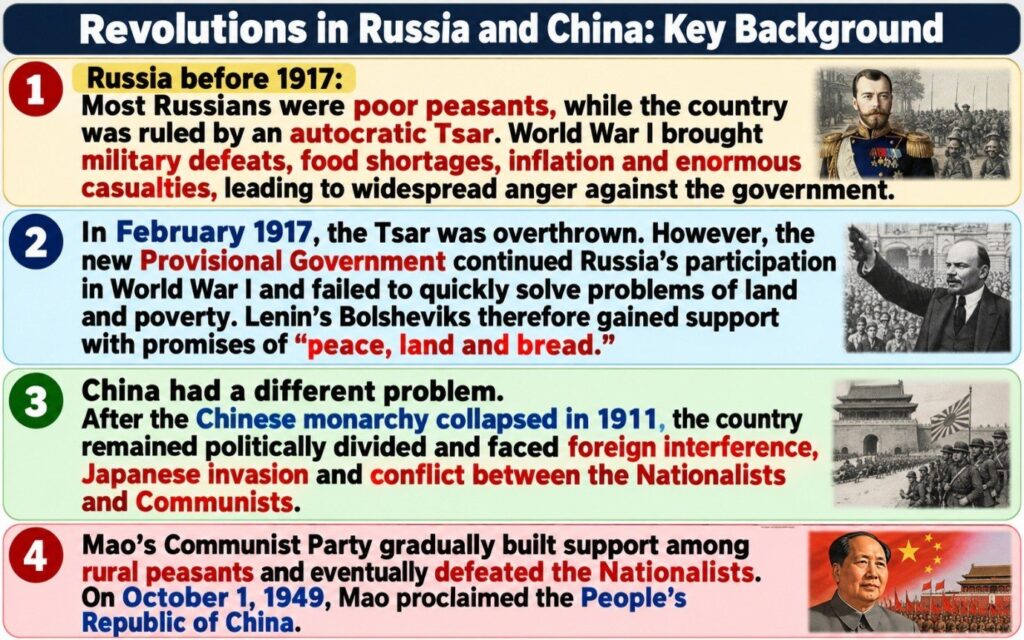
How the Russian Revolution Changed the World
- It created the first durable socialist state based on Marxist principles.
- It brought land redistribution, workers’ rights, public ownership, education and social welfare to the centre of political debate.
- Socialist movements and organised labour became more influential across Europe and elsewhere.
- The Soviet Union’s anti-imperialist position encouraged anti-colonial struggles in Asia, Africa and Latin America.
- However, Soviet rule also produced forced collectivisation, famine, political repression and the Gulag system.
How the Chinese Revolution Was Different
- Marx had expected industrial workers to lead socialist revolution, but Mao adapted Marxism to an overwhelmingly agrarian society.
- Mao made peasants, rural mobilisation, land reform and guerrilla warfare central to revolutionary strategy.
- China showed that socialist revolution could emerge outside industrial Europe.
- Its success inspired several revolutionary and liberation movements in developing countries.
- However, policies such as the Great Leap Forward and Cultural Revolution caused severe economic and social suffering.
Impact on India and the Colonial World
- The two revolutions strengthened the connection between socialism and anti-colonialism.
- Indian thinkers and leaders such as M.N. Roy, Bhagat Singh and Jawaharlal Nehru engaged seriously with socialist ideas.
- Soviet development influenced Indian thinking on economic planning, public-sector industries, land reform and welfare.
- India recognised Communist China early and later promoted Panchsheel, although relations deteriorated and culminated in the 1962 war.
- India nevertheless rejected one-party communist rule and adopted parliamentary democracy with a mixed economy.
Conclusion
The revolutions of 1917 and 1949 changed what millions believed was politically possible. Despite their authoritarian excesses, they permanently placed questions of inequality, labour, land, welfare, imperialism and popular sovereignty at the centre of modern politics.
Source: (The Indian Express)
La Excellence IAS Academy, the best IAS coaching in Hyderabad, known for delivering quality content and conceptual clarity for UPSC 2026 preparation.
FOLLOW US ON:
◉ YouTube : https://www.youtube.com/@CivilsPrepTeam
◉ Facebook: https://www.facebook.com/LaExcellenceIAS
◉ Instagram: https://www.instagram.com/laexcellenceiasacademy/
GET IN TOUCH:
Contact us at info@laex.in, https://laex.in/contact-us/
or Call us @ +91 9052 29 2929, +91 9052 99 2929, +91 9154 24 2140
OUR BRANCHES:
Head Office: H No: 1-10-225A, Beside AEVA Fertility Center, Ashok Nagar Extension, VV Giri Nagar, Ashok Nagar, Hyderabad, 500020
Madhapur: Flat no: 301, survey no 58-60, Guttala begumpet Madhapur metro pillar: 1524, Rangareddy Hyderabad, Telangana 500081
Bangalore: Plot No: 99, 2nd floor, 80 Feet Road, Beside Poorvika Mobiles, Chandra Layout, Attiguppe, Near Vijaya Nagara, Bengaluru, 560040