
Paper: GS-II | Subject: Polity | Topic: Constitutional Bodies | Issue: Legal Immunity of Election Commissioners and Constitutional Accountability
Context
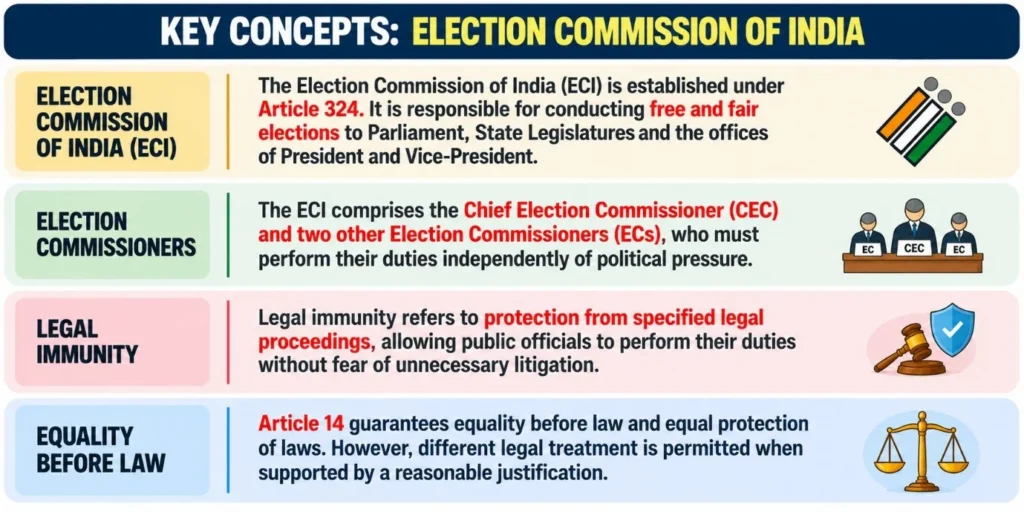
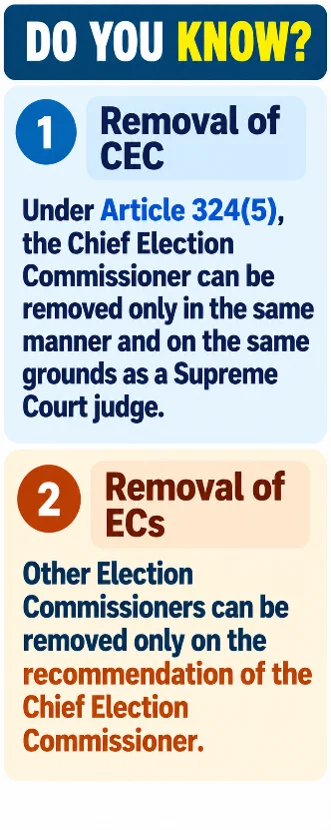
Recently, the Supreme Court issued notice to the Centre on a petition filed by the Association for Democratic Reforms (ADR) challenging Section 16 of the 2023 law governing Election Commissioners. The provision grants continuing legal immunity for official acts, raising concerns about accountability.
Explanation
What Does Section 16 of the 2023 Act Provide?
- Section 16 prevents courts from entertaining or continuing civil or criminal proceedings against CECs and ECs for actions or statements made while performing, or purportedly performing, official duties.
- The immunity extends beyond their tenure, protecting former Commissioners from proceedings concerning covered official acts.
- The provision was absent from the original Bill and was introduced through an amendment during its passage in the Rajya Sabha.
Why Is the Provision Controversial?
- Concern over accountability: Petitioners argue that continuing immunity could shield Commissioners from legal consequences for misconduct committed under the claim of official duty.
- Equality before law: The petition questions whether such extensive protection is consistent with Article 14, particularly when other constitutional authorities enjoy more limited immunities.
- Comparison with constitutional protections:
- Article 361 protects the President and Governors from criminal proceedings during their tenure.
- Articles 105 and 194 protect legislators for parliamentary or legislative speech and votes, rather than granting general immunity.
- Need for independence: Supporters argue that legal protection prevents politically motivated litigation from influencing sensitive electoral decisions.
The Central Constitutional Question
- The dispute concerns whether institutional independence can justify continuing protection from personal legal proceedings, particularly when official misconduct is alleged.
- Importantly, immunity from personal proceedings against Commissioners does not eliminate judicial review of Election Commission decisions.
- The Supreme Court must therefore examine whether Section 16 reasonably balances independence, accountability and equality before law.
Conclusion
Election Commissioners require protection from political interference to conduct free and fair elections. However, institutional independence must coexist with legal accountability. The constitutional challenge highlights the need to balance these principles without weakening either electoral autonomy or the rule of law.
Source: (The Hindu)
La Excellence IAS Academy, the best IAS coaching in Hyderabad, known for delivering quality content and conceptual clarity for UPSC 2026 preparation.
FOLLOW US ON:
◉ YouTube: https://www.youtube.com/@CivilsPrepTeam
◉ Facebook: https://www.facebook.com/LaExcellenceIAS
◉ Instagram: https://www.instagram.com/laexcellenceiasacademy/
GET IN TOUCH:
Contact us at info@laex.in, https://laex.in/contact-us/
or Call us @ +91 9052 29 2929, +91 9052 99 2929, +91 9154 24 2140
OUR BRANCHES:
Head Office: H No: 1-10-225A, Beside AEVA Fertility Center, Ashok Nagar Extension, VV Giri Nagar, Ashok Nagar, Hyderabad, 500020
Madhapur: Flat no: 301, survey no 58-60, Guttala begumpet Madhapur metro pillar: 1524, Rangareddy Hyderabad, Telangana 500081
Bangalore: Plot No: 99, 2nd floor, 80 Feet Road, Beside Poorvika Mobiles, Chandra Layout, Attiguppe, Near Vijaya Nagara, Bengaluru, 560040